Welcome to BKPOWER!












Household Inverter丨Off-Grid Inverter丨BK-SCMAX-11KVA
PRODUCT PARAMETERS
The BK-INV series is a wall-mounted off-grid all-in-one photovoltaic inverter designed specifically for premium villas, off-grid/weak-grid areas (villages, ranches, islands), small commercial premises (convenience stores, clinics, EV charging stations), and mobile/RV scenarios. It integrates dual-MPPT solar controllers, a pure-sine-wave inverter, intelligent battery management system (BMS), and UPS-grade transfer switch into a compact unit, enabling autonomous scheduling of solar, battery, and grid power for 24-hour stable green energy supply.
- All-in-One Compact Design for Easy Deployment
- Dual-MPPT for Maximum Solar Energy Harvesting
- UPS-Grade Seamless Power Switching
- Smart Triple-Source Energy Scheduling
- Flexible Parallel Expansion & Battery Compatibility
- Rugged Design for Harsh Environments
- Full-Stack Communication & Tool-Free Maintenance
- Comprehensive Safety Protection
Description
FAQs
Request A Quote
Description
Product Overview
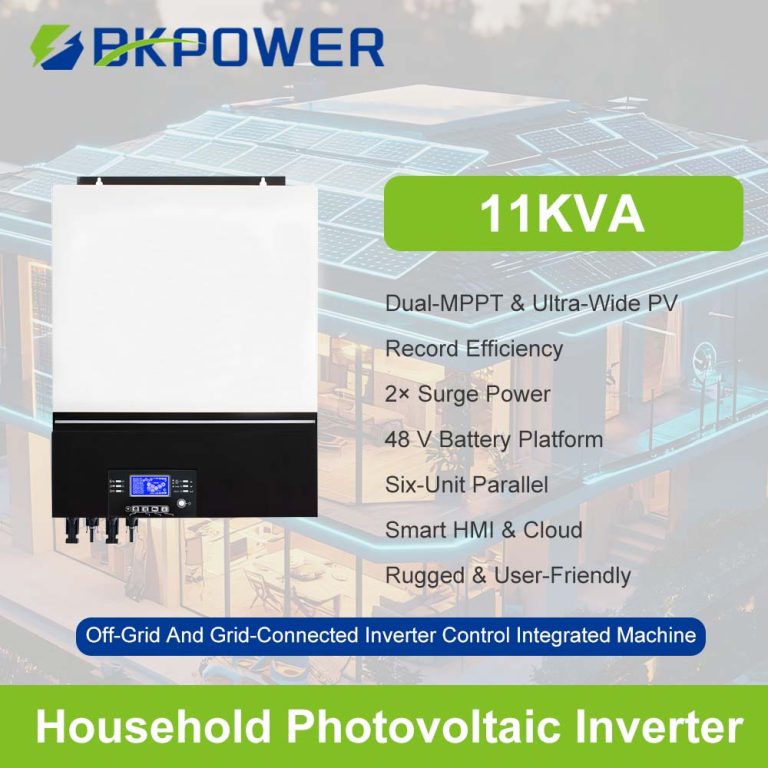
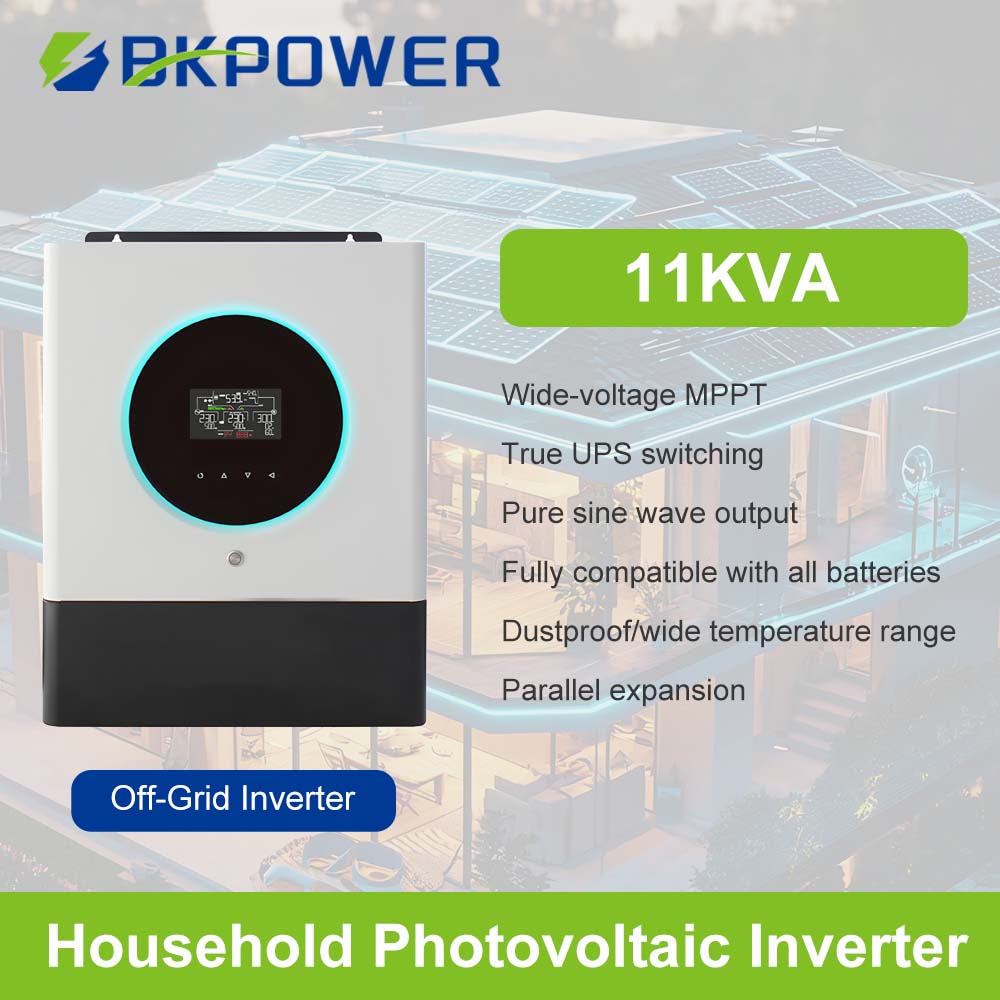
The BK-SCMAX-11KVA is a next-generation wall-mounted off-grid all-in-one inverter. It integrates dual-MPPT solar controllers, a pure-sine-wave inverter, an intelligent battery management system and UPS-grade switching into a single unit. Up to six devices can be paralleled to reach 66 KW. Measuring only 600×425×150 mm and weighing just 21 KG, it can be wall-mounted and commissioned in 30 minutes, delivering 24-hour stable green power for homes, small commercial sites and off-grid micro-stations.
Application
- Premium villas & estates
20 KWh battery bank + 11KW inverter to achieve 70–90 % self-consumption.
- Off-grid or weak-grid areas
Micro-grids for villages, ranches and islands, powering water pumps, air conditioners and processing equipment.
- Small commercial premises
Convenience stores, clinics, EV charging stations with automatic backup, reducing diesel dependence.
- RV & mobile storage
2–3 units paralleled for a 15 KW-class mobile power supply for large motorhomes and campsites.
- Emergency backup
Paralleled with diesel generators for peak-shaving, cutting fuel consumption by 30–50 % and reducing noise and emissions.
Product Features
- Dual MPPT
90–450 V ultra-wide input, 18 A per tracker, full output even in weak light.
- 10 ms UPS-class transfer
Seamless switching among grid, solar and battery for zero-downtime loads.
- Smart triple-source scheduling
Programmable time slots and priorities for peak-shaving and lower electricity bills.
- RGB status bar
Real-time operating state at a glance, zero-barrier on-site maintenance.
- Full-stack communication
RS485 / CAN / RS232 / USB / Wi-Fi / dry contact, compatible with mainstream BMS and EMS.
- Tool-free maintenance
Snap-in fan replacement in 3 minutes; independent battery compartment allows capacity expansion without interference.
- Six-unit parallel
Single unit 11 KW, scalable up to 66 KW on demand.
Specifications
| Model | BK- MKSII-8KVA | |
| Product Type | Residential photovoltaic inverter | |
| Power Capacity | 11000VA/11000W | |
| Number Of Parallel Machines | Up to 6 units | |
| AC Input | Voltage | 230VAC |
| Voltage Range | 170-280Vac (for personal computers) 90-280Vac (suitable for household appliances) | |
| Output | Voltage | 230V±5% |
| Surge Power | 22000VA | |
| Efficiency | ≥93% | |
| Switching Time | 10ms (computer), 20ms (household appliances) | |
| Waveform | Pure sine wave | |
| Battery | Voltage | 48V |
| Floating Charge Voltage | 54V | |
| Overcharge Protection | 63VDC | |
| Photovoltaic Charging & AC Charging | Photovoltaic Charging type | MPPT |
| Maximum Photovoltaic Array Power | 11000W(5500W*2) | |
| MPPT Operating Voltage Range | 90~450VDC | |
| Maximum Open-circuit Voltage Of Photovoltaic Array | 500VDC | |
| Voltage | 360V | |
| Maximum Photovoltaic Input Current | 18A*2 (maximum 36A) | |
| Maximum Photovoltaic Charging Current | 150A | |
| Maximum AC Charging Current | 150A | |
| Maximum Charging Current | 150A | |
| Environment | Operating Temperature | -10℃-50℃ |
| Storage Temperature | -15℃-60℃ | |
| Humidity | 5%-95% | |
| Physical | dimensions (D×W×H) | 600 x 425 x 150mm |
| Weight | 21kg | |
FAQs
What is UPS?
UPS stands for Uninterruptible Power Supply and is a device that provides a continuous supply of power to protect critical loads from power failures or fluctuations.
What is the main role of UPS?
The main role of a UPS is to provide a backup power source to ensure that critical equipment can continue to operate when utility power is interrupted or unstable, avoiding data loss or equipment damage.
What are the types of UPS?
UPS is mainly divided into three types: offline, online and online interactive.
How to choose the power capacity of UPS?
When choosing the power capacity of the UPS, you need to consider the total power demand of the load, it is usually recommended to choose a slightly larger than the total load power of the UPS to ensure sufficient standby time.
How is the standby time of a UPS determined?
The standby time of a UPS depends on the battery capacity and load power. Standby time usually ranges from 10 minutes to several hours, and the specific needs can be determined according to the actual application scenario.