Bienvenue chez BKPOWER !





UPS power supply selection guide: analysis of double conversion technology
TIPS:Selecting the right Alimentation de l'ASI requires understanding how UPS en ligne delivers zero-transfer power protection. This guide explains ASI à double conversion architecture, compares different alimentation électrique sans interruption topologies, and analyzes application differences between onduleurs pour centres de données et systèmes ASI industriels. Whether you need systèmes d'alimentation de secours for server rooms or Systèmes UPS for factory equipment, this article helps you make informed decisions.
I. UPS Power Supply Fundamentals: Why Your Business Needs Backup Power Systems
Power interruptions occur every minute. Statistics show annual global economic losses from power outages exceed $150 billion. For data centers, healthcare facilities, and manufacturing operations, Alimentation sans interruption (ASI) is not optional—it is essential for survival.
Alimentation de l'ASI delivers three core values:
- Instant protection: Switches to battery power within milliseconds
- Traitement de l'alimentation électrique: Filters voltage fluctuations and harmonic interference
- Continuous operation: Ensures zero-interruption for critical loads
Whether you operate a small server room or a large industrial facility, selecting the right Système UPS directly impacts business continuity.
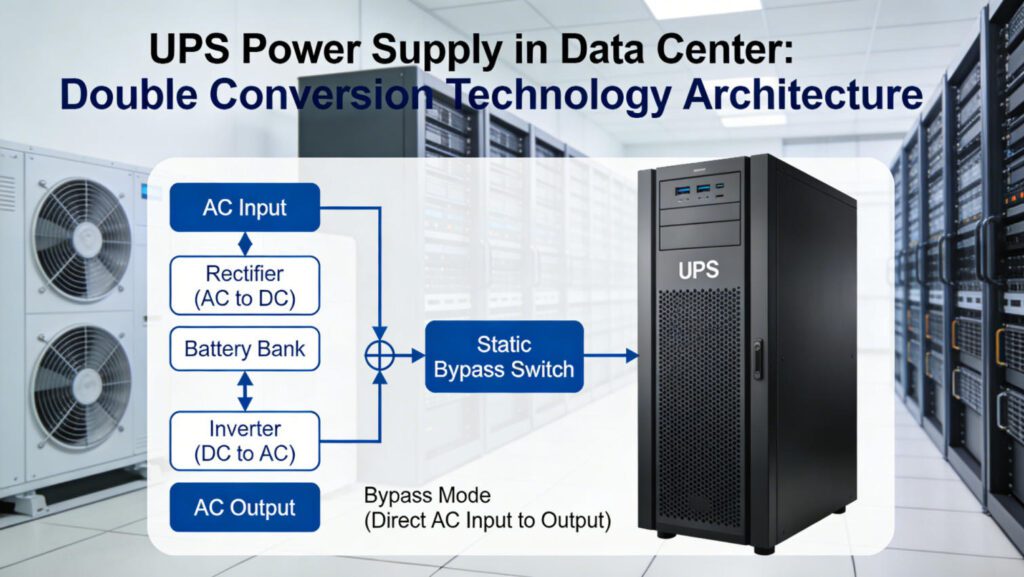
II. UPS Power Supply Technology Architecture Explained
1. Double Conversion Online UPS: The Highest Level of Power Protection
ASI à double conversion represents the current market mainstream technology, capturing 58.1% of the industrial UPS market share. This architecture provides the highest grade of power quality assurance.
Four-Step Working Process:
- Utility power input first passes through the rectifier converting to DC power
- DC power charges the battery bank and supplies the inverter
- Inverter converts DC back to pure AC power
- Load always receives power from inverter, achieving zero transfer time
Principaux avantages :
- Output voltage stability controlled within ±2-3%
- Complete isolation from input power disturbances
- Zero millisecond transfer time for sensitive electronic equipment
2. Standby UPS: Economical Basic Protection
ASI de secours suits budget-conscious environments with relatively stable power quality.
Working Flow:
- During normal utility power, load connects directly to mains
- When power fails, relay switches to battery inverter supply
- Transfer time typically 4-10 milliseconds
Scénarios applicables :
- Personal computers and office equipment
- Network routers and small switches
- Non-critical business applications
3. Line-Interactive UPS: Balancing Performance and Cost
Onduleur interactif en ligne regulates voltage through transformer taps without frequent battery switching.
Technical Characteristics:
- Voltage regulation range typically ±15%
- Transfer time 2-4 milliseconds
- Higher efficiency than double conversion topology
III. How to Choose the Right UPS Power Supply for Your Business
1. Évaluer les besoins en énergie
Calculating total load power is the first selection step. List all equipment needing protection and check their rated power labels.
Calculation Formula:
- Total Power = Equipment 1 Power + Equipment 2 Power + Equipment 3 Power…
- UPS Capacity = Total Power × 1.2 (20% headroom reserve)
Common Power Ranges:
- Less than 1kVA: Personal workstations and network equipment
- 1-10kVA: Small server rooms and departmental applications
- 10-50kVA: Medium data centers and critical infrastructure
- Above 50kVA: Large industrial facilities and campus-wide deployment
2. Determine Topology Structure
Select technical architecture based on application scenarios:
| Scénario d'application | Topologie recommandée | Key Considerations |
|---|---|---|
| Data Centers & Servers | Double Conversion Online | Zero transfer time, power quality |
| Medical Imaging Equipment | Double Conversion Online | Equipment sensitivity, regulatory compliance |
| Automatisation industrielle | Line-Interactive or Double Conversion | Environmental tolerance, reliability |
| Office Computers | Standby or Line-Interactive | Cost-effectiveness, basic protection |
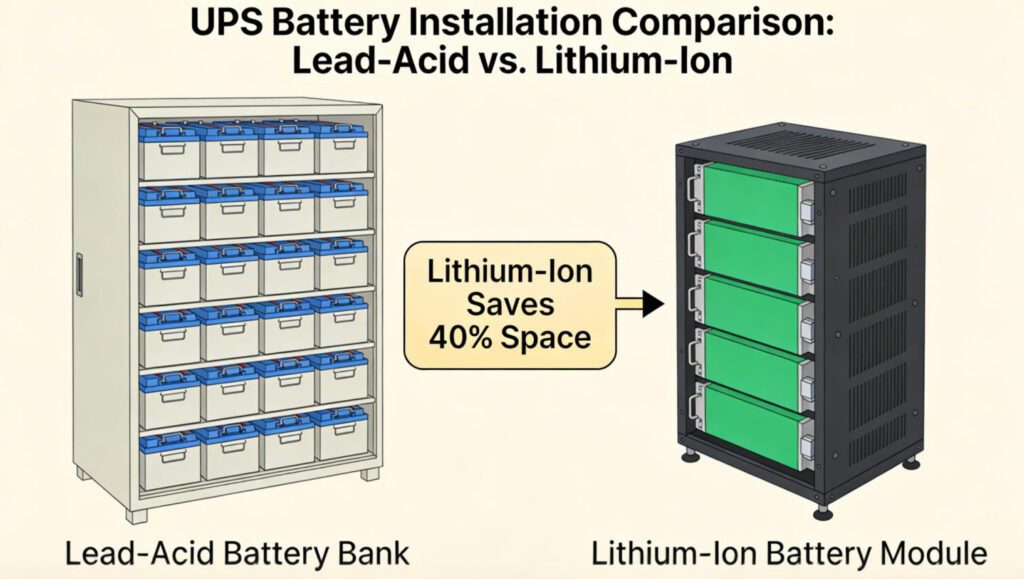
3. Choix de la technologie de batterie
Moderne Alimentation de l'ASI offers two mainstream battery technologies:
Batterie au plomb à régulation par soupape (VRLA) :
- Lower initial cost
- 3-5 year replacement cycle
- Requires regular maintenance
Lithium-Ion Batteries:
- 40% reduction in floor space
- 2-3 times longer service life
- 10-15 year operational lifespan
- Lower total cost of ownership
IV. Industry Application Deep Dive
1. Data Center UPS Deployment Strategy
Data centers impose the most stringent requirements on Systèmes UPS. Any power interruption can result in millions of dollars in losses.
Deployment Best Practices:
- Adopt 2N or N+1 redundant architecture
- Sélectionner ASI modulaire for easy capacity expansion
- Deploy dual power feed systems
- Integrate intelligent monitoring platforms
2024 market data shows onduleurs pour centres de données market size reached $12.47 billion. Modular UPS en ligne has become the mainstream trend, supporting 500-1250kW power range with efficiency up to 97.5%.
2. Industrial UPS Systems Applications
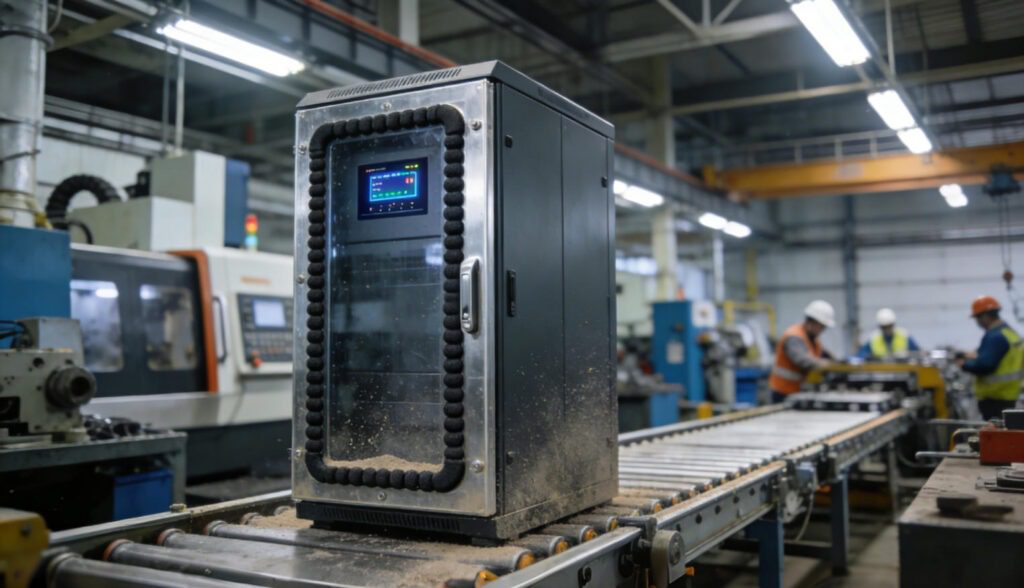
Industrial environments face unique challenges: high temperatures, dust, vibration, and chemical corrosion.
Industrial-Grade UPS Key Features:
- IP protection rating reaching IP54 or higher
- Wide temperature operating range (-20°C to 50°C)
- Shock and vibration resistant design
- Three-phase input/output configuration
Manufacturing, oil & gas, and rail transit industries rely on systèmes ASI industriels to ensure continuous production.
3. Medical Facility UPS Configuration
Hospital life support equipment, surgical lighting, and imaging diagnostic devices require Alimentation de l'ASI with highest reliability.
Medical Application Special Requirements:
- Compliance with IEC 60601-1 medical electrical safety standards
- Transformateur d'isolement for leakage prevention
- Silent operation (less than 45 decibels)
- Emergency bypass function
V. 2026 UPS Technology Development Trends
1. Intelligence and Digitalization
Moderne Systèmes UPS integrate IoT sensors and cloud platform connectivity. Operators can monitor in real-time via mobile apps:
- Input/output voltage and frequency
- Battery health status and remaining lifespan
- Load rate and energy efficiency indicators
- Fault warnings and automatic diagnostics
2. Energy Efficiency Improvements
Double conversion topology efficiency continues improving. Leading manufacturers have introduced models exceeding 97% efficiency, significantly reducing cooling costs and energy expenses.
3. Edge Computing Drives Demand
With edge data center proliferation, compact UPS en ligne demand surges. These devices need to adapt to harsh environments while providing telecom-grade reliability.
VI. Procurement Decision Checklist
Before finalizing your Alimentation de l'ASI vendor, confirm the following elements:
Technical Specification Verification:
- Rated power meets current and next 3 years’ growth requirements
- Input voltage range covers local grid fluctuations
- Overload capability reaches 125% continuous operation, 150% for 1 minute
- Efficiency curve performs well at typical load rates
Service Support Evaluation:
- Local technical service team response time
- Spare parts inventory adequacy
- Preventive maintenance plan availability
- Surveillance à distance service options
Total Cost of Ownership Analysis:
- Initial equipment procurement cost
- Battery replacement cycle and cost
- Energy cost (calculate 10-year period based on efficiency differences)
- Maintenance service contract fees
VII. Conclusion: Investing in Reliable Power Protection
Alimentation sans interruption (ASI) is the cornerstone of business continuity. While ASI à double conversion requires higher initial investment, its zero-interruption protection and power quality advantages are irreplaceable in critical application scenarios.
Evaluate your power risk exposure. If downtime costs far exceed Système UPS investment, choosing the highest reliability UPS en ligne is a wise decision. For non-critical applications, line-interactive UPS ou ASI de secours provide more cost-effective protection solutions.
Remember: Alimentation de secours systèmes are not cost centers, but business insurance. Their value becomes immediately apparent when power interruptions occur.
Références
- Commission électrotechnique internationale (CEI)Site officiel : www.iec.ch
- Underwriters Laboratories (UL)Site officiel : www.ul.com
- Comité européen de normalisation (CEN)Site officiel : www.cen.eu
- Standardization Administration of China (SAC) Site web officiel : www.sac.gov.cn
- Zhongguancun Energy Storage Industry Technology Alliance (CNESA)Site web officiel : www.cnESA.org
- Organisation internationale de normalisation (ISO)Site officiel : www.iso.org