Bienvenue chez BKPOWER !





Are Industrial Frequency UPS Systems Obsolete in 2026? Technical Analysis
TIPS:Will ASI à fréquence industrielle systems become obsolete in 2026? The clear answer is no. While line frequency UPS outdated narratives dominate IT discussions, critical industrial sectors retain strong demand. This article explains why ASI à fréquence industrielle architecture remains essential for motor loads and medical equipment, debunking line frequency UPS outdated myths with technical evidence from 2026 markets.

Ⅰ. Introduction: The Resilience of Industrial Frequency UPS in 2026
Summary Preview: Will fréquence industrielle UPS systems become obsolete in 2026? The clear answer is no. While line frequency UPS outdated narratives dominate IT discussions, critical industrial sectors retain strong demand. This article explains why ASI à fréquence industrielle architecture remains essential for motor loads and medical equipment, debunking line frequency UPS outdated myths with technical evidence from 2026 markets.
The uninterruptible power supply landscape continues evolving rapidly. High-frequency UPS systems now dominate data center installations. Their compact size and superior efficiency make them ideal for server racks. However, declaring the death of transformer-based UPS technology would be premature and technically inaccurate.
2026 market data reveals sustained demand for industrial frequency UPS configurations. Manufacturing facilities, healthcare institutions, and petrochemical plants continue specifying these systems. Their unique capabilities address load challenges that transformerless designs cannot safely manage.
This analysis examines the technical foundations behind this sustained relevance. We explore why three phase UPS systems with isolation transformers outperform high-frequency alternatives in heavy industrial applications.
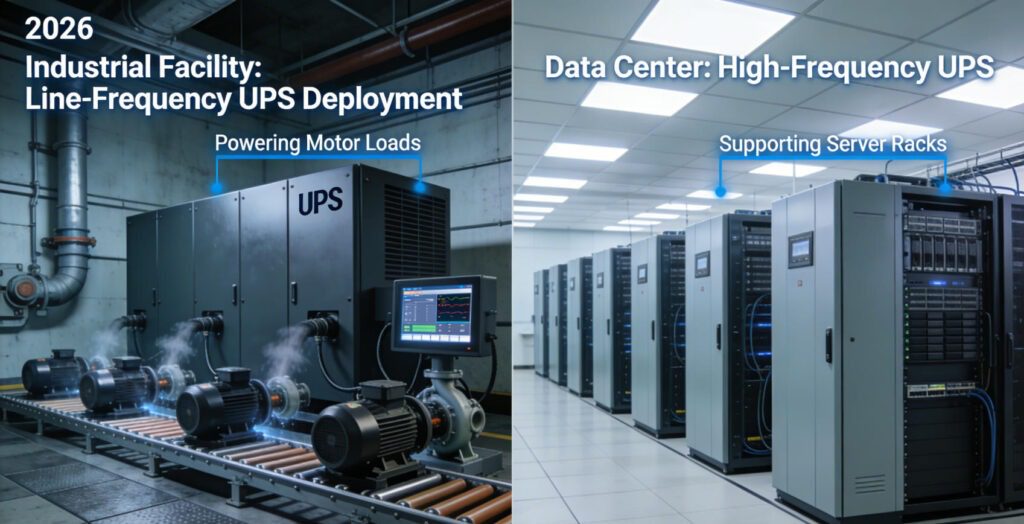
Figure 1: Industrial frequency UPS systems continue serving critical motor loads in manufacturing facilities throughout 2026. Filename: industrial_frequency_ups_installation_2026.png
Ⅱ. Understanding the “Obsolete” Narrative
1. The High-Frequency Revolution
High-frequency UPS technology has transformed commercial power protection. These systems operate at 10-20 kHz switching frequencies. They eliminate bulky 50/60 Hz transformers. The resulting footprint reduction exceeds 50%. Efficiency improvements reach 95-98%.
Data centers drive adoption enthusiastically. Space constraints prioritize compact designs. Energy costs justify efficiency premiums. IT loads lack the inrush characteristics that challenge power electronics.
These advantages created a perception problem. Industry observers began viewing transformer-based systems as legacy technology. Articles proclaimed the impending obsolescence of line-frequency designs. This narrative oversimplifies application requirements.
2. Market Segmentation Reality
The UPS market splits into distinct segments. Commercial and IT applications favor high-frequency topology. Industrial and critical infrastructure segments maintain different priorities. Their requirements favor isolation and robustness over compact dimensions.
2026 market analysis confirms this bifurcation. High-frequency systems capture 75% of sub-100 kVA commercial sales. Industrial frequency UPS retains 60% market share in heavy industrial sectors above 100 kVA. The technology serves different masters.
Ⅲ. The Technical Case for Isolation Transformers
1. Galvanic Isolation Fundamentals
Industrial frequency UPS systems incorporate output isolation transformers. These components provide galvanic isolation between input and output circuits. The transformer creates a true electrical barrier. Common mode noise cannot cross this boundary.
High-frequency UPS systems lack inherent isolation. They rely on electronic switching alone. Some designs add external transformers. These additions increase cost and reduce efficiency advantages. The integrated isolation of industrial designs proves superior.
Galvanic isolation protects sensitive medical equipment. Patient safety standards often mandate electrical separation. Industrial controls benefit from noise immunity. The transformer filters high-frequency transients that damage programmable logic controllers.
2. Motor Load Challenges
Motor loads present unique power protection challenges. Starting currents reach 600-800% of rated values. These inrush currents last several seconds. High-frequency UPS systems struggle with these surges. Their semiconductor ratings limit transient capacity.
Industrial frequency UPS systems handle these demands naturally. The output transformer provides magnetic energy storage. This inertia absorbs motor starting shocks. Winding impedance limits fault current slew rates. The design accommodates industrial machinery requirements.
Three phase UPS configurations face particular challenges with motor loads. Unbalanced starting currents stress power electronics. Isolation transformers distribute these imbalances magnetically. The system maintains output regulation during asymmetric loading.
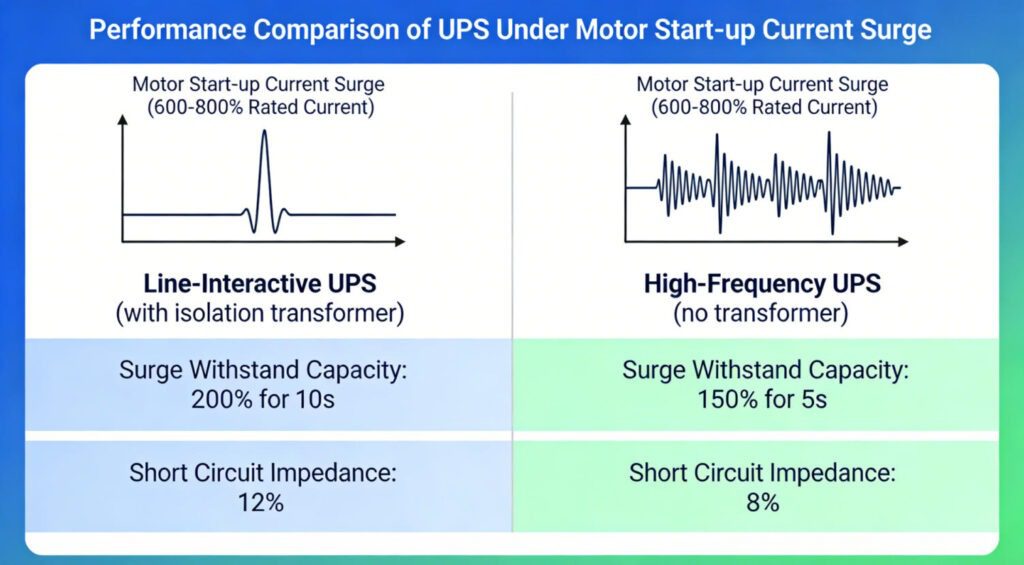
Figure 2: Comparative analysis showing industrial frequency UPS capability to handle motor inrush versus high-frequency system limitations. Filename: ups_motor_load_comparison_chart.png
Ⅳ. Critical Application Requirements
1. Medical Equipment Standards
Healthcare facilities operate under stringent electrical safety standards. Isolation transformers provide patient protection. Leakage current limitations become achievable. Ground fault risks decrease significantly.
Medical imaging equipment requires clean power. MRI machines and CT scanners contain sensitive RF circuits. Isolation prevents conducted interference. The transformer acts as a low-pass filter. High-frequency UPS switching noise stays contained.
Life support systems cannot tolerate failure. Industrial frequency UPS designs demonstrate superior overload capability. Short-term surges to 150% of rated capacity remain within operating parameters. This margin provides critical safety buffers.
2. Industrial Control System Protection
Manufacturing automation relies on programmable controllers. These devices communicate via low-voltage signals. Electrical noise disrupts communication protocols. Isolation transformers prevent ground loop formation.
Variable frequency drives create harmonic pollution. These nonlinear loads stress upstream equipment. Industrial frequency UPS systems absorb and isolate these disturbances. The transformer impedance limits harmonic propagation.
Process continuity demands reliability. Petrochemical facilities operate continuously for years. Equipment must withstand harsh electrical environments. Transformer-based designs tolerate voltage sags and swells better than high-frequency alternatives.
3. Backup Power Systems Integration
Generator set compatibility favors industrial frequency designs. The transformer impedance buffers generator voltage distortion. High-frequency UPS systems sometimes reject generator power. Their active rectifiers conflict with frequency stability.
Two-input configurations become possible with isolation. The main and bypass sources need not share neutrals. This selectivity improves system reliability. Maintenance becomes safer with true electrical separation.
Ⅴ. Performance Under Duress
1. Short-Circuit Withstand Capability
Electrical faults occur in industrial environments. Output short circuits test UPS survivability. Industrial frequency UPS systems excel here. The transformer limits fault current magnitude. Magnetic saturation provides inherent protection.
High-frequency UPS systems rely on electronic current limiting. Semiconductor fuses provide backup protection. The speed of response becomes critical. False trips may occur with motor starting formes d'onde.
Phase-neutral short circuits clear more reliably with transformer-based designs. The delta-zigzag winding configuration provides higher fault currents to trip downstream breakers. This coordination protects distribution systems.
2. Environmental Ruggedness
Industrial sites present harsh conditions. Temperature extremes exceed 40°C regularly. Dust and moisture contaminate air-cooled equipment. Vibration affects rotating machinery nearby.
Industrial frequency UPS systems tolerate these conditions. Their larger thermal mass handles temperature swings. Transformer windings resist contamination better than high-density circuit boards. Robust construction withstands mechanical stress.
IP54 protection ratings are standard for industrial designs. High-frequency systems typically offer IP20. The difference matters in manufacturing floors and outdoor installations.
Ⅵ. Economic Considerations Beyond Initial Cost
1. Total Cost of Ownership Analysis
High-frequency UPS systems cost less initially. Their purchase price runs 20-30% below equivalent transformer-based units. This advantage proves misleading for industrial applications.
Operating costs include maintenance. Industrial frequency UPS designs use robust components. Thyristor rectifiers tolerate abuse better than IGBT active front ends. Transformer windings rarely fail. System longevity often exceeds 20 years.
High-frequency systems require controlled environments. Cooling costs increase operational expenses. More frequent component replacement occurs in harsh industrial sites. The initial savings evaporate over the equipment lifecycle.
2. Application-Specific Value
Tower UPS configurations in industrial settings prioritize availability over space efficiency. The physical size of industrial frequency systems becomes acceptable. Footprint costs less than process downtime.
Monophasé UPS applications below 10 kVA increasingly use high-frequency designs. This trend does not extend to three phase UPS systems above 100 kVA. The dividing line follows load characteristics, not calendar years.
Double conversion UPS topologies exist in both categories. The conversion method matters less than the output stage design. Industrial applications continue selecting transformateur d'isolement outputs in 2026.
Ⅶ. The 2026 Technology Landscape
1. Hybrid Developments
Manufacturers explore middle-ground solutions. Some high-frequency systems now offer optional isolation transformers. These additions respond to industrial demand. However, they recreate the size and weight of traditional designs.
True innovation focuses on transformer optimization. Amorphous core materials reduce losses. Winding techniques improve efficiency. These advances narrow the performance gap without eliminating isolation benefits.
Digital control systems enhance both architectures. Advanced monitoring improves reliability. Predictive maintenance reduces downtime. These software developments apply universally.
2. Market Forecast Realities
Industry analysts predict steady demand through 2030. Industrial frequency UPS sales grow 4-5% annually in heavy industrial sectors. Infrastructure investment drives continuity. Aging electrical grids require robust protection.
Regional variations exist. Developing industrial economies favor proven technology. Established markets upgrade rather than replace. The installed base of transformer-based systems creates replacement demand.
Sustainability trends actually favor longevity. Equipment lasting 20+ years reduces embodied carbon. Industrial frequency UPS durability aligns with circular economy principles. Frequent replacement of less robust systems increases environmental impact.
Ⅷ. Making the Right Technology Choice
1. Decision Framework
Selecting UPS architecture requires load analysis. Motor content determines requirements. Mixed loads with significant motor percentages favor isolation. IT-only installations suit high-frequency designs.
Environmental assessment proves critical. Clean, climate-controlled rooms accommodate either technology. Manufacturing floors, outdoor installations, and medical facilities demand transformer-based robustness.
Future expansion plans affect selection. Scalable ASI modulaire systems exist in both categories. However, industrial growth typically increases motor load percentages. Planning for isolation proves prudent.
2. Specification Best Practices
Resist generic procurement templates. Data center specifications inadequately address industrial needs. Define load characteristics precisely. Include inrush current specifications. Specify harmonic content tolerance.
Require short-circuit withstand documentation. Verify temperature operating ranges. Demand environmental compatibility certifications. These details ensure appropriate technology selection.
Consult manufacturers’ application engineers. Describe operational scenarios completely. Discuss maintenance accessibility requirements. Specify battery configuration preferences. Collaborative specification prevents mismatches.
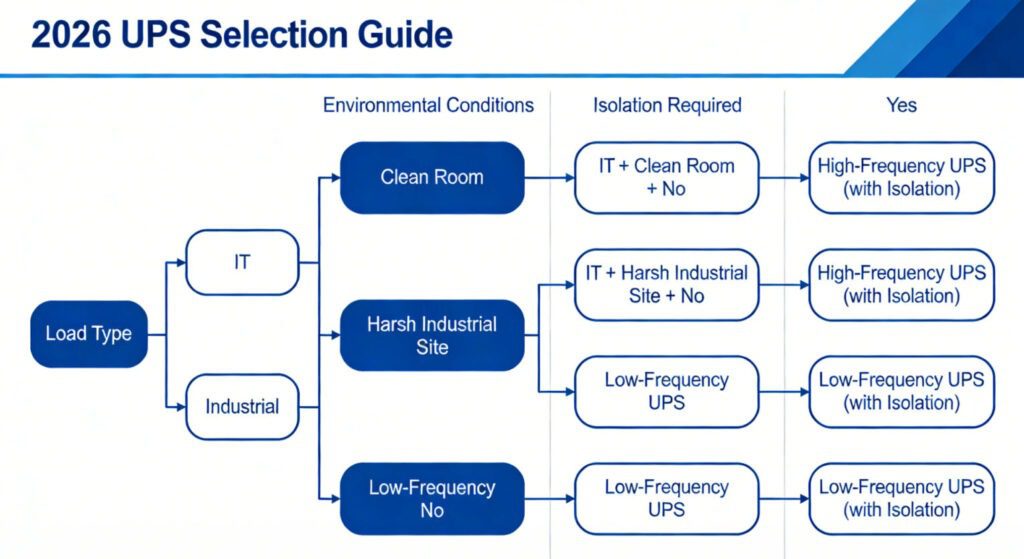
Figure 3: Decision matrix for selecting between industrial frequency and high-frequency UPS systems in 2026 applications. Filename: ups_selection_guide_2026.png
Ⅸ. Future-Proofing Industrial Power
1. Digital Integration Trends
Modern industrial frequency UPS systems incorporate advanced monitoring. Ethernet connectivity enables remote management. Predictive algorithms anticipate maintenance needs. These digital capabilities match high-frequency offerings.
Integration with building management systems improves. Power quality data informs facility operations. Energy consumption tracking supports sustainability reporting. The technology modernizes without sacrificing isolation fundamentals.
2. Sustainability Considerations
Long equipment life reduces waste. Industrial frequency UPS longevity supports environmental goals. Repairability exceeds modular high-frequency designs. Component-level maintenance extends service life further.
Efficiency improvements continue. Transformer losses decrease with advanced materials. System-level optimization compensates for inherent transformer losses. The efficiency gap narrows while isolation advantages persist.
Industrial frequency UPS technology remains far from obsolete in 2026. Specific applications demand its unique capabilities. Motor load protection, medical safety standards, and industrial ruggedness require isolation. The technology continues evolving without abandoning its core strengths. Specifiers should select based on application requirements rather than architectural trends.
Références
- Commission électrotechnique internationale (CEI)Site officiel : www.iec.ch
- Underwriters Laboratories (UL)Site officiel : www.ul.com
- Comité européen de normalisation (CEN)Site officiel : www.cen.eu
- Standardization Administration of China (SAC) Site web officiel : www.sac.gov.cn
- Zhongguancun Energy Storage Industry Technology Alliance (CNESA)Site web officiel : www.cnESA.org
- Organisation internationale de normalisation (ISO)Site officiel : www.iso.org