Bem-vindo à BKPOWER!





Future of Transformer Based UPS in Complex Grid Environments
TIPS:The future of transformer based UPS technology looks increasingly bright as power grids grow more complex. While digitalization dominates discussions, UPS baseado em transformador systems solve critical challenges that modern grids create. This article explores why future of transformer based ups depends on grid modernization trends including renewable integration and harmonic proliferation, revealing how isolation technology becomes essential infrastructure.

Ⅰ. Introduction: Grid Complexity Transforms UPS Value Proposition
Summary Preview: O future of transformer based UPS technology looks increasingly bright as power grids grow more complex. While digitalization dominates discussions, UPS baseado em transformador systems solve critical challenges that modern grids create. This article explores why future of transformer based ups depends on grid modernization trends including renewable integration and harmonic proliferation, revealing how isolation technology becomes essential infrastructure.
Power grid architectures are undergoing unprecedented transformation. Solar panels and wind turbines now feed electricity into distribution networks. Electric vehicle charging stations create sudden demand surges. These changes bring flexibility but also chaos. Power quality degrades as grid complexity increases.
Traditional assumptions about UPS technology no longer apply. High-frequency systems gained popularity when grids were stable. The equation changes with widespread renewable integration. Transformer isolation provides benefits that electronic filtering cannot match.
2026 market analysis reveals a counterintuitive trend. While high-frequency UPS dominates data centers, transformer based UPS sales accelerate in industrial and critical infrastructure sectors. The market reaches $8.76 billion globally. Growth drivers now include grid instability rather than despite it.

Figure 1: Renewable energy integration and harmonic disturbances create new demand for transformer-based UPS isolation in critical infrastructure. Filename: modern_grid_complexity_transformer_ups.png
Ⅱ. The New Reality of Power Grid Complexity
1. Renewable Energy Integration Challenges
Solar and wind power transform grid characteristics. These sources generate electricity intermittently. Cloud coverage drops solar output instantly. Wind speed fluctuations affect turbine generation. Traditional power plants provided inertia. Renewables lack this stabilizing feature.
Grid operators struggle with frequency regulation. Voltage fluctuations become common. Power electronic converters introduce harmonics. The clean sine waves of yesterday disappear. Modern grids deliver distorted formas de onda.
Three phase UPS systems face particular challenges. Unbalanced generation affects phase relationships. Voltage sags spread across distribution networks. Harmonic content increases with each new solar installation.
2. Harmonic Pollution Proliferation
Nonlinear loads now dominate electrical demand. Variable frequency drives control motors. LED lighting replaces incandescent bulbs. Computer power supplies draw current in pulses. All generate harmonic distortion.
Total Harmonic Distortion (THD) levels rise steadily. Utilities report THD exceeding 8% in urban areas. Industrial zones see 15% distortion routinely. Equipment specifications allow 5% maximum. The gap creates reliability risks.
High-frequency UPS systems struggle with incoming harmonics. Active filters compensate but add complexity. Components degrade faster under continuous harmonic stress. Reliability suffers despite sophisticated electronics.
Ⅲ. Transformer-Based UPS: The Technical Advantage
1. Galvanic Isolation Fundamentals
Isolation transformers create true electrical separation. They transfer power magnetically without direct connection. Primary and secondary windings remain physically separate. Common mode noise cannot cross this barrier.
This isolation proves essential in modern grids. Utility-side disturbances stay contained. Ground reference issues resolve automatically. The transformer acts as a protective moat around critical loads.
Double conversion UPS systems with isolation handle worst-case scenarios. Voltage spikes attenuate across winding inductance. Harmonic currents meet impedance barriers. Neutral conductor problems disappear with delta-wye transformations.
2. Common Mode Noise Suppression
Switching power electronics generate electrical noise. Frequency ranges reach megahertz levels. This noise travels through capacitive coupling. Sensitive equipment experiences disruption.
Transformer isolation blocks common mode paths. Interwinding capacitance remains minimal. Shielded constructions add protection layers. Control systems operate without interference.
Medical facilities particularly benefit from this protection. Patient safety standards mandate low leakage currents. Diagnostic equipment requires noise-free environments. UPS de frequência industrial systems deliver these capabilities inherently.

Figure 2: Galvanic isolation mechanism showing how transformer-based UPS blocks grid-borne disturbances from reaching critical loads. Filename: transformer_isolation_technical_diagram.png
Ⅳ. Critical Infrastructure Applications
1. Manufatura e automação industrial
Modern factories rely on precision control systems. Programmable Logic Controllers (PLCs) manage production lines. Variable frequency drives control motor speeds. Robotic systems perform delicate operations.
All these devices suffer from power quality issues. Voltage sags cause program resets. Harmonics create heating in motor windings. Transient overvoltages damage semiconductors.
Tower UPS configurations in industrial settings prioritize protection over efficiency. The robust construction of transformer-based systems withstands harsh environments. Dust, vibration, and temperature extremes challenge electronic-only designs.
Monofásico UPS units protect individual control systems. Three phase UPS systems secure entire production lines. Both benefit from galvanic isolation in electrically noisy factories.
2. Healthcare and Medical Equipment
Hospital electrical systems face unique demands. Life support equipment cannot tolerate interruptions. Imaging machines require stable voltage. Surgical suites need absolute reliability.
Isolation transformers provide patient safety. They limit fault current magnitude. Ground leakage drops to microamp levels. Equipment protects patients and operators simultaneously.
Grid instability threatens hospital operations. Energia de reserva systems must handle transfer seamlessly. Transformer-based UPS units provide this capability. Manual bypass options maintain continuity during maintenance.
3. Petrochemical and Process Industries
Continuous processes dominate chemical manufacturing. Interruptions cost millions per hour. Safety systems must function during power anomalies. Explosion-proof environments require robust equipment.
Industrial frequency UPS systems serve these needs. They tolerate high ambient temperatures. Humidity and corrosive atmospheres challenge electronics less severely. Twenty-year lifespans reduce replacement costs.
Process control systems use analog signals across long distances. Isolation prevents ground loop formation. Noise immunity ensures measurement accuracy. Safety instrumented systems maintain protection functions.
Ⅴ. Grid-Interactive Capabilities
1. Generator Set Compatibility
Facilities increasingly rely on backup generators. Renewable intermittency necessitates standby power. Generator electrical characteristics differ from utility grids.
Generators produce higher harmonic content. Voltage regulation proves less precise. Frequency stability fluctuates during load changes.
Transformer-based UPS systems accommodate these variations. The transformador de isolamento buffers generator transients. Inverters synchronize more easily with generator outputs. Load transfer occurs smoothly without disruption.
2. Energy Storage Integration
Battery energy storage systems (BESS) combine with UPS functionality. These hybrid systems provide extended backup. They also enable peak shaving applications.
Isolation transformers simplify integration. Battery grounding schemes adapt flexibly. Multiple source configurations become possible. The transformer handles voltage level matching automatically.
UPS on-line configurations with isolation support bidirectional power flow. Grid-interactive capabilities emerge naturally. Facilities participate in demand response programs. Revenue generation offsets infrastructure costs.
Ⅵ. Economic Analysis in Complex Grid Environments
1. Total Cost of Ownership Reconsidered
High-frequency UPS systems cost less initially. Purchase prices run 20-30% below transformer equivalents. This advantage diminishes with grid complexity.
Frequent voltage anomalies stress electronics. Capacitor lifetimes shorten in high-THD environments. Active filter components require maintenance. Unplanned downtime costs exceed initial savings.
Transformer-based designs tolerate abuse better. Magnetic components rarely fail. Conservative ratings handle overload situations. System longevity extends 15-20 years in harsh conditions.
2. Risk Mitigation Value
Grid instability creates business risks. Production losses cost immediate revenue. Equipment damage requires capital expenditure. Reputational damage affects long-term profitability.
Transformer isolation reduces these risks. Protection levels exceed electronic alternatives. Uptime statistics improve measurably. Insurance premiums may decrease with demonstrable protection.
Critical infrastructure operators increasingly recognize this value. Specification requirements tighten for industrial applications. Data center operators may compromise on efficiency. Hospitals and factories prioritize reliability.
Ⅶ. Future Grid Trends and UPS Evolution
1. Distributed Energy Resource Growth
More renewable sources will connect to distribution grids. Electric vehicle adoption accelerates. Microgrids proliferate for resilience. Each trend increases power quality challenges.
Transformer-based UPS technology adapts to these changes. Robust fundamental design requires minimal modification. Digital controls add intelligence without compromising isolation. Modular construction scales with demand.
The technology converges with smart grid concepts. Advanced metering reveals grid conditions. Predictive algorithms optimize battery cycling. Monitoramento remoto enables proactive maintenance.
2. Sustainability Considerations Paradox
Environmental concerns drive renewable adoption. However, electronics-heavy UPS systems have shorter lifespans. Frequent replacement increases electronic waste. Mining for semiconductors carries environmental costs.
Transformer-based systems offer sustainability advantages. Long service life reduces replacement frequency. Copper and steel recycle easily. Magnetic principles never become obsolete.
Efficiency improvements continue. Amorphous transformer cores reduce losses. Silicon carbide semiconductors improve conversion. The efficiency gap narrows while isolation benefits persist.
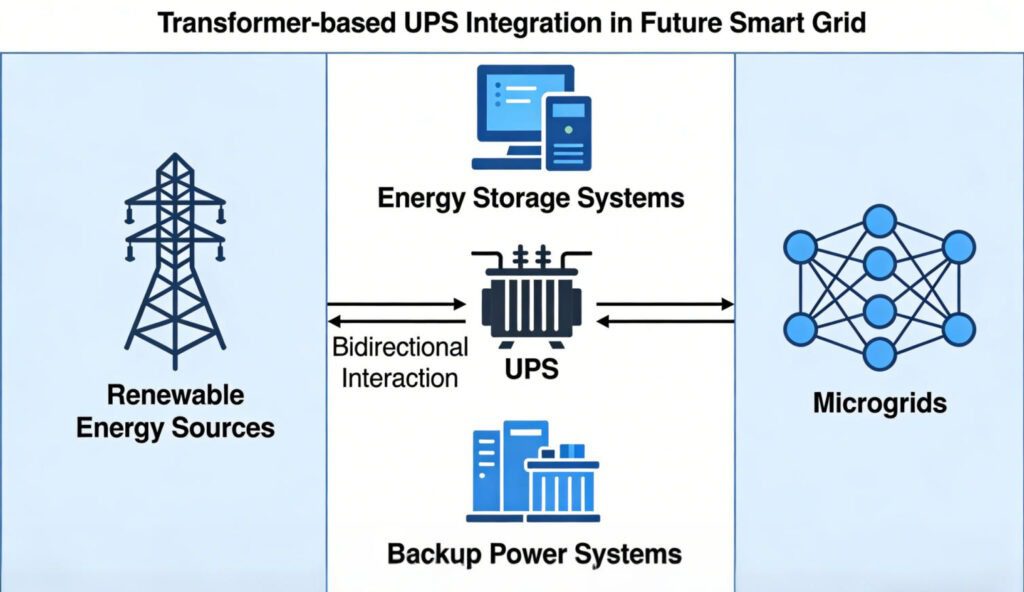
Figure 3: Transformer-based UPS integration with modern renewable-heavy grids and distributed energy resources. Filename: future_grid_integration_ups.png
Ⅷ. Selection Guidelines for Complex Environments
1. Site Assessment Protocol
Evaluate local grid conditions before Seleção de UPS. Measure existing harmonic levels. Review utility outage statistics. Assess environmental conditions.
Facilities near renewable generation need stronger protection. Industrial zones with high motor content require isolation. Coastal areas face corrosion challenges. All factors influence technology choice.
Three phase UPS systems above 100 kVA particularly benefit from transformer isolation. The investment pays dividends in reliability. Smaller single phase UPS applications may use simpler designs.
2. Specification Best Practices
Resist generic procurement templates. Specify harmonic environment requirements. Define acceptable voltage tolerance ranges. Require transient response documentation.
Demand isolation capabilities for critical loads. Specify galvanic separation explicitly. Include long-term reliability metrics. Plan for 15-20 year service life.
Consult manufacturers about grid conditions. Describe renewable energy integration plans. Discuss generator backup configurations. Collaborative specification ensures appropriate solutions.
Ⅸ. The Strategic Imperative
Organizations face increasing power quality challenges. Grid modernization brings benefits and risks simultaneously. Critical infrastructure cannot tolerate experimentation.
Transformer-based UPS technology provides proven protection. It handles grid complexity that challenges electronic-only designs. The future of transformer based UPS aligns with grid evolution trends. As power systems grow more complex, isolation becomes more valuable—not less.
Investment decisions should reflect this reality. Short-term efficiency metrics mislead in complex environments. Total cost of ownership favors robust solutions. Critical infrastructure operators must prioritize reliability.
The transformation of electrical grids continues unabated. Transformer isolation offers stability amid this change. Organizations that recognize this strategic advantage will maintain operational continuity. Those thatignore it risk costly disruptions as grid complexity increases.
Referências
- Comissão Eletrotécnica Internacional (IEC)Site oficial: www.iec.ch
- Underwriters Laboratories (UL)Site oficial: www.ul.com
- Comitê Europeu de Padronização (CEN)Site oficial: www.cen.eu
- Administração de Padronização da China (SAC) Site oficial: www.sac.gov.cn
- Zhongguancun Energy Storage Industry Technology Alliance (CNESA)Site oficial: www.cnESA.org
- Site oficial da International Organization for Standardization (ISO): www.iso.org