Welcome to BKPOWER!












Medical UPS vs Isolation Transformer: Critical Power Protection Guide
TIPS:Double conversion UPS systems and isolation transformers form the backbone of critical power protection in modern healthcare facilities. Understanding the technical relationship between industrial frequency UPS architectures and true isolation requirements is essential for electrical engineers designing medical-grade backup power systems. This comprehensive guide clarifies why industrial frequency UPS output transformers cannot serve as medical isolation transformers, explores grounding hazards in healthcare environments, and provides actionable strategies for implementing compliant online UPS configurations that ensure patient safety and regulatory adherence.
Ⅰ. Introduction: The Critical Role of Power Protection in Healthcare
Modern healthcare facilities rely on sophisticated electronic equipment for diagnosis, treatment, and patient monitoring. From MRI machines to ventilators, these devices demand stable, clean power to function accurately. Power fluctuations or outages can compromise patient safety and data integrity. This is where double conversion UPS systems become essential—they provide continuous, regulated power to critical medical equipment.
Understanding the relationship between industrial frequency UPS and isolation transformers is crucial for electrical engineers designing medical power systems. Many professionals wonder: Can the built-in transformer of an industrial frequency UPS serve as an isolation transformer? This article clarifies this common misconception while providing actionable insights for medical facility power design.
Ⅱ. Medical Facility Requirements for UPS Systems
1. Classification of Medical Locations
Medical facilities classify locations based on electrical risk and patient contact:
- Group 0: No patient contact; power interruption poses no life risk
- Group 1: External or non-cardiac invasive procedures; short power breaks acceptable
- Group 2: Intracardiac procedures and life support; zero-tolerance for power interruptions
According to IEC 60364-7-710 and GB16895.24, Group 2 areas require uninterruptible power supplies with transfer times ≤0.5 seconds. These areas include operating rooms, ICUs, and cardiac catheterization labs where backup power systems must operate seamlessly.
2. Grounding System Requirements
The JGJ312-2013 Medical Building Electrical Design Code specifies that TN-S systems using three-phase UPS must include isolation transformers with repeated grounding. However, industry debate continues regarding whether industrial frequency UPS output transformers qualify as true isolation transformers.
Ⅲ. Understanding UPS Topologies
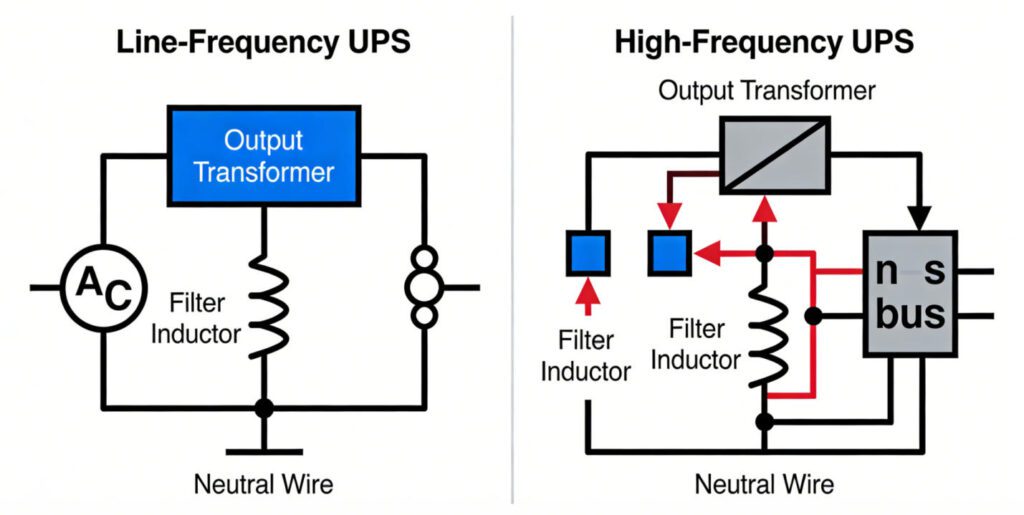
1. Industrial Frequency UPS
Industrial frequency UPS systems utilize:
- Silicon-controlled rectifier (SCR) thyristor bridges
- IGBT inverters operating at 50Hz
- Built-in output transformers for voltage step-up
These systems use 6-pulse or 12-pulse rectification. The output transformer serves dual purposes: voltage elevation and harmonic filtering. Because the DC bus voltage is relatively low, the transformer boosts output to standard 380V/400V levels while filtering inverter switching noise.
2. High-Frequency UPS
Modern high-frequency UPS systems feature:
- IGBT-based high-frequency rectifiers (typically 20kHz switching)
- Power factor correction (PFC) circuits
- Output filter inductors instead of transformers
These systems achieve higher efficiency and smaller footprints. The elevated DC bus voltage (typically 400V+) allows direct 380V output without step-up transformers, replacing them with compact filter inductors.
Ⅳ. Why Industrial Frequency UPS Transformers Are NOT Isolation Transformers
1. The Critical Neutrality Issue
The defining characteristic of true isolation transformers per GB19212.1-2016 and GB19212.16-2017 is complete electrical separation between input and output circuits. Specifically, clause 19.1 states: “Input and output circuits shall be electrically separated from each other, constructed so that no direct or indirect connection exists between these circuits through any other conductive part.”
However, industrial frequency UPS systems connect the neutral conductor (N) directly from input to output through the transformer secondary winding. This creates a continuous electrical path violating true galvanic isolation requirements.

2. System Configuration Analysis
In industrial frequency UPS topology:
- The neutral line enters the UPS input
- It provides reference potential for the rectifier, battery charger, and inverter
- The same neutral connects to the transformer secondary neutral point
- This configuration maintains common neutral continuity
This design enables seamless transfer between mains and inverter modes but precludes true isolation. The neutral connection persists whether the system operates on utility power or battery backup.
3. Safety Implications for Medical Installations
Direct neutral connectivity means:
- No galvanic isolation between input and output
- Potential for ground fault current propagation
- Inability to create independent grounding systems
- Violation of medical IT system requirements per IEC 60364-7-710
V. Grounding Hazards of Industrial Frequency UPS Output Transformers
1. System Grounding Transformation
Connecting the UPS output neutral to ground fundamentally alters the electrical system configuration. In standard TN-S installations, this creates an undesirable TN-C condition where neutral and protective earth combine—a configuration strictly prohibited in medical environments per international safety standards.
The resulting system presents:
- Elevated touch voltages during faults
- Neutral current flowing through protective conductors
- Potential electromagnetic interference with sensitive medical equipment
- Compromised safety for patient-contact devices
2. Regulatory Non-Compliance
Medical electrical installations must comply with:
- IEC 60601-1 for medical equipment safety
- IEC 60364-7-710 for medical location installations
- NFPA 99 for healthcare facility electrical systems
- GB16895.24 for Chinese medical installations
All these standards mandate IT system configurations (isolated power systems) or properly isolated TN-S systems for Group 2 medical locations. Improper UPS grounding jeopardizes compliance and patient safety.
VI. Correct Isolation Transformer Implementation
1. External Isolation Transformer Configuration
Proper medical power design requires dedicated isolation transformers installed:
- At the UPS output: Preferred method offering flexibility and optimal performance
- Separate from UPS location: Allows positioning near critical loads
- With independent grounding: Establishes true galvanic isolation
This configuration enables:
- True neutral-to-ground separation
- Reduced zero-ground voltage
- Compliance with medical IT system requirements
- Enhanced protection against microshock hazards
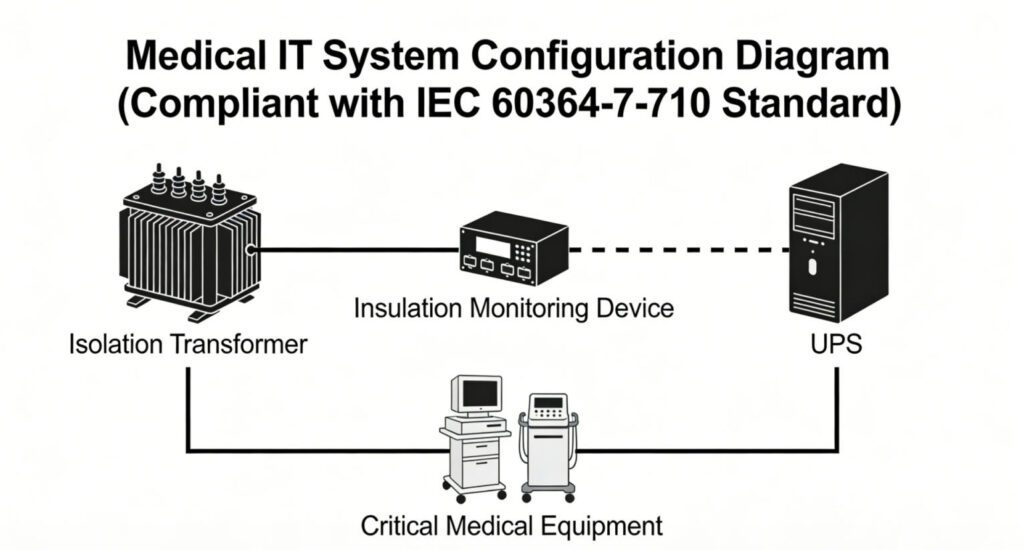
2. Medical IT System Architecture
For Group 2 medical locations, the complete system includes:
- Medical-grade isolation transformer per IEC 61558-2-15
- Insulation monitoring device (IMD) per IEC 61557-8
- Automatic transfer switching between normal and safety power
- Fault location detection systems
- Visual and audible alarm systems
The isolation transformer creates an unearthed IT system where first fault conditions do not interrupt power—critical for life-support applications.
VII. Selection Guidelines for Medical UPS Systems
1. Capacity and Topology Selection
When specifying online UPS systems for healthcare:
- Choose true double conversion topology for zero transfer time
- Select capacity with 20-30% headroom above calculated load
- Specify medical-grade isolation transformers for Group 2 areas
- Ensure compliance with IEC 60601-1 and UL 60601-1
2. Single-Phase vs. Three-Phase Considerations
Medical IT systems typically utilize:
- Single-phase systems (≤10kVA): For limited-area protection with restricted fault zones
- Three-phase systems (>10kVA): For facility-wide power protection with proper segmentation
Smaller single-phase UPS with dedicated isolation transformers offer advantages in controlling fault locations and simplifying maintenance.
VIII. Conclusion: Best Practices for Medical Power Protection
Industrial frequency UPS output transformers serve important functions—voltage regulation, harmonic filtering, and impedance matching—but they do not provide true electrical isolation required for medical applications. Engineering professionals must recognize this distinction and specify dedicated medical-grade isolation transformers for healthcare installations.
Proper implementation requires:
- External isolation transformers at UPS output or downstream
- Compliance with IEC 60364-7-710 and IEC 60601-1
- Regular insulation monitoring and maintenance
- Integration with overall emergency power systems
By understanding these technical distinctions, facility managers and electrical engineers can ensure patient safety while maintaining regulatory compliance in critical healthcare environments.
References
- International Electrotechnical Commission (IEC)Official website: www.iec.ch
- Underwriters Laboratories (UL)Official website: www.ul.com
- European Committee for Standardization (CEN)Official website: www.cen.eu
- Standardization Administration of China (SAC)Official website: www.sac.gov.cn
- Zhongguancun Energy Storage Industry Technology Alliance (CNESA)Official website: www.cnESA.org
- International Organization for Standardization (ISO)Official website: www.iso.org