Willkommen bei BKPOWER!












Hospital MRI Backup: Why Transformer Is Non-Negotiable
TIPPS:Isolation transformer based UPS solutions are absolutely mandatory for hospital MRI systems. Standard UPS units without isolation transformer based UPS architecture expose imaging equipment to catastrophic failure risks. MRI scanners demand power purity below 1% THD. Common mode noise creates image artifacts that compromise diagnostic accuracy. Trenntransformator based UPS designs provide the galvanic isolation that blocks ground-borne interference. BKPOWER medical-grade systems deliver 140dB common mode rejection. This technical superiority makes transformers non-negotiable for MRI Reservestrom.
Ⅰ. Introduction: The Non-Negotiable Requirement
MRI systems represent the pinnacle of diagnostic imaging technology. These multi-million-dollar machines create detailed anatomical images. They guide life-saving medical procedures. They detect cancers at early stages. However, MRI scanners possess extreme sensitivity to power quality disturbances. A single voltage transient can corrupt an hour-long scanning session. Power interruptions force expensive helium quenches. Diagnostic accuracy depends entirely on electrical power stability.
Hospital electrical grids present hostile environments for sensitive equipment. Switching operations create voltage spikes. Elevator motors inject harmonic distortion. Fluorescent lighting generates high-frequency noise. These disturbances travel through neutral conductors and ground paths. They reach MRI systems through power cables. Standard UPS units provide battery backup. However, they lack critical isolation capabilities. Transformers become absolutely non-negotiable for MRI protection.
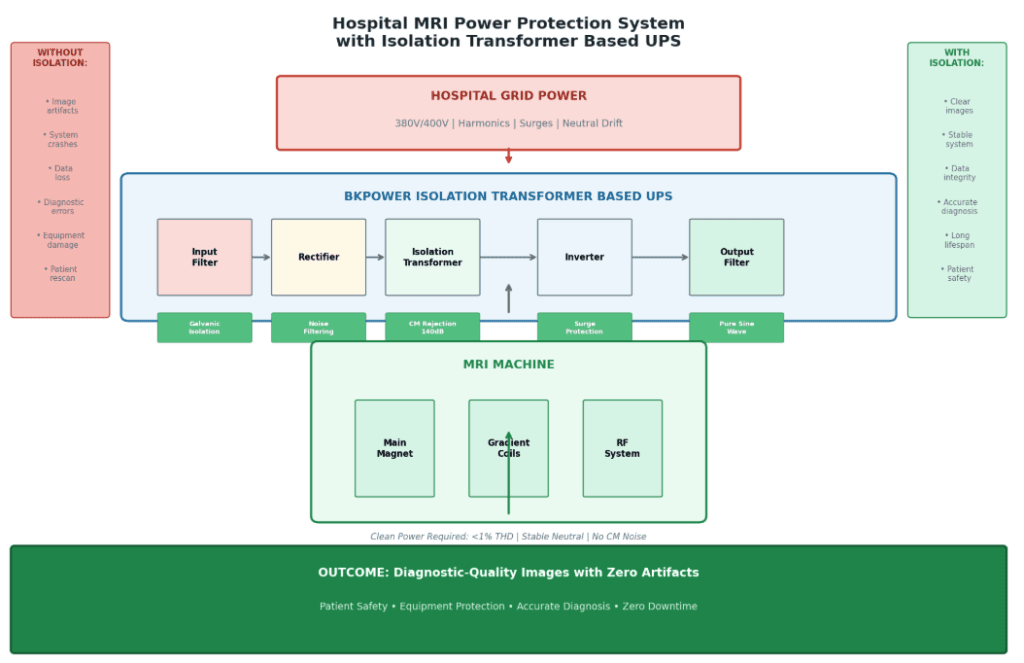
BKPOWER isolation transformer based UPS systems solve these challenges. Our designs incorporate medical-grade isolation transformers. These components provide galvanische Isolierung between grid and load. Common mode noise attenuation reaches 140dB. Output THD remains below 1%. This technical superiority ensures diagnostic-quality imaging under all grid conditions.
Ⅱ. Why Standard UPS Fails for MRI Applications
1.The Common Mode Noise Problem
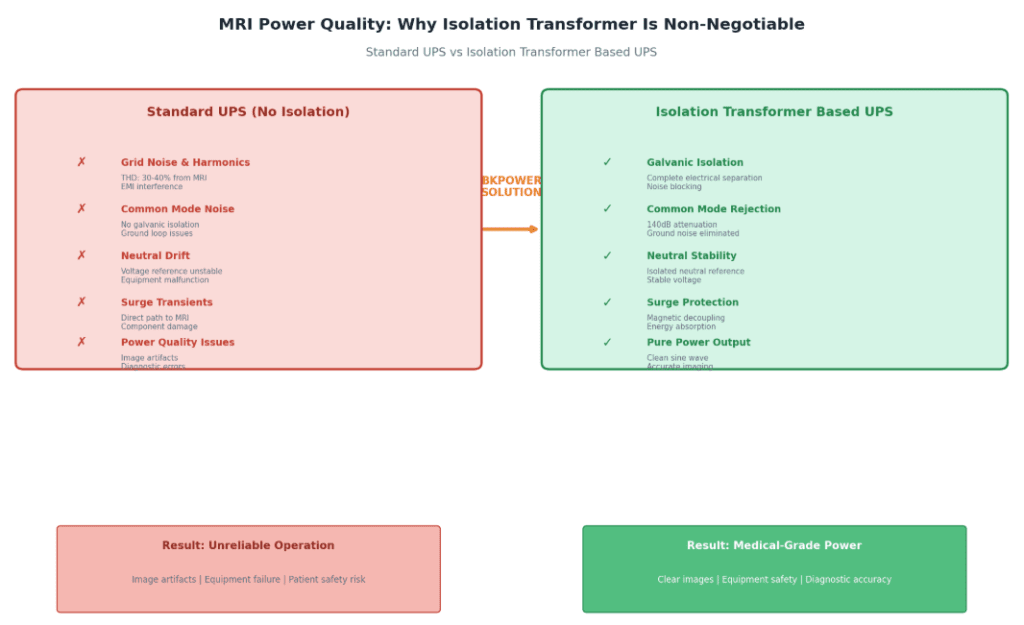
Electrical noise manifests in two forms: differential mode and common mode. Differential noise appears between line and neutral conductors. Standard filters suppress this noise effectively. Common mode noise presents the real danger. It appears equally on both line and neutral relative to ground. This noise bypasses conventional filtering.
Ground loops create common mode noise currents. Multiple grounding points in hospital buildings generate potential differences. Current flows through ground conductors. These currents induce voltage drops. Sensitive equipment picks up the noise. MRI systems suffer severe image degradation.
Standard online UPS systems provide no common mode rejection. Their electronics connect directly to grid neutral. Ground noise propagates straight to output terminals. MRI scanners receive polluted power. Diagnostic images show artifacts. Radiologists cannot interpret scans accurately.
2.Neutral Drift and Reference Instability
MRI systems require stable voltage references. Gradient coil amplifiers measure current precisely. RF transmitters maintain frequency accuracy. These functions depend on stable neutral-to-ground relationships.
Hospital grids experience neutral drift constantly. Unbalanced three-phase loading shifts neutral voltage. Harmonic currents elevate neutral potential. High-frequency switching transients disturb reference levels. Standard UPS systems track these disturbances. They reproduce neutral variations at output terminals.
Isolation transformers solve this problem through galvanische Isolierung. The primary and secondary windings share no electrical connection. A new neutral reference establishes on the secondary side. This reference remains stable regardless of primary-side disturbances. MRI systems receive rock-solid voltage references.
3.Surge and Transient Pathways
Lightning strikes near hospital buildings. Grid switching operations create transients. Motor starting generates voltage spikes. These surges seek pathways to ground.
Standard UPS designs provide direct electrical paths. Surge protection devices clamp voltages. However, energy still reaches sensitive electronics. Repeated stress degrades components. Catastrophic failures occur during severe events.
Isolation transformers block surge pathways magnetically. Primary-to-secondary coupling occurs through magnetic fields only. High-frequency transients encounter winding inductance. Energy dissipates as harmless heat. MRI systems receive pure sine wave power regardless of grid disturbances.
Ⅲ. The Physics of Galvanic Isolation
1.Magnetic Coupling vs Electrical Connection
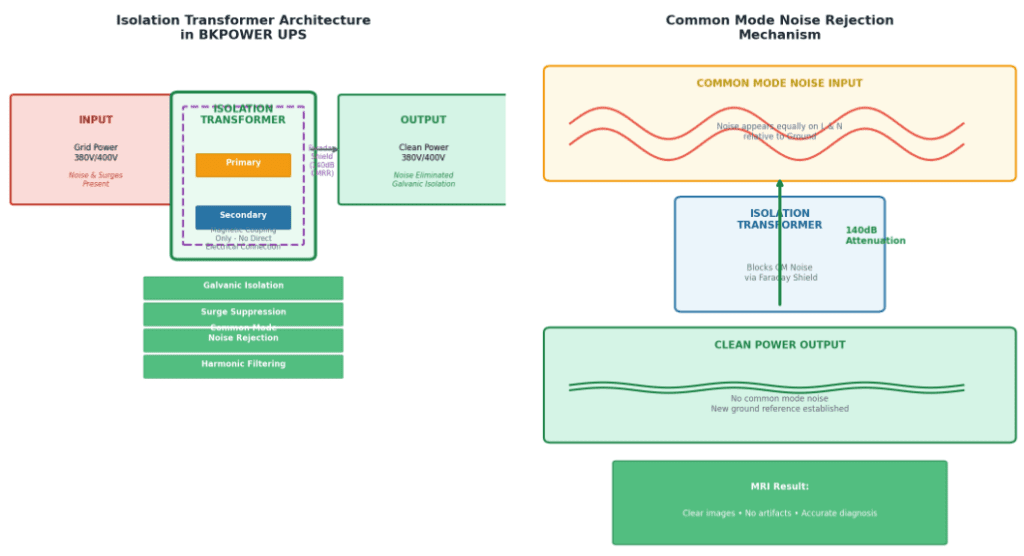
Transformers transfer energy through electromagnetic induction. Alternating current creates magnetic fields in primary windings. These fields induce voltage in secondary windings. No direct wire connection exists between input and output.
Diese galvanische Isolierung breaks ground loop circuits. Common mode noise currents cannot flow through transformer windings. They remain trapped on the primary side. Secondary-side equipment operates in electrically isolated environments.
BKPOWER isolation transformers utilize triple-shielded designs. Faraday screens between windings intercept capacitive coupling. These screens connect to ground. They shunt high-frequency noise safely away. The result: 140dB common mode rejection ratio (CMRR).
2.Common Mode Rejection Mechanism
Common mode noise rides equally on line and neutral conductors. Both conductors show identical voltage variations relative to ground. Differential-mode circuits ignore this noise. However, sensitive electronics often reference ground. They pick up common mode interference.
Isolation transformers present high impedance to common mode signals. Primary and secondary windings couple only differential signals. Common mode voltage sees only leakage inductance. This impedance limits noise current flow. Typical CMRR values exceed 100dB at power frequencies.
MRI systems benefit dramatically from this rejection. Gradient amplifiers receive clean power. RF systems operate without interference. Digital control circuits maintain timing accuracy. Images emerge free from power-related artifacts.
Ⅳ. MRI Power Quality Specifications
1.Total Harmonic Distortion Requirements
MRI scanners generate powerful magnetic fields. Gradient coils switch rapidly during sequences. These operations create electrical harmonics. The machines also demand harmonic-free input power.
Manufacturer specifications typically require THD below 5%. Premium systems demand THD below 1%. High-frequency harmonics cause image artifacts. They disturb magnetic field homogeneity. They create noise in receiver circuits.
Standard UPS inverters produce 3-5% THD. This proves adequate for office computers. It fails MRI requirements. Isolation transformers provide additional filtering. Winding inductance shunts high-frequency harmonics. Iron-core saturation characteristics suppress distortion.
BKPOWER isolation transformer based UPS systems achieve <1% THD. Output filters eliminate switching noise. Medical-grade isolation removes grid-borne harmonics. MRI scanners receive technically pure power.
2.Voltage Regulation and Stability
MRI gradient amplifiers require precise voltage. Current slew rates reach hundreds of amperes per microsecond. These transient loads demand stable bus voltage. Voltage sag during gradient switching causes image distortion.
Standard UPS systems regulate voltage electronically. Feedback loops respond in milliseconds. MRI transients occur in microseconds. Electronic regulation cannot respond quickly enough.
Isolation transformers provide instantaneous voltage support. Magnetic coupling responds at light speed. Winding inductance supplies transient current. Output voltage remains stable during aggressive loading. This passive stability complements active electronic regulation.
3.Inrush Current Handling
MRI systems present challenging startup profiles. Magnet cryocoolers draw high initial currents. Gradient amplifiers charge capacitor banks. These inrush currents reach 300-500% of nominal ratings.
Standard UPS systems trip on overcurrent. They transfer to bypass or shut down completely. These transitions disrupt MRI operation. Magnet temperature rises during outages. Helium boils off. Recovery requires expensive quench and refill procedures.
Isolation transformers tolerate severe overloads. Magnetic cores saturate gracefully. Windings handle surge currents without damage. BKPOWER systems specify 150% overload for 60 seconds. Inrush currents pass harmlessly. MRI systems start reliably every time.
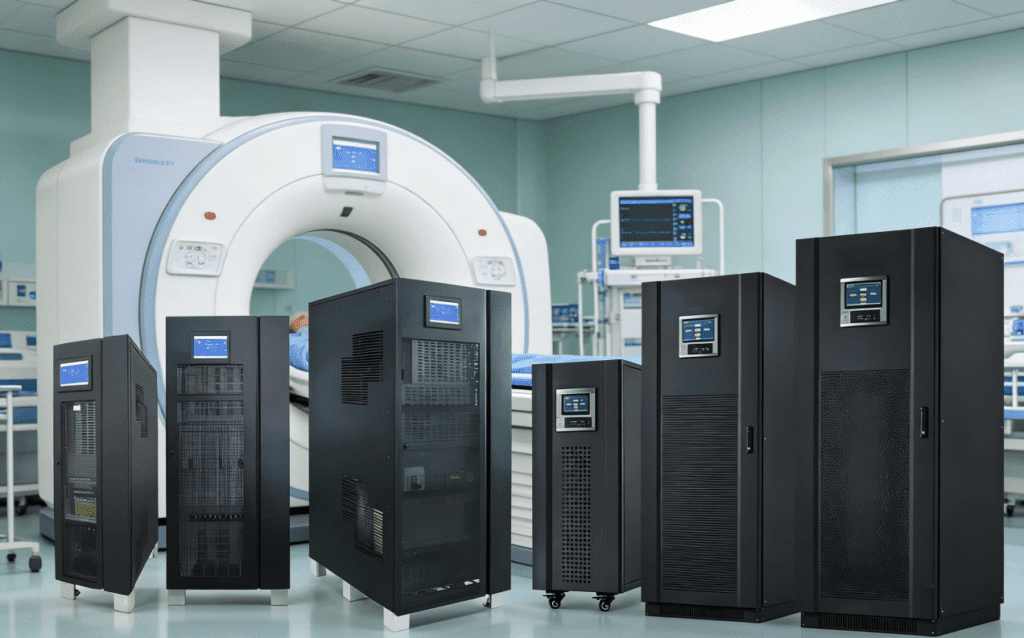
Ⅴ. Technical Architecture of Isolation Transformer Based UPS
1.Input Stage and Filtering
Grid power enters through input circuit breakers. EMI filters suppress high-frequency noise. Phase-controlled rectifiers convert AC to DC. This stage handles wide input voltage variations.
Isolation transformers require special consideration. Inrush currents during energization challenge rectifiers. Soft-start circuits limit initial current. Pre-charge resistors protect capacitors. These measures ensure reliable transformer energization.
2.The Isolation Transformer Core
This component defines system capabilities. BKPOWER utilizes K-rated transformers. These tolerate high harmonic currents without overheating. Faraday shields provide electrostatic isolation. Multiple shield layers maximize CMRR.
Core materials receive careful selection. Grain-oriented silicon steel minimizes losses. High saturation flux density supports overload capability. Vacuum impregnation prevents moisture ingress. Vacuum-pressure impregnation (VPI) enhances insulation life.
Winding configurations optimize performance. Separated primary and secondary sections reduce capacitance. Interleaved windings improve coupling. Copper sizing handles 300% surge currents. These details ensure two-decade service life.
3.Output Inverter and Regulation
IGBT inverters generate AC output. PWM techniques create sine Wellenformen. Output filters remove switching components. Isolation transformers provide final conditioning. They absorb inverter switching noise. They present low impedance to load transients.
Dual-conversion architecture ensures zero transfer time. Online operation isolates MRI from grid disturbances. Battery backup bridges generator startup delays. Autonomy ranges from minutes to hours based on configuration.
Ⅵ. Consequences of Omitting Isolation Transformers
1.Image Artifacts and Diagnostic Failures
Radiologists depend on artifact-free images. Subtle pathologies hide behind noise patterns. Power-quality artifacts mimic disease states. False positives trigger unnecessary procedures. False negatives miss critical diagnoses.
Common mode noise creates specific artifact patterns. Ghosting appears along phase-encode directions. Banding modulates image intensity. Stripe artifacts obscure anatomical details. These patterns confuse interpretation. They reduce diagnostic confidence.
Isolation transformers eliminate these artifacts. They provide electrically quiet environments. SNR (signal-to-noise ratio) improves measurably. Contrast resolution enhances. Subtle pathologies become visible.
2.Equipment Damage and Failure
MRI systems cost millions of dollars. Helium fills cost hundreds of thousands. Magnet quenches destroy imaging capability. Power-quality failures trigger these disasters.
Surge damage accumulates in gradient amplifiers. IGBT modules fail catastrophically. RF power transistors degrade. Control computers lock up. Repair costs mount rapidly. Downtime destroys scan schedules.
Isolation transformers prevent this damage. They absorb surge energy magnetically. They block fast transients. They provide electrical quiet zones. Equipment lasts design lifetime. Maintenance costs drop substantially.
3.Patient Safety and Rescan Requirements
MRI scans require patient cooperation. Claustrophobic patients tolerate procedures poorly. Sedated patients face anesthesia risks. Rescanning subjects patients to additional stress.
Power failures mid-scan force repetition. Image artifacts force repetition. Unstable systems produce nondiagnostic studies. Patients suffer through multiple sessions. Scheduling backlogs grow. Revenue suffers.
Reliable power systems prevent these problems. Scans complete successfully the first time. Patients receive prompt diagnosis. Scanner utilization maximizes. Hospital revenue flows smoothly.
Ⅶ. Regulatory and Compliance Considerations
Medical electrical equipment operates under strict standards. IEC 60601-1 defines safety requirements. Leakage current limits protect patients. Grounding specifications ensure safety.
Isolation transformers simplify compliance. They reduce leakage currents. They provide redundant grounding isolation. They meet medical-grade insulation requirements. Certification bodies recognize these benefits.
Hospital accreditation organizations emphasize power reliability. Joint Commission standards address life safety. CMS regulations govern reimbursement. Power failures create compliance violations. Documented UPS systems satisfy auditors.
Insurance underwriters recognize isolation benefits. Transformer-based systems receive favorable risk ratings. Premium reductions offset equipment costs. Risk managers appreciate this advantage.
Ⅷ. Economic Analysis: True Cost of Power Protection
Initial purchase price misleads many buyers. Standard UPS systems cost 30-40% less. However, total ownership costs tell different stories.
Unprotected MRI systems suffer frequent failures. Annual downtime reaches 5-10% without proper UPS. Each day of downtime costs tens of thousands in lost revenue. Emergency repairs require premium labor rates. Parts availability delays compound losses.
Helium quenches prove especially expensive. Modern MRI magnets contain thousands of liters of liquid helium. Quenches vent this expensive coolant. Refill costs exceed $50,000. Magnet recovery requires days of downtime.
Isolation transformer based UPS systems prevent these costs. Reliability exceeds 99.9%. Design life spans 15-20 years. Maintenance costs remain minimal. Total ownership costs fall 50% below standard alternatives over system lifetime.
Ⅸ. BKPOWER Medical Grade Solutions
BKPOWER engineers designed isolation transformer based UPS systems specifically for medical imaging. Our solutions address MRI requirements comprehensively.
1.Medical-Grade Isolation Specifications
K-rated transformers handle high harmonic loads. Triple Faraday shields provide 140dB CMRR. Hospital-grade outlets incorporate isolation monitoring. Ground fault protection meets NEC requirements.
2.Scalable Power Ranges
Systems range from 30kVA to 300kVA. Parallel configurations provide redundancy. N+1 architectures eliminate single points of failure. Hot-swappable modules permit maintenance without downtime.
3.Advanced Monitoring and Management
LCD displays show real-time parameters. SNMP integration enables network monitoring. Battery management systems optimize cell life. Predictive analytics warn of developing problems.
4.Application Engineering Support
Site surveys assess power quality. Load analysis determines proper sizing. Installation supervision ensures optimal deployment. Commissioning tests verify performance.
Ⅹ. Conclusion: The Non-Negotiable Choice
MRI power protection demands isolation transformers. This requirement is not optional. It is not negotiable. It is fundamental physics.
Standard UPS systems protect against outages. They regulate voltage. They cannot provide galvanische Isolierung. They cannot reject common mode noise. They cannot meet MRI power quality demands.
BKPOWER isolation transformer based UPS systems deliver medical-grade power. They block ground-borne interference. They absorb surges magnetically. They provide stable voltage references. They ensure diagnostic-quality imaging.
Hospital administrators must recognize this requirement. Specifying transformerless UPS for MRI invites disaster. Image artifacts compromise patient care. Equipment damage destroys capital investment. Downtime destroys operational efficiency.
The choice is clear. Protect your MRI investment properly. Specify isolation transformer based UPS from BKPOWER. Your radiologists will see the difference. Your patients will benefit. Your bottom line will improve. Transformers are non-negotiable.
Referenzen
- Internationale Elektrotechnische Kommission (IEC)Offizielle Website: www.iec.ch
- Underwriters Laboratories (UL)Offizielle Website: www.ul.com
- Europäisches Komitee für Normung (CEN)Offizielle Website: www.cen.eu
- Standardization Administration of China (SAC)Offizielle Website: www.sac.gov.cn
- Zhongguancun Energy Storage Industry Technology Alliance (CNESA)Offizielle Website: www.cnESA.org
- Internationale Organisation für Normung (ISO)Offizielle Website: www.iso.org