Bem-vindo à BKPOWER!












Data Center Backup in Regions with Unstable Grids
DICAS:Fonte de alimentação ininterrupta industrial systems provide essential protection for data centers operating in unstable grid environments. These Fonte de alimentação ininterrupta industrial units withstand severe voltage fluctuations that destroy standard high-frequency UPS equipment. Emerging markets face power grid instability with frequent surges, sags, and outages. Standard UPS systems fail rapidly under these harsh conditions. Data center operators experience repeated downtime and equipment damage. Fonte de alimentação ininterrupta industrial solutions offer robust transformer-based protection. BKPOWER UPS de frequência industrial ensures continuous operation through extended voltage ranges. This article explains why transformer-based technology outperforms high-frequency alternatives in challenging power environments.
Ⅰ. Introduction: The Data Center Challenge in Emerging Markets
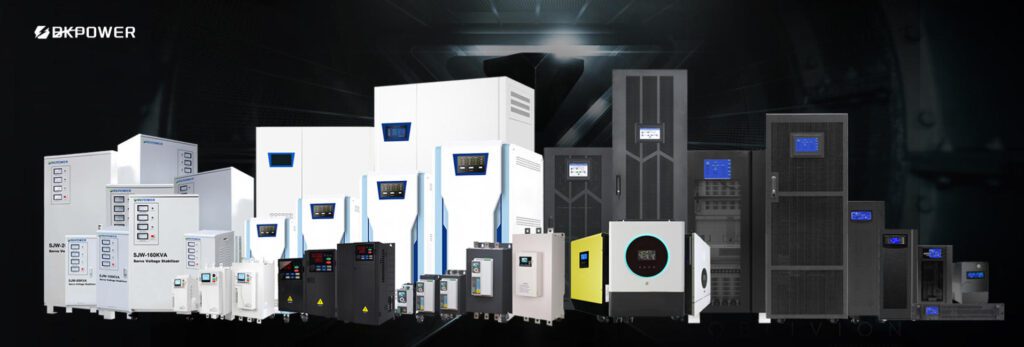
Data center expansion accelerates across Africa, South Asia, and Southeast Asia. These regions offer growing digital economies and untapped market potential. However, power infrastructure lags behind technological advancement. Grid instability creates severe operational challenges for mission-critical facilities.
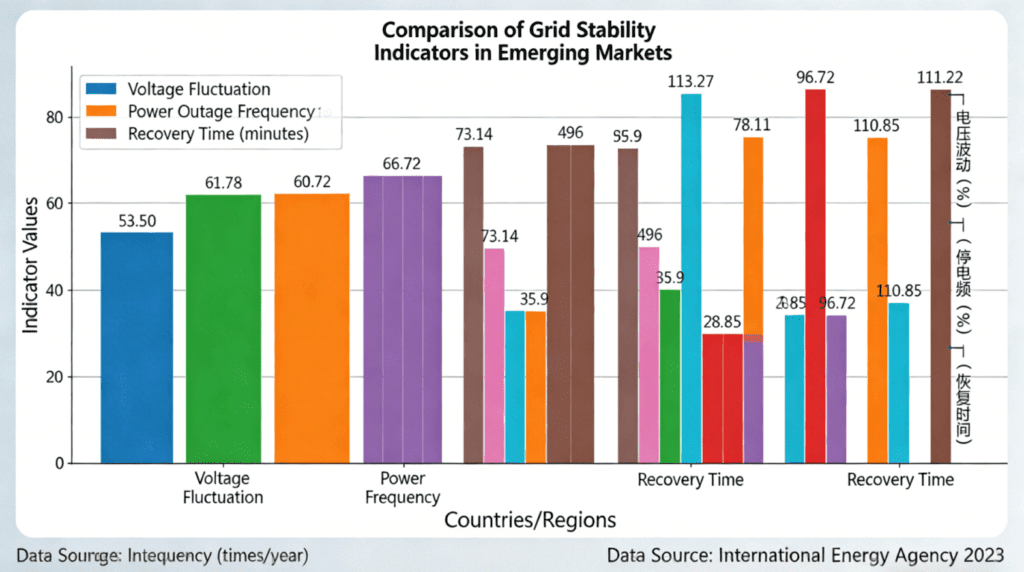
Power grids in emerging markets exhibit extreme volatility. Voltage fluctuations range from 30% below nominal to 40% above standard levels. Outages occur weekly or even daily in some locations. Power quality metrics like THD (Total Harmonic Distortion) frequently exceed acceptable standards. These conditions destroy sensitive electronic equipment rapidly.
Traditional high-frequency UPS systems dominate developed markets. These compact units work well in stable grid environments. Engineers design them for voltage variances within ±10%. They cannot survive the harsh power conditions common in developing regions. Component failure rates reach 20-30% annually in unstable grids.
Fonte de alimentação ininterrupta industrial systems provide the answer. These transformer-based units withstand severe electrical stresses. Wide input voltage ranges accommodate extreme fluctuations. Robust isolation transformers protect against surges and spikes. Data centers achieve reliable uptime despite grid instability.
Ⅱ. Understanding Grid Instability in Developing Regions
1.Voltage Fluctuation Patterns
Power quality varies significantly across different geographies. Developed nations maintain grid voltage within ±5% of nominal 230V/400V standards. Developing regions experience much wider variances. Rural installations may see voltage swings from 180V to 280V on single-phase lines. Industrial areas confront even worse conditions.
Cyclical loading patterns create predictable voltage dips. Agricultural irrigation systems draw massive power seasonally. Industrial facilities start heavy motors during production cycles. These loads depress grid voltage for hours at a time. Standard UPS batteries discharge continuously attempting to compensate. Battery life degrades rapidly under such stress.
Random voltage spikes present equal dangers. Lightning strikes nearby transmission lines. Grid switching operations create transients. Industrial equipment generates harmonic pollution. High-frequency UPS electronics absorb these shocks directly. IGBT modules fail without warning. Capacitors rupture from overvoltage stress.
2.Frequency and Harmonic Issues
Grid frequency stability affects UPS synchronization. Standard frequency tolerance is ±0.5Hz. Some developing grids vary ±2Hz or more. High-frequency UPS systems detect these variations as faults. They switch to battery mode unnecessarily. Batteries discharge and recharge hundreds of times daily. This abuse destroys capacidade da bateria within months.
Harmonic distortion introduces additional complexity. Non-linear loads like variable speed drives pollute power networks. THD levels reaching 15-20% appear regularly. High-frequency UPS rectifiers draw distorted currents. They reflect harmonics back into already compromised grids. Local voltage quality degrades further. Transformers overheat. Neutral conductors carry dangerous currents.
Fonte de alimentação ininterrupta industrial systems manage these challenges differently. Traditional transformer-based designs tolerate frequency variations naturally. Iron-core magnetics filter harmonic content inherently. Grid pollution affects internal electronics minimally.
Ⅲ. High-Frequency vs Industrial Frequency Technology
1.High-Frequency UPS Architecture
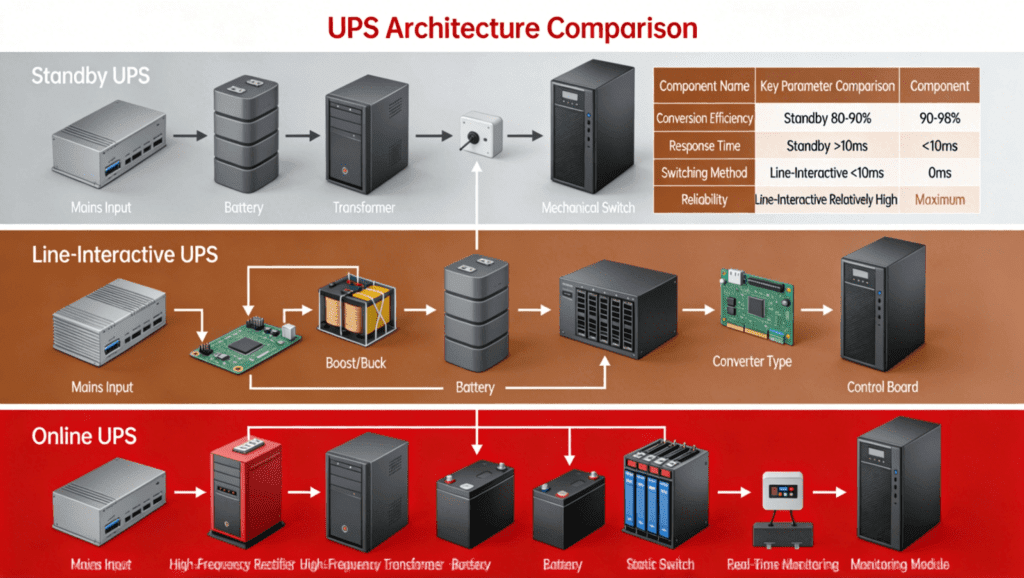
High-frequency UPS systems utilize modern semiconductor technology. IGBT-based rectifiers operate at 20-100kHz switching frequency. These components eliminate bulky power transformers. Units become compact and lightweight. Efficiency reaches 94-96% under optimal conditions.
However, this design sacrifices robustness for efficiency. IGBT modules face direct exposure to grid transients. Surge protection devices provide limited defense. High-frequency transformers lack the thermal mass to absorb energy spikes. Components operate near thermal limits continuously. Failure rates increase exponentially in harsh environments.
The topology lacks electrical isolation between input and output. Neutral-to-line isolation requires separate transformers. Grid-borne disturbances propagate directly to protected loads. Common-mode noise affects sensitive IT equipment. Grounding issues create safety hazards.
2.Industrial Frequency UPS Advantages
Fonte de alimentação ininterrupta industrial systems employ traditional transformer-based designs. Power frequency transformers operate at line frequency (50/60Hz). These iron-core devices provide inherent benefits.
First, isolation transformers create true galvanic separation. Grid disturbances remain on the input side. Output power remains clean and stable. Surge energy dissipates in transformer windings rather than semiconductor junctions. Equipment receives comprehensive protection.
Second, magnetic components tolerate extreme overloads. Industrial frequency transformers handle 300-500% surge currents momentarily. This capacity absorbs voltage spikes without damage. IGBT devices in high-frequency units fail instantly under similar stress.
Third, wide voltage input ranges reduce battery dependency. UPS para data center unstable grid models accept ±25% input variance. Batteries activate only during genuine outages. Battery cycle count remains low. Service life extends to 10-15 years rather than 2-3 years.
Ⅳ. Technical Specifications for Unstable Grid Environments
1.Input Voltage Range Requirements
Standard UPS systems specify ±15% input voltage tolerance. This proves inadequate for emerging market installations. Fonte de alimentação ininterrupta industrial units offer ±25% or even ±30% ranges.
Consider a 400V nominal three-phase system. The UPS accepts 300-520V continuously. Voltage regulators compensate for extreme conditions. Output voltage remains stable at 400V ±1%. Servers receive perfectly conditioned power despite grid chaos.
This wide range eliminates frequent switching to battery mode. The UPS operates in line-interactive mode during most disturbances. Batteries reserve capacity for true power failures. Battery lifespan increases dramatically. Maintenance costs decrease proportionally.
2.Overload and Surge Capacity
Data centers present dynamic load profiles. Server startups create inrush currents. Cooling compressors cycle on and off. These variations demand UPS flexibility.
High-frequency UPS systems specify 125% overload for 10 minutes. Industrial frequency units provide 150% for 60 seconds. This capacity accommodates aggressive load profiles. The UPS never transfers to bypass unexpectedly.
Surge current ratings show even greater differences. Industrial transformers absorb 10-20x nominal current momentarily. This capability protects against lightning-induced transients. High-frequency electronics fail under such stress.
3.Environmental Tolerance
Emerging market data centers often lack climate control. Ambient temperatures reach 45°C or higher. Dust and humidity challenge equipment reliability.
Fonte de alimentação ininterrupta industrial systems withstand these conditions. Large transformer heat sinks dissipate thermal energy effectively. Conservative component ratings maintain reliability at temperature extremes. Conformal coated circuit boards resist humidity and contaminants.
High-frequency UPS units require climate-controlled environments. Small enclosures limit thermal capacity. High-density electronics overheat quickly. Fans ingest dust, causing clogging and failure.
Ⅴ. Economic Analysis: Total Cost of Ownership
Purchase price represents only partial system cost. Data center operators must evaluate total ownership expenses over 10-15 year lifespans.
High-frequency UPS units cost 30-50% less initially. However, these savings evaporate quickly in unstable grids. Annual failure rates reach 20-30%. Replacement parts and labor accumulate rapidly. Downtime costs dwarf equipment expenses. Battery replacement occurs every 2-3 years. Total costs exceed industrial frequency alternatives within five years.
Data center UPS unstable grid solutions require higher initial investment. Industrial frequency units cost more due to copper and iron content. Transformers add substantial weight and material expense. However, operational economics favor this approach.
Failure rates drop below 3% annually. Equipment operates reliably for 15-20 years. Batteries last 8-10 years with proper management. Downtime incidents become rare exceptions. Total ownership costs prove 40-60% lower over system lifetime.
Consider a 100kVA installation example. High-frequency UPS purchase price: $15,000. Industrial frequency equivalent: $25,000. Over 10 years, the high-frequency system incurs $45,000 in maintenance and downtime. The industrial frequency system costs $12,000. Net savings exceed $23,000 despite higher purchase price.
Ⅵ. BKPOWER Industrial Frequency Solutions
BKPOWER engineers designed specialized Fonte de alimentação ininterrupta industrial systems for harsh environments. Our industrial frequency UPS line addresses emerging market challenges specifically.
1.Extended Range Input (ERI) Technology
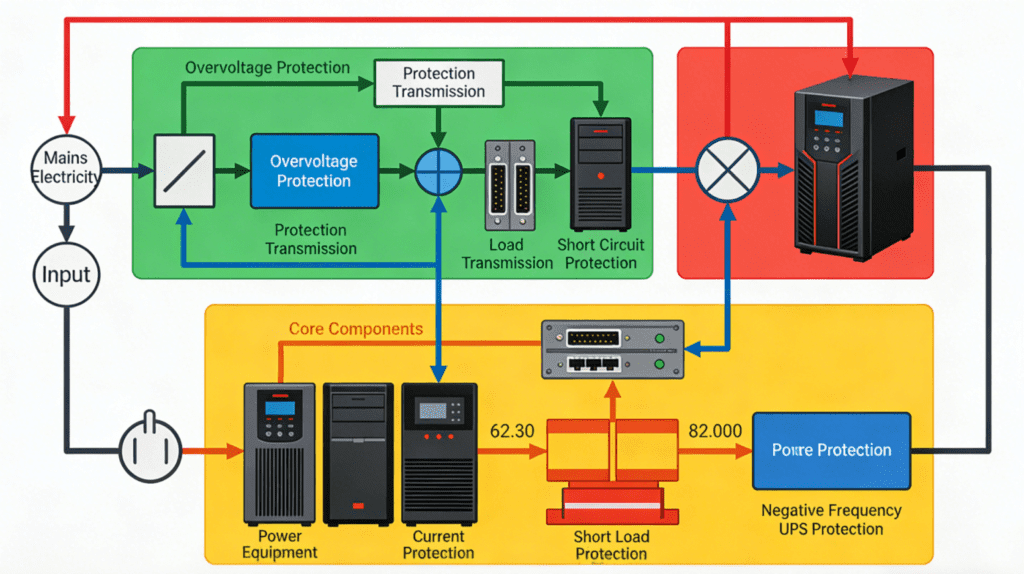
Our rectifier circuits accept ±25% input voltage variance continuously. Digital control systems optimize switching patterns for grid conditions. Output voltage regulation maintains ±1% accuracy regardless of input disturbance. Batteries engage only for severe outages outside normal range.
2.Triple-Defense Protection Architecture
First defense utilizes input isolation transformers. These units clamp surge voltages and filter harmonics. Second defense employs IGBT inverters with 300% surge ratings. Third defense provides output conditioning for sensitive loads. Three-stage protection ensures maximum equipment safety.
3.Smart Battery Management (SBM)
Intelligent charging algorithms adapt to ambient temperature. Monitoramento remoto tracks battery health continuously. Predictive maintenance identifies cell failures before they affect operation. Battery service life extends to maximum theoretical limits.
4.Scalable Modular Design
Power modules from 10kVA to 200kVA combine in parallel configurations. Systems grow with data center expansion. N+1 redundancy configurations eliminate single points of failure. Maintenance occurs without service interruption.
Ⅶ. Implementation Best Practices
Successful deployments require proper system engineering. Site assessment determines actual power quality conditions. Power monitors log voltage and frequency variations over weeks. Analysis reveals true UPS requirements.
Sizing calculations must consider future growth. Data centers expand capacity regularly. UPS systems need 25-30% headroom for additional loads. Transformer tap settings optimize for local voltage levels.
Installation practices affect system reliability. Proper grounding dissipates surge energy. Cable sizing minimizes voltage drop. Ventilation systems maintain ambient temperature within specifications.
Maintenance programs preserve long-term functionality. Quarterly inspections verify connection integrity. Annual testing exercises backup systems. Battery monitoring alerts technicians to developing problems before they cause outages.
Ⅷ. Conclusion: Making the Right Investment Choice
Data center infrastructure decisions impact operational success for decades. Power protection choices prove especially critical in emerging markets. Grid instability challenges conventional approaches. Fonte de alimentação ininterrupta industrial systems provide proven solutions.
High-frequency UPS technology offers efficiency advantages in stable environments. Industrial frequency designs provide the robustness developing regions require. Transformer isolation, wide input ranges, and surge tolerance protect valuable IT assets.
BKPOWER data center UPS unstable grid solutions combine proven technology with modern control systems. Industrial frequency architecture ensures two-decade service life. Digital monitoring provides contemporary convenience. Data centers achieve world-class uptime regardless of local grid quality.
The choice between UPS technologies ultimately balances immediate cost against long-term reliability. For emerging market data centers, industrial frequency Fonte de alimentação ininterrupta industrial systems deliver superior value. Protection of critical infrastructure justifies thoughtful investment in robust equipment.
Referências
- Comissão Eletrotécnica Internacional (IEC)Site oficial: www.iec.ch
- Underwriters Laboratories (UL)Site oficial: www.ul.com
- Comitê Europeu de Padronização (CEN)Site oficial: www.cen.eu
- Administração de Padronização da China (SAC) Site oficial: www.sac.gov.cn
- Zhongguancun Energy Storage Industry Technology Alliance (CNESA)Site oficial: www.cnESA.org
- Site oficial da International Organization for Standardization (ISO): www.iso.org