Chào mừng đến với BKPOWER!












Smart Monitoring for Industrial UPS Systems
TIPS:Modern Bộ lưu điện công nghiệp trực tuyến systems demand intelligent remote UPS monitoring capabilities to ensure continuous power protection across distributed facilities. This comprehensive guide examines how Bộ lưu điện công nghiệp trực tuyến infrastructure leverages remote UPS monitoring through SNMP, Modbus protocols, and cloud platform integration. We explore multi-layered communication architectures, real-time data analytics, and proactive maintenance strategies that transform traditional battery backup systems into smart, connected power management solutions for Industry 4.0 environments.
Ⅰ. Introduction to Remote Monitoring in Industrial UPS
Power infrastructure has evolved beyond simple backup devices. Modern facilities require intelligent oversight of every critical component. Giám sát từ xa transforms UPS systems from passive hardware into active participants in facility management.
Traditional maintenance models relied on scheduled physical inspections. Technicians visited sites quarterly or monthly. This approach created blind spots between visits. Failures could develop unnoticed until the next inspection cycle.
Remote monitoring eliminates these gaps. Continuous data collection provides real-time visibility. Operators detect anomalies immediately. Predictive algorithms identify degradation trends before failures occur.
Online industrial UPS systems particularly benefit from advanced monitoring. These units protect mission-critical loads in manufacturing, data centers, and healthcare. Any downtime carries significant financial or safety implications. Remote oversight ensures these systems maintain optimal readiness 24/7.
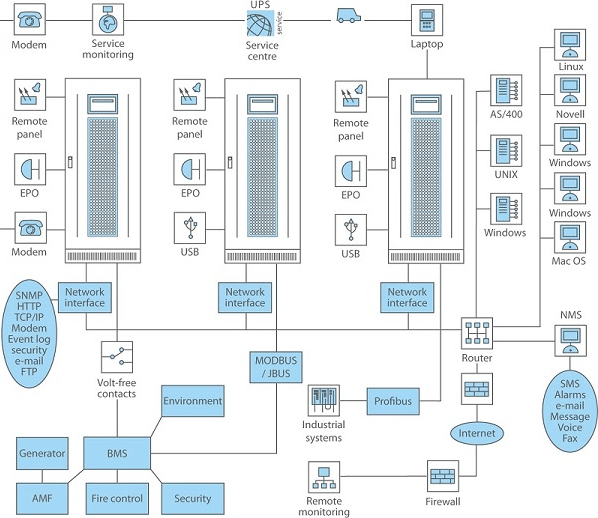
The convergence of Information Technology (IT) and Operational Technology (OT) drives monitoring sophistication. Modern UPS units bridge both worlds. They communicate using industrial protocols like Modbus and IT standards like SNMP. This dual capability enables seamless integration with existing facility management systems.
Ⅱ. Communication Protocols and Architecture
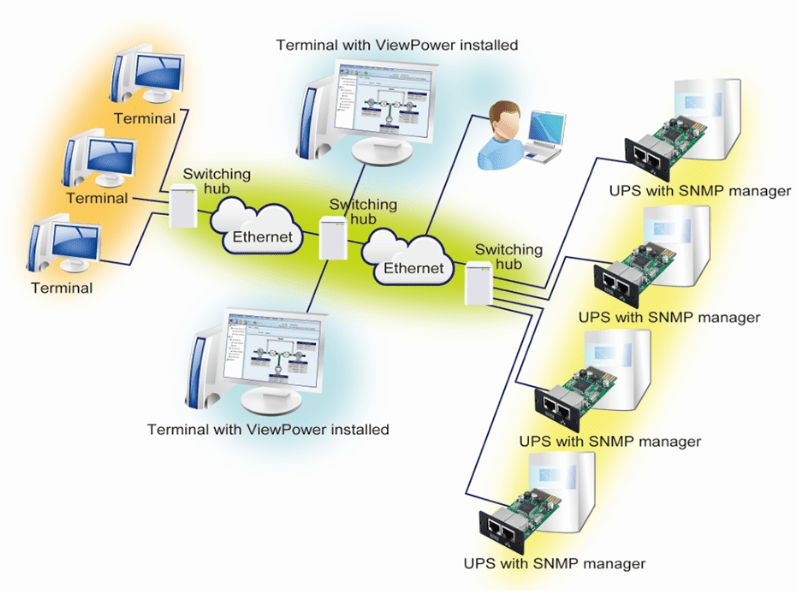
1. SNMP Protocol Implementation Simple Network Management Protocol (SNMP) dominates IT infrastructure monitoring. It provides standardized methods for device communication and status reporting.
UPS systems implementing SNMP act as managed network devices. They operate as agents within the network management architecture. Network Management Systems (NMS) poll these agents for status information. Agents also send unsolicited trap messages when critical events occur.
SNMPv3 offers significant security improvements over earlier versions. It provides authentication, encryption, and access control. These features are essential for industrial environments where cybersecurity threats continue escalating.
Standard Management Information Bases (MIBs) define UPS-specific data points. RFC 1628 specifies the Universal UPS MIB. It standardizes variables for battery status, input/output voltage, load percentage, and alarm conditions. This standardization enables interoperability across different vendors and management platforms.
2. Modbus Protocol Integration Modbus remains the de facto standard for industrial automation. It originated in the programmable logic controller (PLC) environment. Today, it dominates building management systems (BMS) and manufacturing execution systems (MES).
Modbus TCP operates over standard Ethernet networks. It uses client-server architecture. The Modbus client (often a SCADA system) requests data from the UPS (server). The UPS responds with register values containing operational parameters.
Modbus RTU uses serial communications (RS-485). It suits environments where Ethernet infrastructure is limited. Many legacy industrial systems rely on RTU exclusively.
The protocol maps UPS parameters to holding registers. Register addresses correspond to specific measurements. For example, register 40001 might contain input voltage. Register 40002 holds output frequency. Documentation defines these mappings for integration engineers.
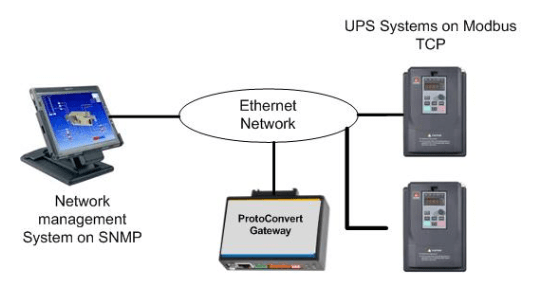
3. Multi-Protocol Architectures Nâng cao Bộ lưu điện công nghiệp trực tuyến systems support simultaneous multi-protocol operation. They expose Modbus registers for facility systems. They simultaneously respond to SNMP queries from IT management platforms.
Gateway devices bridge protocol differences when native support is unavailable. A Modbus-to-SNMP gateway translates between formats. This enables legacy equipment integration without hardware replacement.
Communication cards provide physical connectivity. Options include:
- Ethernet ports for TCP/IP protocols
- Serial ports for RS-232/RS-485
- USB interfaces for local diagnostics
- Dry contact outputs for hardwired alarm systems
Ⅲ. Cloud Platform Connectivity and IoT Integration
1. Cloud Monitoring Architecture Cloud platforms extend visibility beyond facility boundaries. They aggregate data from multiple locations into centralized dashboards. This architecture is ideal for enterprises with distributed operations.
The typical cloud monitoring stack includes:
- Edge devices (UPS units with network connectivity)
- Secure communication channels (often MQTT over TLS)
- Cloud infrastructure ( AWS IoT, Azure IoT Hub, or proprietary platforms)
- Web applications and mobile apps
- Analytics engines for pattern recognition
Data flows continuously from UPS units to cloud storage. Historical trends become available for analysis. Machine learning algorithms process this data. They identify patterns indicating potential failures.
2. Edge Computing Capabilities Modern monitoring extends beyond simple data transmission. Edge computing processes data locally before cloud transmission. This reduces bandwidth requirements. It enables faster local responses.
Intelligent UPS units can:
- Analyze battery impedance locally
- Detect power quality anomalies in real-time
- Trigger automatic load shedding during outages
- Execute predictive maintenance algorithms
Edge processing ensures critical decisions happen immediately. Only aggregated data and alerts travel to the cloud. This hybrid approach balances local responsiveness with centralized visibility.
3. API Integration Ecosystems RESTful APIs enable custom integrations. They allow third-party developers to build applications using UPS data. Common integration targets include:
- Enterprise Asset Management (EAM) systems
- Computerized Maintenance Management Systems (CMMS)
- Building Automation Systems (BAS)
- Data Center Infrastructure Management (DCIM) platforms
APIs support both data retrieval and command issuance. Authorized applications can query status. They can also control UPS behavior remotely. This includes initiating self-tests, adjusting voltage setpoints, or performing graceful shutdowns.
Ⅳ. Monitoring Parameters and Data Analytics
1. Critical Monitoring Metrics Comprehensive remote UPS monitoring tracks multiple parameter categories:
Thông số điện:
- Input voltage, current, and frequency
- Output voltage, current, hệ số công suất, and THD
- Bypass voltage and synchronization status
- Battery voltage, current, and temperature
Operational Status:
- Load percentage and trend
- Battery charge state and runtime estimates
- Inverter and bypass operational modes
- Fan status and thermal conditions
Environmental Data:
- Ambient temperature and humidity (via external sensors)
- Cabinet intrusion detection
- Water leakage sensors for flood-prone areas
2. Predictive Analytics Applications Raw data becomes valuable through analytics. Advanced monitoring platforms offer:
Battery Health Prediction: Algorithms analyze discharge cycles, temperature history, and impedance trends. They predict remaining battery life months in advance. This enables planned replacement before failure.
Capacity Planning: Historical load trending identifies growth patterns. Facilities plan UPS upgrades before reaching capacity limits. This prevents overload conditions during expansion.
Efficiency Optimization: Power usage effectiveness (PUE) calculations incorporate UPS efficiency data. Operators identify opportunities to improve energy consumption. ECO mode switching can be automated based on load conditions.
3. Anomaly Detection Systems Machine learning models establish baseline operational patterns. They flag deviations indicating potential problems:
- Abnormal battery discharge rates suggesting end-of-life
- Input voltage fluctuations indicating utility grid issues
- Increasing internal temperatures predicting fan failures
- Unusual switching patterns revealing control system faults
These systems reduce false alarms. They focus attention on genuine issues requiring intervention.
Ⅴ. Security Considerations for Networked UPS Systems
1. Cybersecurity Threat Landscape Network-connected UPS units present potential attack vectors. Security researchers have demonstrated vulnerabilities in various UPS management interfaces. Threats include:
- Unauthorized configuration changes
- Firmware manipulation
- Denial-of-service attacks affecting power availability
- Lateral movement into broader networks
2. Hardening Best Practices Secure deployment requires layered defenses:
Network Segmentation: Isolate UPS management interfaces on dedicated VLANs. Limit access to authorized management systems only. Implement firewall rules restricting traffic to necessary ports.
Protocol Security:
- Prefer SNMPv3 over SNMPv1/v2c
- Enable encryption and authentication
- Use strong, unique community strings
- Implement certificate-based authentication where available
Access Control: Role-based access limits user capabilities. Administrators configure systems. Operators view status only. Audit logs track all configuration changes.
Firmware Management: Regular security patching protects against known vulnerabilities. Verify firmware authenticity before installation. Maintain backup configurations for rapid restoration.
Ⅵ. Implementation Strategies for BKPOWER Systems
1. Hardware Configuration Options BKPOWER industrial UPS systems support flexible monitoring configurations. Standard RS232/RS485 interfaces provide local connectivity. Optional communication expansion cards enable advanced networking.
The SNMP/JBUS/MODBUS dry contact card offers comprehensive protocol support. Installation is field-upgradeable. Businesses start with basic monitoring. They add capabilities as requirements evolve.
Dry contacts provide basic alarm integration without network complexity. They signal:
- UPS on battery
- Low battery warning
- UPS fault conditions
- Load on bypass
These signals integrate with building alarm panels or PLC discrete inputs.
2. Integration Workflows Successful implementation follows structured methodology:
Phase 1: Network Infrastructure Preparation
- Assign static IP addresses or configure DHCP reservations
- Establish VLANs for industrial control systems
- Verify network connectivity and latency
Phase 2: Device Configuration
- Set SNMP community strings and trap destinations
- Configure Modbus register mappings
- Set threshold values for alarms
- Synchronize time via NTP servers
Phase 3: Management System Integration
- Import MIB files into NMS platforms
- Configure polling intervals and timeouts
- Establish alert escalation procedures
- Test failover notification paths
3. Maintenance and Troubleshooting Remote diagnostics simplify maintenance procedures. Technicians verify UPS health before site visits. This ensures they bring appropriate replacement parts.
Common remote troubleshooting capabilities include:
- Reviewing event logs for fault sequences
- Checking battery test results
- Verifying load transfer operations
- Monitoring thermal performance trends
Firmware updates deploy remotely across the network. This reduces maintenance windows and travel costs.
Ⅶ. Industry Applications and Use Cases
1. Manufacturing Facilities Smart factories rely on continuous power for automation systems. Online industrial UPS units protect PLCs, robotics, and process controllers.
Remote monitoring enables:
- Centralized oversight of multiple production lines
- Integration with Manufacturing Execution Systems (MES)
- Predictive maintenance scheduling during planned downtimes
- Quality data correlation with power events
2. Data Center Operations Colocation facilities manage thousands of UPS units across diverse client environments. Cloud-based monitoring provides unified visibility.
Operators benefit from:
- Multi-tenant dashboard segregation
- Capacity planning across distributed infrastructure
- Automated service level agreement (SLA) compliance reporting
- Energy consumption optimization
3. Critical Infrastructure Power utilities, transportation systems, and emergency services use remote monitoring for regulatory compliance and operational assurance.
Key applications include:
- Substation control system protection
- Traffic management center Nguồn điện dự phòng
- Hospital life support system oversight
- Telecommunications central office monitoring
Ⅷ. Future Trends in UPS Monitoring Technology
1. Digital Twin Technology Digital twins create virtual UPS models mirroring physical units. They simulate behavior under various scenarios. Operators test configuration changes virtually. They predict maintenance needs with greater accuracy.
2. 5G Connectivity 5G networks enable low-latency monitoring of mobile and temporary installations. Construction sites and disaster response operations benefit from rapid deployment without fixed infrastructure.
3. Artificial Intelligence Optimization AI algorithms optimize UPS behavior in real-time. They predict load changes and adjust operating modes. They negotiate with smart grids for demand response participation.
4. Blockchain for Energy Trading Distributed ledger technology enables peer-to-peer energy trading. Ắc quy UPS storage participates in grid stabilization markets. Blockchain records transactions immutably.
Phần kết luậnRemote UPS monitoring transforms power protection from insurance policy to strategic asset. Online industrial UPS systems equipped with SNMP, Modbus, and cloud connectivity provide the visibility required for modern facility management.
Organizations implementing comprehensive monitoring reduce operational costs. They improve system reliability. They extend equipment lifespan through predictive maintenance.
BKPOWER industrial UPS solutions offer the protocol flexibility and communication options required for diverse integration scenarios. As Industry 4.0 advances, intelligent power monitoring becomes not merely advantageous but essential for competitive operations.
Tài liệu tham khảo
- Ủy ban Kỹ thuật Điện Quốc tế (IEC)Trang web chính thức: www.iec.ch
- Underwriters Laboratories (UL)Trang web chính thức: www.ul.com
- Ủy ban Tiêu chuẩn hóa Châu Âu (CEN)Trang web chính thức: www.cen.eu
- Cục Quản lý Tiêu chuẩn hóa Trung Quốc (SAC)Trang web chính thức: www.sac.gov.cn
- Liên minh Công nghệ Công nghiệp Lưu trữ Năng lượng Zhongguancun (CNESA)Trang web chính thức: www.cnESA.org
- Tổ chức Tiêu chuẩn hóa Quốc tế (ISO)Trang web chính thức: www.iso.org