Willkommen bei BKPOWER!












Common Misconceptions About Industrial Frequency UPS
TIPS:Despite persistent myths about industrial UPS suggesting this technology is obsolete, Industriefrequenz USV remains the backbone of critical power protection in 2025. This article debunks common misconceptions including “outdated technology” and “low efficiency equals inferior,” revealing why transformer-based designs continue outperforming alternatives in demanding environments. Understanding the myths about industrial UPS helps procurement professionals make evidence-based decisions rather than relying on marketing hype. Modern Industriefrequenz USV integrates advanced IGBT technology, achieves 20-30 year service life, and provides surge tolerance that high-frequency units cannot match. The reality is that industrial UPS has evolved significantly while maintaining the reliability advantages that made it indispensable for manufacturing, healthcare, and infrastructure applications.
Ⅰ. Introduction: The Myth Problem
The UPS industry suffers from persistent misconceptions. Marketing departments promote simplified narratives. Technical specifications confuse non-experts. Decision-makers struggle to separate fact from fiction.
Industrial frequency UPS faces particular skepticism. High-frequency alternatives dominate marketing materials. Efficiency ratings grab attention. Compact designs impress buyers. In this environment, industrial UPS appears outdated by comparison.
However, appearance deceive. Industrial UPS continues serving critical applications. Manufacturing facilities rely on it. Healthcare systems trust it. Infrastructure operators specify it. The technology has evolved significantly while maintaining core advantages.
This article addresses four damaging myths. We provide technical evidence. We compare real-world performance. We demonstrate why industrial UPS remains essential for demanding applications. Understanding these truths ensures appropriate technology selection.
Ⅱ. Myth 1: “Industrial UPS is Outdated Technology”
1. The Misconception
Many believe industrial frequency UPS represents obsolete technology. The reasoning seems logical. Transformers occupy space. Weight increases. Efficiency lags behind transformerless designs. Therefore, the technology must be old and inferior.
This reasoning contains fundamental errors. It confuses design philosophy with technological advancement. It ignores application context. It prioritizes secondary characteristics over primary requirements.
The myth persists because of marketing. High-frequency UPS manufacturers emphasize efficiency percentages. They highlight compact footprints. They rarely mention reliability trade-offs. Buyers form impressions from incomplete information.
2. The Reality: Modern Industrial UPS Technology
Contemporary industrial UPS bears little resemblance to decades-old designs. Modern systems incorporate:
IGBT power modules: Modern industrial UPS uses sixth-generation IGBT technology. These devices switch efficiently. They handle high currents. They operate reliably under stress. IGBT technology has revolutionized power conversion while retaining transformer benefits.
Advanced control systems: Digital signal processors (DSPs) manage power flow. Adaptive algorithms optimize performance. Real-time monitoring tracks every parameter. Touchscreen interfaces provide intuitive operation. These are not outdated systems.
Communication capabilities: Ethernet, Modbus, and SNMP integration enable remote management. Predictive analytics identify maintenance needs. Integration with building management systems streamlines operations. Modern industrial UPS is thoroughly contemporary.
3. Evolution vs. Obsolescence
Industrial UPS has evolved continuously. The fundamental architecture—transformer-based isolation—remains sound. This architecture provides benefits that modern electronics cannot replicate. The combination of proven topology with modern components creates optimal solutions.
Consider automotive technology. Internal combustion engines continue evolving despite electric alternatives. Hybrid systems combine proven technology with modern efficiency. Industrial UPS follows similar logic. It integrates the best of established and emerging technologies.
The transformer provides galvanic isolation. It buffers against surges. It handles motor loads gracefully. These advantages persist regardless of electronic advances. Modern industrial UPS leverages these benefits while incorporating contemporary control and monitoring.

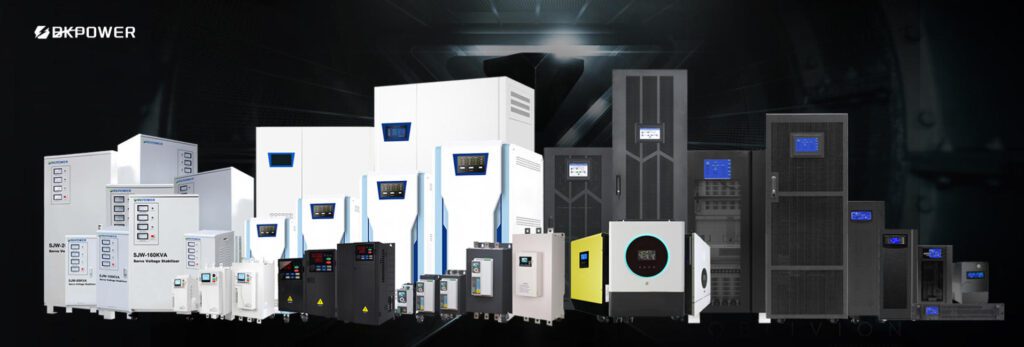
Figure 2: Modern industrial on-line UPS system showing advanced IGBT-based power electronics with intelligent monitoring touchscreen interface, demonstrating contemporary technology integration.
Ⅲ. Myth 2: “Low Efficiency Means Obsolete Technology”
1. The Efficiency Obsession
Efficiency ratings have become dominant selection criteria. Marketing emphasizes percentages. “97% efficient” sounds better than “93% efficient.” Buyers naturally prefer higher numbers.
This focus creates distorted decision-making. Efficiency is important but not paramount. One must consider:
- Application requirements
- Total cost of ownership
- Reliability needs
- Service life expectations
A 4% efficiency difference on a 100 kW load equals 4 kW. At $0.10/kWh, this costs $3,500 annually. Over 20 years, $70,000 in additional energy costs. This seems significant until examining the complete picture.
2. The TCO Reality
Efficiency differences affect operating costs. However, other factors dominate total cost of ownership:
Initial acquisition: Industrial UPS costs $35,000. Standard UPS costs $20,000. Difference: $15,000.
Replacement timeline: Standard UPS requires replacement every 7-10 years. Over 20 years, three units. Total: $60,000. Industrial UPS serves 20 years. Total: $35,000. Savings: $25,000.
Downtime costs: Standard UPS MTBF is 180,000 hours (20 years expectation). Industrial UPS MTBF is 250,000 hours (28 years expectation). With $50,000/hour downtime cost, avoiding one 4-hour outage saves $200,000.
Energy costs: 4% efficiency difference costs $70,000. However, savings exceed this:
- Capital savings: $25,000
- Downtime avoidance: $200,000
- Less maintenance: $10,000
- Net TCO advantage: $165,000
3. Context Determines Priority
Data centers prioritize efficiency. They operate 24/7. Power density is extreme. Cooling costs amplify inefficiency. For these applications, high-frequency UPS makes sense.
Industrial facilities prioritize reliability. Manufacturing downtime costs $10,000-50,000/hour. Process interruptions create safety hazards. Equipment damage from poor power quality exceeds UPS costs. For these applications, industrial UPS Effizienz trade-offs are justified.
Efficiency alone does not determine obsolescence. System design philosophy determines suitability. Industrial UPS trades 3-4% efficiency for 39% higher MTBF and 200-300% overload capability. This trade-off proves optimal for industrial applications.
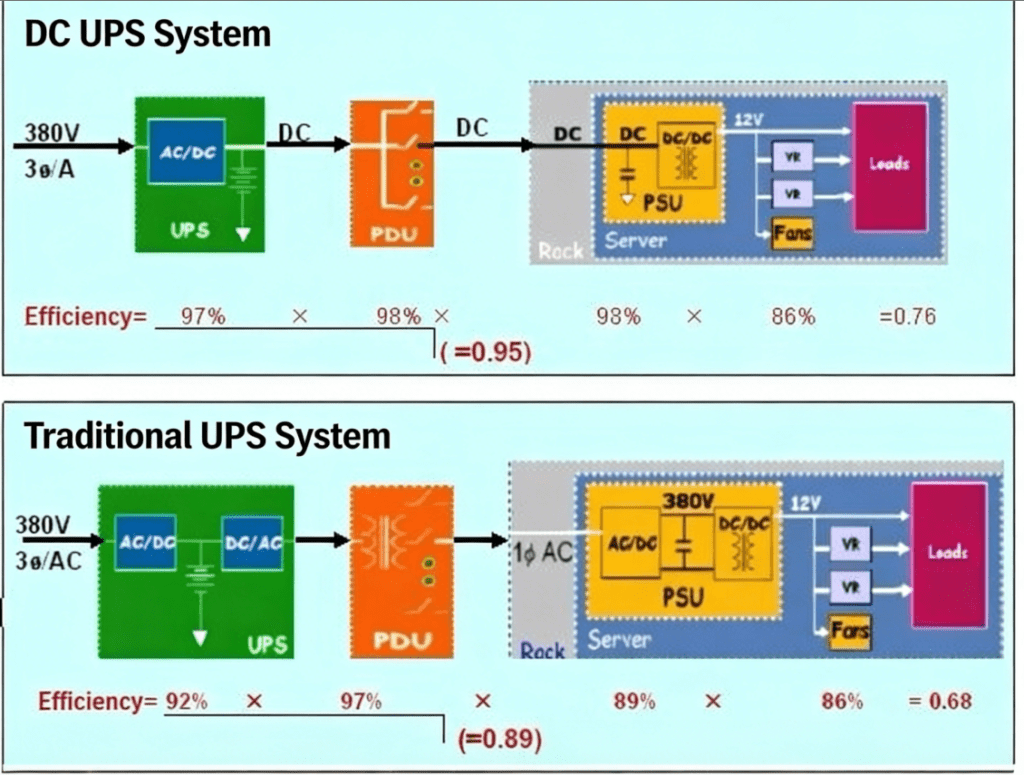
Figure 3: Efficiency comparison showing industrial UPS (92%) vs high-frequency UPS (97%), but TCO analysis reveals industrial UPS saves $165K over 20 years through higher reliability and service life.
Ⅳ. Myth 3: “All UPS Systems Are Equal”
1. The One-Size-Fits-All Fallacy
Some professionals believe UPS technology has converged. They think one UPS design suits all applications. This belief leads to specification errors. It causes deployment failures. It wastes capital investment.
The reality is starkly different. Industrial UPS and commercial UPS serve fundamentally different requirements. Comparing them is like comparing heavy-duty trucks with passenger cars. Both have wheels and engines. Neither substitutes for the other.
Specifications reveal differences:
- Surge capacity: Industrial 300%, Commercial 125%
- Overload rating: Industrial 200% for 10 minutes, Commercial 125% for 60 seconds
- Temperature range: Industrial -10°C to +55°C, Commercial 0°C to +40°C
- Service life: Industrial 20-30 years, Commercial 5-10 years
2. Application Mismatch Consequences
Using commercial UPS in industrial environments causes predictable failures:
Motor starting: Commercial UPS reacts to 6-8× starting current by transferring to bypass. Loads experience unprotected power. Inrush currents damage upstream equipment. Motor loads fail to start reliably.
Environmental stress: Dust infiltrates electronics. Heat degrades capacitors. Vibration loosens connections. Commercial UPS not designed for these conditions fails prematurely.
Power quality: Commercial UPS struggles with harmonics from VFDs. Poor Leistungsfaktor reduces capacity. Voltage regulation suffers under nonlinear loads.
These failures are not UPS defects. They are application mismatches. The wrong technology was specified for the requirements.
3. Industrial-Specific Advantages
Industrial UPS provides capabilities commercial units lack:
Galvanic isolation: Transformer isolation blocks common-mode noise. It prevents ground loops. It protects against inverter faults. This isolation is essential for sensitive industrial controls.
Magnetic buffering: Transformers absorb surge energy. Motor starting currents magnetize cores gradually. Inverters experience reduced stress. This buffering enables reliable motor load operation.
Rugged construction: Heavy steel enclosures resist mechanical damage. Sealing prevents dust ingress. Component mounting withstands vibration. These features suit harsh environments.
The cost of using inappropriate UPS technology far exceeds any initial savings. Downtime, equipment damage, and replacement costs accumulate quickly. Industrial UPS is purpose-built for industrial requirements.

Figure 4: Comparison showing industrial UPS (heavy-duty, surge-rated 300%) vs commercial UPS (office-grade, mild environment), demonstrating fundamental design differences for different applications.
Ⅴ. Myth 4: “UPS Requires No Maintenance”
1. The Set-and-Forget Assumption
Some buyers assume modern UPS operates maintenance-free. They believe capacitors last forever. They think batteries never fail. They ignore thermal degradation. This assumption proves costly.
UPS systems contain consumable components. Capacitors dry out. Batteries chemically degrade. Fans wear out. Connections loosen. Dust accumulates. Without maintenance, these issues cause failures.
The “maintenance-free” myth stems from marketing. Manufacturers emphasize reliability. They highlight long service intervals. They rarely discuss preventive maintenance importance. Buyers infer zero maintenance requirements.
2. The Maintenance Reality
Preventive maintenance extends UPS life by 25-50%. It detects issues before catastrophic failure. It ensures optimal performance. It protects warranty coverage.
Maintenance requirements include:
Battery management: Capacity testing identifies weak cells. Temperature compensation optimizes charging. Equalization prevents sulfation. Proper battery maintenance achieves 10-20 year life versus 3-5 years without care.
Thermal management: Fan inspection prevents failures. Filter cleaning maintains airflow. Heat sink inspection ensures conduction. These steps prevent thermal degradation.
Component inspection: Capacitor testing identifies ESR increases. Connection torque prevents arcing. Semiconductor inspection detects degradation. Early detection enables planned replacement.
3. Accessibility Enables Maintenance
Industrial UPS designs facilitate maintenance. Front-accessible components require no rear clearance. Modular designs allow hot-swappable replacement. Diagnostic systems identify failing components.
These design features reduce maintenance burden. Technicians work safely and efficiently. Service time minimizes. System availability maximizes. Maintenance becomes routine rather than disruptive.
Ignoring maintenance creates false economy. “Saving” $2,000/year on service contracts risks $100,000+ downtime events. Failed batteries damage entire battery strings. Overheating destroys expensive power modules.
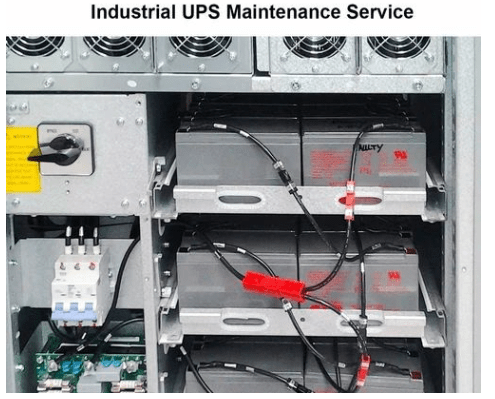
Figure 5: Industrial UPS maintenance service showing battery bank inspection, connection torque verification, and thermal monitoring, demonstrating the importance of preventive maintenance for 20+ year service life.
Ⅵ. Modern Industrial UPS Capabilities
1. Integration with Smart Grids
Industrial UPS has evolved beyond simple backup power. Modern systems integrate with smart electrical grids. They provide frequency regulation services. They enable demand response programs. They participate in virtual power plants.
These capabilities transform UPS from cost center to revenue generator. Grid services provide payments to UPS owners. Energy storage arbitrage reduces electricity costs. Peak shaving lowers demand charges.
Intelligent control systems manage these functions. They predict power requirements. They optimize battery cycling. They balance backup readiness with grid participation. Modern industrial UPS is a sophisticated energy management platform.
2. Fortschrittliche Batterietechnologien
Industrial UPS now accommodates lithium-ion batteries. These batteries offer:
- 3000-5000 cycle life versus 500-800 for lead-acid
- 10-15 year service life versus 3-5 years
- 95-98% round-trip efficiency versus 85-90%
- 50-70% weight reduction
Integration challenges include thermal management and safety systems. However, benefits justify complexity for many applications. Lithium-ion industrial UPS achieves lower total cost of ownership despite higher initial cost.
Battery management systems (BMS) optimize performance. Cell balancing ensures uniform state of charge. Temperature monitoring prevents thermal runaway. Predictive algorithms identify end-of-life approaching.
3. Digital Transformation
Industrial UPS embraces Industry 4.0. Cloud connectivity enables Fernüberwachung. Machine learning predicts maintenance needs. Digital twins simulate performance under various conditions.
These capabilities transform maintenance from reactive to predictive. Technicians receive alerts before failures occur. Service visits target specific components. Downtime windows minimize. System availability approaches 100%.
The industrial UPS of 2025 bears little resemblance to systems from 1995. The architecture remains proven. The implementation becomes sophisticated. The capabilities expand dramatically.
Ⅶ. When to Choose Industrial vs. High-Frequency UPS
1. Industrial UPS Selection Criteria
Select industrial frequency UPS when:
- Load includes motors, compressors, or pumps
- Environment contains dust, vibration, or temperature extremes
- Service life requirement exceeds 15 years
- Downtime costs exceed $10,000/hour
- Surge currents exceed 200% of normal load
- Galvanic isolation is required
Applications include:
- Manufacturing plants with CNC machines
- Petrochemical facilities with explosion-proof requirements
- Water treatment with large motor loads
- Healthcare with life safety systems
- Transportation infrastructure
2. High-Frequency UPS Selection Criteria
Select high-frequency transformerless UPS when:
- Die Ladung besteht hauptsächlich aus IT-Geräten
- Environment is climate-controlled
- Der physische Platz ist stark begrenzt
- Energy efficiency is paramount
- Die Haushaltszwänge sind erheblich
- 5-10 year service life is acceptable
Applications include:
- Data centers with strict PUE requirements
- Office buildings with clean environments
- Telecommunications facilities
- Small commercial loads without motors
3. The Selection Process
Effective selection requires analysis:
- Characterize load types and magnitudes
- Evaluate environmental conditions
- Determine availability requirements
- Calculate total cost of ownership
- Assess growth projections
- Consider maintenance capabilities
BKPOWER provides engineering assessments. We analyze load profiles. We recommend appropriate technologies. We ensure optimal protection for your specific requirements. Contact our technical team for application guidance.
Conclusion: Truth Over Myths
Myths about industrial UPS have persisted too long. The technology is not outdated. Efficiency differences do not determine superiority. Not all UPS are equal. Maintenance is essential.
Modern industrial UPS integrates advanced technology with proven architecture. It provides capabilities that high-frequency alternatives cannot match. It serves applications where reliability trumps efficiency margins.
The evidence is clear. Industrial UPS achieves 250,000-hour MTBF. It handles 300% surge currents. It operates for 20-30 years. It survives harsh environments. These facts contradict the myths.
Decision-makers should evaluate total cost of ownership. They should consider application requirements. They should prioritize reliability for critical operations. They should look beyond marketing claims.
BKPOWER TF Series represents modern industrial UPS excellence. We combine proven transformer-based architecture with contemporary electronics. We provide the reliability that industrial applications demand. We debunk the myths with performance.
Your critical power infrastructure deserves truth, not misconceptions. Contact BKPOWER to learn how modern industrial UPS protects your operations with proven technology enhanced by continuous innovation.
Referenzen
- Internationale Elektrotechnische Kommission (IEC)Offizielle Website: www.iec.ch
- Underwriters Laboratories (UL)Offizielle Website: www.ul.com
- Europäisches Komitee für Normung (CEN)Offizielle Website: www.cen.eu
- Standardization Administration of China (SAC)Offizielle Website: www.sac.gov.cn
- Zhongguancun Energy Storage Industry Technology Alliance (CNESA)Offizielle Website: www.cnESA.org
- Internationale Organisation für Normung (ISO)Offizielle Website: www.iso.org