Willkommen bei BKPOWER!












Einphasige vs. dreiphasige USV: Leitfaden zur Auswahl für den industriellen Einsatz
TIPPS: Die Wahl zwischen einphasigen und dreiphasigen USV-Anlagen entscheidet über die Zuverlässigkeit der Stromversorgung in der Industrie. Erfahren Sie mehr über die Topologien „3/1“ und „3/3“ bei den USV-Systemen mit Netzfrequenz von BKPOWER.
Ⅰ. Die Kosten einer falschen Auswahl: Warum in industriellen Anwendungsszenarien zwischen einphasigen und dreiphasigen USVs unterschieden werden muss

In der industriellen Stromverteilung kann eine falsche Wahl zwischen einphasigen und dreiphasigen USVs zu zwei ganz unterschiedlichen Katastrophen führen. Die eine ist das Prinzip “ein kleines Pferd zieht einen großen Wagen” – der Einsatz von einphasigen UPS Drehstrommotoren mit Gewalt anzutreiben, wodurch der Wechselrichter sofort überlastet und durchbrennt. Der andere Fall ist das Prinzip “großes Pferd zieht kleinen Wagen” – eine Drehstrom-USV, die stark unsymmetrische Einphasenlasten versorgt, was zu einer Überlastung des Neutralleiters und einer Überhitzung des Transformators führt.
Die Ingenieure von BKPOWER stoßen vor Ort häufig auf zwei Probleme: ① Beschaffungsabteilungen kaufen einphasige USVs nach dem Prinzip der “ähnlichen Leistung”, stellen jedoch bei der Lieferung fest, dass die Anlagen der Produktionslinie eine dreiphasige 380-V-Versorgung benötigen und nicht angeschlossen werden können; ② Rechenzentren nutzen dreiphasige USVs zur Versorgung zahlreicher einphasiger Server, doch aufgrund einer ungleichmäßigen Lastverteilung überschreitet der Strom in einer Phase den Nennwert von 120%, was eine Schutzabschaltung der USV auslöst. Die Ursache: Der Unterschied zwischen einphasigen und dreiphasigen USVs liegt nicht lediglich in der “Leistungsgröße”, sondern in grundlegenden Unterschieden. Leistungsformen, topologische Architekturen und Lastkompatibilität.
Ⅱ. Die elektrischen Grundlagen von Einphasen- und Dreiphasen-USVs
1. Leistungsform: Einfache Sinuswelle vs. rotierendes Magnetfeld
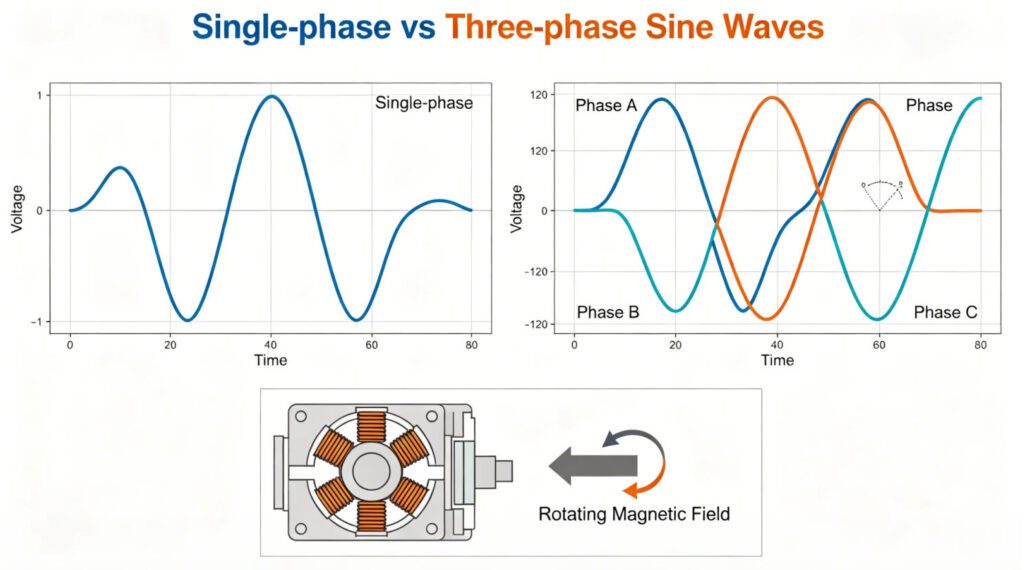
Eine einphasige USV gibt eine einzelne Sinuswelle (L-N, 220 V) aus, geeignet für ohmsche Lasten (Computer, Beleuchtung, Heizungen). Eine dreiphasige USV gibt drei Sinuswellen mit einer Phasenverschiebung von 120° aus (L1-L2-L3, 380 V Netzspannung), deren kombiniertes Magnetfeld ein drehendes Magnetfeld—die physikalische Grundlage für Drehstrom-Asynchronmotoren, große Kompressoren und den Spindelantrieb von CNC-Maschinen.
Wichtigste Schlussfolgerung: Für jede industrielle Last mit Drehstrommotoren muss eine Drehstrom-USV verwendet werden. Einphasen-USVs können keine rotierenden Magnetfelder erzeugen. Der Betrieb von Drehstrommotoren über Einphasen-Wechselrichter führt zu Drehmomentpulsationen, Überhitzung und Wirkungsgradverlusten von mehr als 50%.
2. Wirkungsgrad der Energieübertragung: Warum der Dreiphasenbetrieb der Industriestandard ist
Bei gleicher Leiterquerschnittsfläche übertragen dreiphasige Systeme √3-mal (etwa 1,732-mal) die Leistung von Einphasensystemen, während die Kupferverluste nur um 50% ansteigen. Das bedeutet:
- 10-kW-Last: Einphasig sind 10 mm² Kabel erforderlich; dreiphasig sind nur 4 mm² pro Phase erforderlich
- 100-kW-Industrieanlage: Einphasige USV benötigt 500 A Strom (massive Kabel und Leistungsschalter); dreiphasige USV benötigt nur 152 A pro Phase
- Die Oberschwingungen im Eingangsstrom des Gleichrichters einer dreiphasigen USV lassen sich durch die Mehrpuls-Technologie leichter ausgleichen (12-Puls-Gleichrichtung, THDi < 10%).
Für Geräte in Industriequalität wie das BKPOWER BK-G33 Netzfrequenz-USV, Einphasenstrom ist Standard – bei einer Leistung von 60 kVA würde der Einphasenstrom 273 A betragen, was die Belastungsgrenzen von Standardsteckdosen und Sicherungsautomaten überschreiten würde.
3. Neutralstromfalle: Die Kunst des Ausgleichs bei dreiphasigen USVs mit einphasigen Lasten
Wenn eine dreiphasige USV einphasige Geräte versorgt und die Lastverteilung auf die drei Phasen ungleichmäßig ist, fließt im Neutralleiter (N) ein unsymmetrischer Strom. In schweren Fällen kann der Neutralleiterstrom Werte erreichen von 1.732-facher Phasenstrom, was dazu führte, dass:
- Überhitzung des Neutralleiters (bei der Standardausführung wird für den Neutralleiter 50% der Phasenleiterquerschnittsfläche verwendet, was zu einer starken Überlastung führt)
- Drift des Sternpunkts des Ausgangstransformators, dreiphasige Spannungsasymmetrie
- Erhöhte Oberschwingungen der Ausgangsspannung, die sich auf Präzisionsgeräte auswirken
Dreiphasige USV-Lösungen von BKPOWER: ① Bei einer 3/3-Topologie (dreiphasiger Ausgang) sollten einphasige Lasten gleichmäßig auf alle drei Phasen verteilt werden; ② Bei Szenarien mit überwiegend einphasigen Lasten wird empfohlen, USV mit 3/1-Topologie (Dreiphasen-Eingang, Einphasen-Ausgang), um Probleme mit dem Neutralleiterstrom zu vermeiden.
Ⅲ. 1:3 vs. 3:3 USV: Topologieauswahl für BKPOWER-USV-Anlagen mit Netzfrequenz
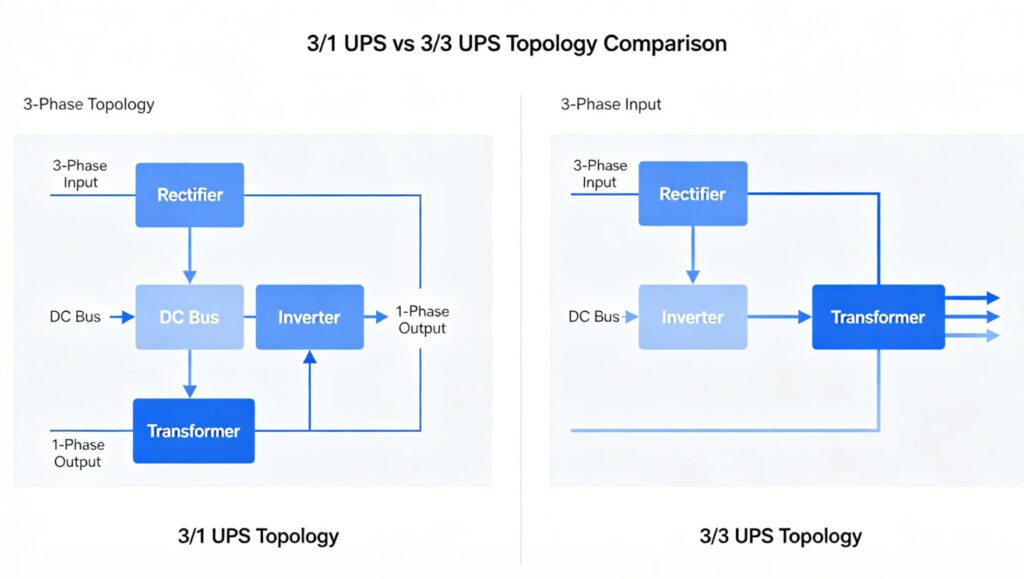
Industrieanwender übersehen häufig einen entscheidenden Aspekt: Die dreiphasige USV selbst ist unterteilt in 3/1 (Dreiphasen-Eingang/Einphasen-Ausgang) und 3/3 (Dreiphasen-Eingang/Dreiphasen-Ausgang) Topologien. Eine falsche Topologieauswahl führt zu ebenso irreversiblen Verlusten.
1. 3/1-USV: Zentraler Schutz mit dreiphasigem Eingang und einphasigem Ausgang
Die 3/1-USV wird an der Vorderseite an das dreiphasige 380-V-Netz angeschlossen, verarbeitet den Strom intern über einen Gleichrichter und einen Wechselrichter und gibt einphasigen 220-V-Strom aus. Zu ihren Vorteilen zählen:
- Löst Probleme mit einphasigen Hochleistungslasten: Wenn die einphasigen Lasten 10 kW überschreiten (Grenzwert für einphasige USVs), bezieht die 3/1-USV Strom aus dem dreiphasigen Netz, wodurch ein übermäßiger einphasiger Strom vermieden wird.
- Symmetrischer Eingangsstrom: Der Dreiphasengleichrichter bezieht Strom gleichmäßig aus drei Leitungen und reduziert so die Oberschwingungsbelastung des Netzes
- Kostenoptimierung: Im Vergleich zum Kauf von drei parallel geschalteten einphasigen USV-Geräten spart eine 3/1-USV Platz und Wartungskosten.
Anwendbare Szenarien: Große einphasige Rechenzentren (Server sind einphasig mit 220 V), einphasige Cluster medizinischer Geräte, zentralisierte Stromversorgung für einphasige Prüfgeräte.
2. 3/3-USV: Der Industriestandard für dreiphasigen Ein- und Ausgang
3/3 Die USV verfügt über einen dreiphasigen Ein- und Ausgang und entspricht damit dem absoluten Standard in industriellen Umgebungen. Die BKPOWER BK-G33 100 kVA Netzfrequenz-USV nutzt diese Topologie mit folgenden Merkmalen:
- Direktantrieb für Drehstrommotoren: Keine Umwandlung erforderlich, liefert direkt dreiphasigen 380-V-Strom zum Antrieb von Motoren, Kompressoren und Pumpenaggregaten
- Integrierter Ausgang Trenntransformator: Der Δ-Y-Transformator der BKPOWER-USV-Serie mit Netzfrequenz sorgt für eine elektrische Trennung zwischen Ein- und Ausgang und unterdrückt gleichzeitig Nullfolgeströme der dritten Harmonischen.
- Einfachere parallele Redundanz: Beim Parallelbetrieb von dreiphasigen USVs ist lediglich eine Phasensynchronisation erforderlich; beim Parallelbetrieb von einphasigen USVs ist zusätzlich eine Synchronisation des Neutralpotentials erforderlich
- Unterstützt unsymmetrische Lasten vom Typ 100%: Die High-End-Modelle von BKPOWER ermöglichen dreiphasige Lastunterschiede von bis zu 100% bei gleichbleibendem Gleichgewicht der Ausgangsspannung
3. Entscheidungsmatrix zur Topologieauswahl
| Lastkennlinien | Empfohlene Topologie | BKPOWER-Modellreferenz | Hauptgrund |
|---|---|---|---|
| Reine Drehstrommotoren/Kompressoren | 3/3 USV | BK-G33 60–400 kVA | Direktantrieb, keine Umrüstung erforderlich |
| Einphasige Hochleistungscluster (>10 kW) | 3/1 USV | BK-G33 Serie 3/1 | Einphasigen Überstrom vermeiden |
| Gemischte Lasten (Dreiphasen- + Einphasen-) | 3/3 USV + einphasige PDU | BK-G33 100 kVA | Dreiphasige Primärversorgung, einphasige Verteilung über PDU |
| Dreiphasen-Unsymmetrie >50% | 3/3-Phasen-Wechselstrom-USV | BK-GH33-Serie | Netzfrequenztransformator mit hoher Unwuchtfestigkeit |
| Rechenzentren (Einphasen-Server) | 3/1 oder 3/3 + Rack-PDUs | BK-G33 100–200 kVA | Auswahl anhand der Verteilungsarchitektur |
Ⅳ. Technische Unterschiede zwischen einphasigen und dreiphasigen USVs mit Netzfrequenz
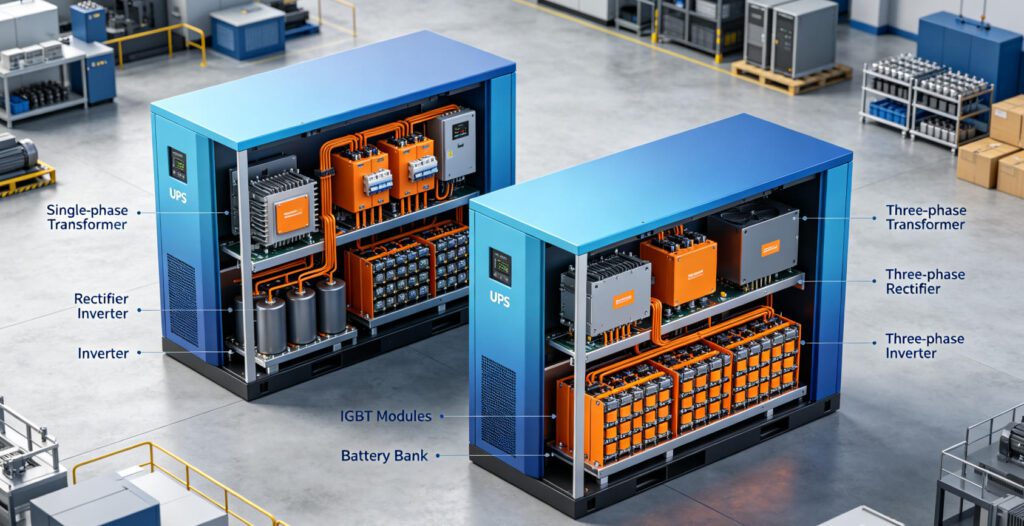
Bei den BKPOWER-USVs mit Netzfrequenz bestehen erhebliche technische Unterschiede in der Umsetzung zwischen einphasigen und dreiphasigen Ausführungen, die sich unmittelbar auf die Zuverlässigkeit im industriellen Einsatz auswirken:
| Technische Dimension | Einphasige USV mit Netzfrequenz | Dreiphasige USV mit Netzfrequenz (BKPOWER BK-G33) |
|---|---|---|
| Gleichrichtertopologie | Einphasige Voll-/Halbbrücken-Gleichrichtung | Dreiphasige 6-Puls-/12-Puls-Gleichrichtung |
| Gleichstrom-Bus-Spannung | 192 V Gleichstrom (16 Zellen) | 384 V Gleichstrom (32 Zellen) oder mehr |
| Aufbau des Wechselrichters | Einphasiger Vollbrücken-Wechselrichter | Dreiphasen-Vollbrücken-Wechselrichter (3 IGBT-Sätze) |
| Ausgangstransformator | Einphasiger Trenntransformator | Dreiphasiger Δ-Y-Trenntransformator |
| Neutrales Fahrverhalten | Direkte N-Line-Ausgabe | Vom Y-Neutralleiter des Transformators abgeleitete N-Leitung, widersteht Unsymmetrie |
| Überlastbarkeit | 125%-150% (modellabhängig) | 150% für 1 Minute (Industriestandard) |
| Parallelfähigkeit | 2–4 Einheiten (Komplex) | 6–8 Einheiten (einfache Phasensynchronisation) |
| Typische Kapazität | 1–20 kVA | 10–400 kVA |
Kernaussage: Der dreiphasige, netzfrequente USV-Isolationstransformator in Δ-Y-Schaltung ist nicht nur ein Spannungswandler – er ist auch ein Nullsequenz-Oberschwingungsfilter. Oberschwingungen dritter Ordnung (3., 9., 15. …) bilden Wirbelströme in der Δ-Wicklung und breiten sich nicht auf die Netzseite aus – eine Netzschutzfunktion, die einphasige USVs nicht bieten können.
Ⅴ. Auswahl von Anwendungsszenarien in der Industrie: Wenn eine dreiphasige USV vorgeschrieben ist
In den folgenden Szenarien ist eine dreiphasige USV nicht “besser”, sondern die “einzige” Wahl:
1. Die Last umfasst Drehstrommotoren (>3 kW)
Industriemotoren ab 3 kW werden durchweg mit einer dreiphasigen 380-V-Versorgung betrieben. Einphasige USVs können diese nicht direkt antreiben. Die Umwandlung über Wechselrichter erhöht die Kosten, die Komplexität und die Anzahl der Ausfallstellen. Das BKPOWER BK-G33 60 kVA kann den Anlauf eines 15-kW-Drehstrommotors direkt bewältigen (unter Berücksichtigung des 5- bis 7-fachen Anlaufstroms).
2. Die Gesamtleistung übersteigt 20 kVA
Einphasige USV-Anlagen stoßen ab 20 kVA an ihre technischen und wirtschaftlichen Grenzen. Eine einphasige USV-Anlage mit 100 kVA nimmt einen Eingangsstrom von 455 A auf und erfordert daher spezielle Hochstrom-Leistungsschalter und -Kabel, während eine dreiphasige USV-Anlage mit 100 kVA nur 152 A pro Phase aufnimmt und dabei mit handelsüblichen industriellen Verteilungskomponenten auskommt.
3. Erforderliche parallele Redundanz (N+1)
Die Technologie für die parallele Redundanz bei dreiphasigen USVs ist ausgereift; sechs parallel geschaltete Geräte erreichen eine 5+1-Redundanz. Beim Parallelbetrieb einphasiger USVs müssen Probleme mit der Neutralleiterspannung gelöst werden; die Zuverlässigkeit ist gering, sodass der Betrieb in der Regel auf vier Geräte beschränkt ist.
4. Dreiphasiger Netzanschluss
In Industrieanlagen wird in der Regel ein dreiphasiger 380-V-Netzanschluss verwendet. Der Zwangseinsatz einer einphasigen USV führt dazu, dass nur eine der drei Phasen beansprucht wird, was zu einer erheblichen dreiphasigen Unsymmetrie im Netz und möglicherweise zu Strafgebühren seitens des Energieversorgers führt. Eine dreiphasige USV gleicht die Leistungsaufnahme auf natürliche Weise aus und entspricht damit den Netzstandards.
Ⅵ. Sinnvolle Anwendungsszenarien für einphasige USVs
Einphasige USV-Anlagen sind keine veraltete Technologie; sie sind in folgenden Fällen nach wie vor die beste Wahl:
- Privat und kleine Büros: Lasten <3 kVA, einphasig, 220 V, Plug-and-Play
- Dezentrale Einphasen-Anlagen: Zum Beispiel Geldautomaten, Sicherheitsüberwachung, einphasige medizinische Geräte (ausgenommen CT)
- Einphasige Spannungsstabilisierung auf der Eingangsseite: In Kombination mit BKPOWER Einphasen-Spannungsstabilisatoren zum Schutz von Präzisionsinstrumenten
- Einphasige Abzweige von einer dreiphasigen USV: Über dreiphasige USV-Verteilerkästen werden einphasige Abzweigstromkreise für den Bürobereich gespeist Reservestrom
Ⅶ. Abstimmung der dreiphasigen BKPOWER-USV mit Stabilisatoren/Transformatoren
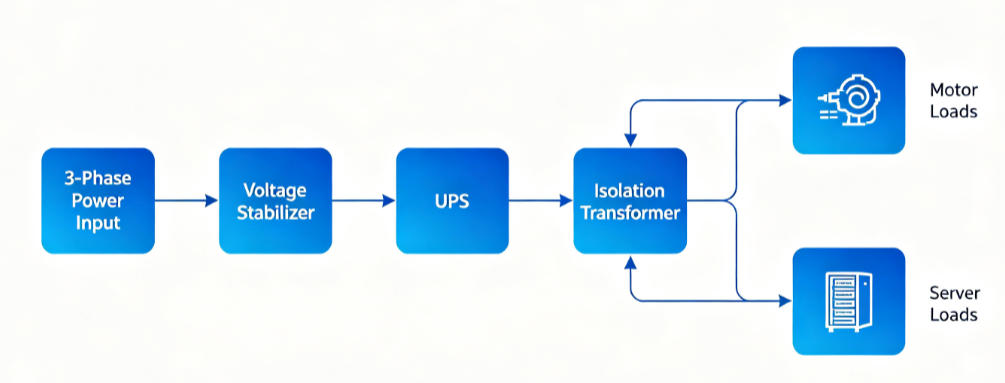
Der Stromschutz in der Industrie ist ein Bereich der Systemtechnik. BKPOWER empfiehlt zwei typische Architekturen:
Architektur A: Dreiphasige Hochleistungs-Industrie-Leitung (3/3-Topologie)
Dreiphasiger Stromanschluss → Dreiphasiger berührungsloser Spannungsregler → BK-G33 100 kVA 3/3 USV → Dreiphasen-Trenntransformator (optional) → Drehstrommotoren/Fertigungslinie
Architektur B: Einphasiges Rechenzentrum (3/1-Topologie)
Dreiphasiger Netzanschluss → Dreiphasiger kontaktloser Anschluss Spannungsregler → BK-G33 100 kVA 3/1 USV → Einphasige Rack-PDUs → Einphasige Server
Beide Architekturen nutzen ein Frontend Stabilisatoren um Spannungsspitzen im Netz abzufangen, wodurch die Entladehäufigkeit der USV-Batterie verringert und die Gesamtlebensdauer des Systems um über 30% verlängert wird.
Quellenangaben
| Quellorganisation | Ressourcentyp | URL |
|---|---|---|
| Internationale Elektrotechnische Kommission (IEC) | Norm für Drehstromsysteme IEC 60038 | https://www.iec.ch |
| IEEE | Industriestandard für die Stromverteilung IEEE 141 | https://www.ieee.org |
| Chinesische Normungsbehörde (SAC) | GB/T 7260 – Nationale Norm für USV-Anlagen | https://www.sac.gov.cn |
| BKPOWER-Produktzentrum | Technische Daten der dreiphasigen USV mit Netzfrequenz | https://bkpowers.com/products/ups-system/ |
| BKPOWER-Technikblog | So funktioniert eine unterbrechungsfreie Stromversorgung | https://bkpowers.com/service/unveiling-the-uninterruptible-power-supply/ |
Empfohlene Artikel
Nachdem Sie diesen Artikel gelesen haben, könnte Sie auch Folgendes interessieren:
- So berechnen Sie die Wattzahl: Leitfaden zur Dimensionierung der Leistung von industriellen USV-Anlagen — Die Leistung und den Strom einer dreiphasigen Last genau berechnen
- So funktioniert eine unterbrechungsfreie Stromversorgung — Doppelwandler, Bypass- und Trenntransformatoren verstehen
- Vorteile industrieller USV-Anlagen und Leitfaden zur Netzfrequenz — Ein detaillierter Einblick in die sieben wesentlichen Vorteile von USV-Anlagen mit Netzfrequenz
- Umrechnung von kWh in Ah bei USV-Batterien und Leitfaden zur Dimensionierung — Konfigurationsmethoden für dreiphasige USV-Batteriebänke
- Produkte für kontaktlose Spannungsregler — Lösungen zum Spannungsschutz auf der Eingangsseite
Produktempfehlung
FAQ
Frage 1: Kann eine dreiphasige USV einphasige Verbraucher versorgen?
Ja, allerdings muss die Lastverteilung berücksichtigt werden. Wenn eine 3/3-USV einphasige Lasten versorgt, sollten die Lasten gleichmäßig auf die drei Phasen verteilt werden, um einen übermäßigen Neutralleiterstrom zu vermeiden. Wenn die einphasigen Lasten 70% überschreiten, sollten Sie eine 3/1-Topologie (dreiphasiger Eingang, einphasiger Ausgang) in Betracht ziehen oder einen Dreiphasen-Ausgleicher hinzufügen. Die BKPOWER BK-G33-Serie unterstützt unsymmetrische Lasten von 100%, doch eine langfristig starke Unsymmetrie beeinträchtigt dennoch die Lebensdauer des Transformators.
Frage 2: Worin bestehen die Unterschiede in der Batteriekonfiguration zwischen einphasigen und dreiphasigen USVs?
Einphasige USVs verwenden in der Regel 192 V DC-Batteriebänke (16 × 12 V in Reihe). Dreiphasige USVs mit Netzfrequenz arbeiten üblicherweise mit 384 V DC (32 Zellen in Reihe) oder einer höheren Spannung. Eine höhere Spannung bedeutet bei gleicher Leistung einen geringeren Strom, wodurch Kabelverluste reduziert werden, jedoch verdoppelt sich die Anzahl der Batterien. Die dreiphasigen USVs von BKPOWER unterstützen Lithium-Batterieoptionen, wodurch die Anzahl der Zellen in 384-V-Systemen reduziert und die Lebensdauer auf über 10 Jahre verlängert wird.
Frage 3: In meinem Werk sind ausschließlich einphasige Geräte installiert. Benötige ich eine dreiphasige USV?
Wenn die Gesamtleistung unter 10 kVA liegt und alle Geräte einphasig sind, reicht eine einphasige USV aus. Übersteigt die Gesamtleistung jedoch 20 kVA, sollten Sie – selbst bei einphasigen Lasten – eine 3/1-USV (dreiphasiger Eingang, einphasiger Ausgang) in Betracht ziehen. Gründe: ① Einphasige USVs über 20 kVA ziehen einen zu hohen Strom (>90 A) und erschweren dadurch die Stromverteilung; ② Eine 3/1-USV bezieht den Strom gleichmäßig aus allen drei Phasen und verhindert so eine dreiphasige Unsymmetrie im Netz; ③ Der Parallelbetrieb von einphasigen USVs mit hoher Leistung ist schwierig; der Parallelbetrieb von 3/1-USVs ist zuverlässiger.
Frage 4: Gibt es einen Unterschied bei der Bypass-Umschaltung zwischen 3/3- und 3/1-USVs?
Ja. Der 3/3-USV-Bypass wird direkt an das dreiphasige Netz angeschlossen; für die Umschaltung ist lediglich eine Synchronisation der drei Phasen erforderlich. Der 3/1-USV-Bypass verfügt zwar über einen dreiphasigen Eingang, liefert jedoch einphasigen Ausgang, was die Umschaltlogik komplexer macht – der einphasige Ausgang des Wechselrichters muss mit der für den Bypass verwendeten Netzphase synchronisiert werden. Die netzfrequenten USV-Anlagen von BKPOWER nutzen digitale DSP-Phasenverriegelungstechnologie, um eine nahtlose Umschaltung in weniger als 4 ms zu erreichen; beide Topologien werden unterstützt.
Frage 5: Ist die parallele Redundanz bei dreiphasigen USVs einfacher als bei einphasigen USVs?
Ja. Für den Parallelbetrieb von dreiphasigen USVs müssen lediglich die Phasen und die Frequenz synchronisiert werden; die Neutralleiter werden automatisch über die Y-Neutralpunkte der Transformatoren verbunden. Beim Parallelbetrieb von einphasigen USVs müssen zusätzlich Probleme mit der Neutralleiterspannung gelöst werden (jede USV kann unterschiedliche Neutralreferenzpotenziale aufweisen), wodurch der Parallelbetrieb in der Regel auf vier Geräte begrenzt ist. Die dreiphasigen USVs von BKPOWER unterstützen den Parallelbetrieb von 6 bis 8 Geräten, wodurch sich N+1- oder N+N-Redundanzarchitekturen problemlos realisieren lassen.