Bienvenido a BKPOWER












How Industrial UPS Systems Work
TIPS:Power instability is not a question of if. It is a question of when. Voltage sags, sudden blackouts, and harmonic distortion cost businesses billions annually. A single outage in a manufacturing plant can halt production for hours. In a hospital, it can risk patient safety. In a data center, it can breach SLA commitments worth thousands of dollars per minute. An industrial UPS sistema solves this by providing immediate, clean backup power the moment grid quality degrades. But not all UPS systems are built the same. Understanding how an uninterruptible power supply works is the first step toward specifying the right unit. This guide walks you through the essential concepts, types, calculations, and real-world applications. You will learn to size and source the right sistema UPS industrial with confidence. We explain how an uninterruptible power supply works from the rectifier to the inverter.
Ⅰ. What Is an Industrial UPS System?
1.The Engineering Definition
A UPS system is an electrical apparatus. It delivers emergency power to connected loads when the primary power source fails. It sits between the utility grid and your equipment. It continuously monitors input quality. It switches to battery-derived AC power within milliseconds when anomalies are detected.
Key components include the rectifier, battery bank, inverter, static bypass switch, and automatic regulador de tensión. The rectifier converts incoming AC to DC. The battery bank stores DC energy for backup runtime. The inverter converts DC back to clean AC power for the load. The static bypass switch transfers load to utility power during maintenance. The automatic voltage regulator corrects minor voltage fluctuations without draining the battery.
2.Why Standard UPS Falls Short in Industrial Settings
Consumer-grade UPS units are built for home offices. They cannot survive factory floors. Industrial UPS systems use ruggedized enclosures. They tolerate wide temperature ranges. They resist dust, moisture, and vibration. Their mean time between failures exceeds 100,000 hours. Standard units fail in these conditions.
Industrial environments demand IP-rated enclosures. They need conformal-coated PCBs. They require fanless or redundant cooling designs. A desktop UPS rated for 0 to 40 degrees Celsius will shut down in a steel mill. An industrial UPS rated for minus 10 to 55 degrees Celsius keeps running.
Ⅱ. How an Uninterruptible Power Supply Works: The Power Flow

1.Normal Mode: AC-DC-AC Double Conversion
In an online double-conversion UPS, incoming AC power flows into the rectifier. The rectifier converts AC to DC. This DC power charges the battery bank. It also feeds the inverter. The inverter reconstructs clean AC power. The load always receives conditioned power. It never connects directly to the raw grid.
This design eliminates power fluctuations. It filters electrical noise. It ensures stable power supply under all conditions. The servers are never directly connected to raw utility power. They always receive conditioned power from the UPS.
2.Battery Mode: Seamless Transfer
When the grid fails, the rectifier stops receiving input. The battery bank instantly supplies DC power to the inverter. The inverter continues delivering AC power to the load. There is zero transfer time. The load never senses the interruption. This is the core of how an uninterruptible power supply works.
The battery autonomy time depends on device power consumption and capacidad de la batería. When mains voltage returns to normal, the rectifier resumes operation. The system returns to normal mode. The battery recharges through the rectifier.
3.Bypass Mode: Maintenance Without Downtime
If the UPS needs service, the static bypass switch transfers the load directly to utility power. This allows technicians to perform maintenance. The load stays energized. When service is complete, the switch returns the load to the UPS.
The static bypass uses silicon-controlled rectifiers (SCRs). It switches in nanoseconds. The maintenance bypass is a mechanical switch. It allows complete UPS isolation for repair. Both modes ensure power continuity regardless of UPS condition.
Ⅲ. Industrial UPS Topologies Compared

1.Standby UPS
The load runs directly on utility power. When the UPS detects a blackout, it switches the load to battery power. Transfer time is 4 to 10 milliseconds. This is acceptable for desktop PCs. It is not suitable for industrial PLCs or medical devices.
Standby UPS units offer the lowest cost entry point. They provide basic surge protection. They output modified sine waves on most models. These are suitable for non-critical loads. Home offices and retail POS systems use them.
2.Line-Interactive UPS
La carga funciona normalmente con energía acondicionada de la red pública. Una toma múltiple autotransformador corrects voltage sags and surges without switching to battery. During a blackout, the inverter activates. This topology offers faster response than standby units. It extends battery life. It suits small-to-medium business servers. Network closets and telecom equipment use it.
Line-interactive units handle routine voltage fluctuations. They are ideal where voltage swings are frequent but blackouts are rare. Learn more about voltage stabilization solutions.
3.Online Double-Conversion UPS
Incoming AC is continuously converted to DC. Then it is reconstructed to AC. The load is always powered by the inverter. There is zero transfer time. This topology isolates the load from all grid anomalies. It provides true sine wave output. Voltage regulation stays within plus or minus 1 percent. Efficiency reaches 93 to 97 percent. Newer designs reach 98 percent at partial load.
This is the standard for data centers. Medical imaging and semiconductor manufacturing require it. Any environment where downtime costs thousands per minute needs this topology. Explore BKPOWER’s online double-conversion UPS series.
4.Modular UPS for Industry 4.0
SAI modular systems use rack-mount power and battery modules. You can add or hot-swap modules without shutting down the critical load. The global modular UPS market is forecast to reach USD 8.9 billion by 2030. This growth is driven by data center demand. Scalable pay-as-you-grow architectures are essential.
Data center loads grow 15 to 20 percent annually. A monolithic 20 kVA UPS cannot expand without replacement. Modular systems let you add 5 to 10 kVA power modules as needed. Read about 2026 data center power trends.
Ⅳ. Core Components Deep Dive

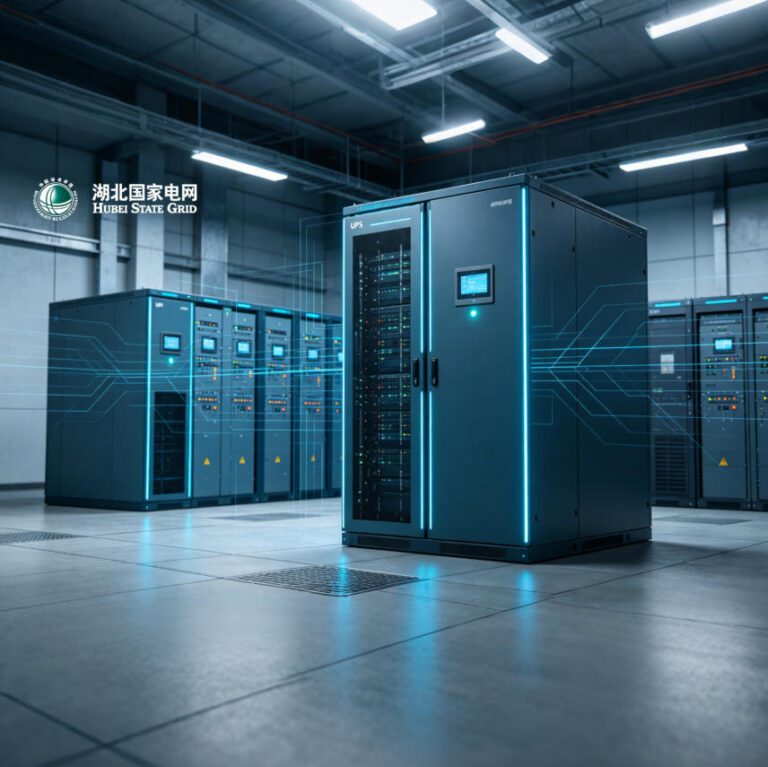
【Insert Image 3 here】
1.IGBT Rectifier and Inverter
Modern industrial UPS systems use insulated-gate bipolar transistor (IGBT) technology. IGBTs handle large power ratings with low losses. They enable fast switching. This reduces harmonic distortion. It improves efficiency to 93 to 97 percent.
Three-level IGBT technology further reduces switching losses. New multi-mode technologies use precision disturbance analyzers. They achieve seamless switching between main power and UPS conditioned power.
2.Battery Chemistry: VRLA vs. LiFePO₄
VRLA lead-acid batteries last 3 to 5 years. They tolerate 50 percent depth of discharge. They weigh more. They charge in 6 to 12 hours. Lithium-ion LiFePO₄ batteries last 8 to 15 years. They tolerate 80 to 90 percent depth of discharge. They charge in 1 to 3 hours. They are 50 to 70 percent lighter. Their energy density is 150 to 200 Wh per kg versus 30 to 50 for VRLA.
In 2024, lithium-ion captured 44.1 percent revenue share of the Batería del SAI market. For new installations with a 10-year horizon, lithium-ion is the default choice.
3.Static Bypass and Maintenance Bypass
The static bypass switch is an automatic transfer switch. It performs as a fail-safe measure. If a UPS internal fault occurs, the switch transfers the load to mains. It circumvents the rectifier, batteries, and inverter. This ensures power continuity during repair.
Static bypass switches are known as safe failure to mains. When operating on bypass, input and output supply is not filtered. This is typical with online double-conversion UPS systems. External mechanical bypass switches are also available. They are commonly used with line-interactive and offline UPS systems.
Ⅴ. Sizing an Industrial UPS: The Engineer’s Formula

1.Load Calculation in Watts
List every device the UPS will protect. Sum the wattage of all connected loads. If only amperage is listed, use Watts equals Volts times Amps times Factor de potencia. For IT equipment, assume a power factor of 0.9 to 0.99. For industrial motor loads, power factor may be 0.7 to 0.8.
Example: two servers at 450W each equal 900W. One network switch at 150W equals 150W. One storage array at 300W equals 300W. Total equals 1350W.
2.kVA Conversion with Power Factor
UPS ratings are expressed in volt-amperes. To convert, use kVA equals Watts divided by 1000 times Power Factor. With a 0.9 PF, 1350W equals 1.5 kVA. Add 20 to 30 percent headroom for future expansion. Recommended UPS size equals 1.5 kVA times 1.25. This rounds up to 2 kVA.
Industry best practice is to add 25 percent headroom. This accounts for peak loads and future growth. Undersizing leaves critical loads exposed. Oversizing wastes capital and reduces efficiency.
3.Runtime and Battery Sizing
Runtime depends on battery capacity and load. Use Runtime equals Battery Capacity in Wh times Depth of Discharge times Inverter Efficiency divided by Load in W. For lead-acid batteries, depth of discharge should not exceed 50 percent. Lithium-ion batteries tolerate 80 to 90 percent depth of discharge.
Example: a 2 kVA UPS with 48V, 100Ah battery bank has total energy of 4800 Wh. With a 1350W load, 50 percent DoD, and 92 percent inverter efficiency, runtime equals 1.63 hours. That is approximately 98 minutes. For extended runtime, add external battery modules. Specify higher Ah capacity at procurement.
4.Match Input/Output Voltage and Phase
Single-phase power covers 110V, 120V, 220V, 230V, and 240V. It is typical for loads up to 20 kVA. Three-phase power covers 208V, 380V, 400V, and 480V. It is standard for industrial loads above 10 kVA. Verify that the UPS input voltage range accommodates your local grid tolerance.
In regions with severe voltage swings, install a servo voltage estabilizador upstream. BKPOWER offers SJW, SBW, ZBW, and AVR series stabilizers for this purpose.
Ⅵ. Industry Applications and 2026 Trends

1.AI Data Centers and High-Density Racks
Data centers require 99.999 percent uptime. A single outage can violate SLAs costing up to USD 10,000 per minute. Online double-conversion UPS systems are mandatory. They deploy in N+1 or 2N redundant configurations. AI workloads push rack densities beyond 30 kW. Lithium-ion UPS systems are replacing VRLA batteries. They offer 3 times energy density. Their lifespan reaches 8 to 10 years. This reduces floor space and cooling load.
2.CNC Manufacturing and Robotics
CNC machines and robotic welding lines are sensitive to voltage dips. A 200 ms sag can reset a PLC program. It can scrap an entire production batch. Industrial UPS systems in the 10 to 200 kVA range provide ride-through time. This allows orderly shutdowns or generator sequencing.
Manufacturing plants in developing regions face severe grid instability. They need online double-conversion UPS with wide input voltage windows. See BKPOWER’s industrial manufacturing solutions.
3.Healthcare and Medical Imaging
MRI scanners and surgical robots cannot tolerate interruptions. Patient monitors require continuous power. Medical-grade UPS systems must comply with IEC 60601-1 safety standards. They provide galvanic isolation. Online double-conversion topology is standard in hospital central UPS installations. Operating theaters use isolated power systems. They prevent microshock hazards.
4.Telecom 5G and Edge Computing
5G radio heads consume 3 to 4 times more power than 4G equipment. Telecom shelters in remote locations rely on ruggedized UPS systems. They need wide temperature tolerance. Lithium-ion batteries require no maintenance access for years. Edge computing nodes are deployed in harsh environments. They need industrial-grade UPS with IP65 enclosures and natural convection cooling.
5.Solar and Renewable Energy Integration
Hybrid solar inverters with built-in UPS functionality are gaining traction. During daylight hours, solar arrays charge batteries and power the load. At night or during outages, the battery inverter seamlessly takes over. This reduces reliance on diesel generators. It aligns with corporate ESG targets.
BKPOWER provides inversor solar solutions that integrate with UPS systems for off-grid and backup applications. Explore BKPOWER transformer products for solar integration.
Ⅶ. Procurement Guide: Factory Direct vs. Distributor
1.Customization and OEM/ODM
Factory-direct manufacturers offer full voltage, capacity, and firmware customization. Trading companies limit you to catalog SKUs. BKPOWER operates as a factory-direct manufacturer. It has in-house R&D, SMT lines, and automated test rigs. This enables custom OEM and ODM projects. Private-label branding is available. Custom enclosures and firmware tailored to regional grid standards are offered.
2.Certification and Export Compliance
Verify CE, and ISO 9001 documentation. Factory-direct suppliers provide full traceability. Trading companies often offer opaque certification chains. BKPOWER holds global certifications. These include CE, ISO 9001, and IEC 62040 compliance. They enable unrestricted export to 100-plus countries.
3.TCO Over 10 Years
Calculate total cost of ownership. Include energy losses, battery replacements, and downtime risk. Lithium-ion batteries reduce TCO despite higher upfront cost. Modular UPS systems preserve capital through pay-as-you-grow expansion. A trading company marks up prices 15 to 40 percent. Factory-direct pricing eliminates this margin.
BKPOWER offers FOB, CIF, and DDP Incoterms. It has experience in 50-plus countries. Contact BKPOWER for factory-direct pricing.
4.Remote Monitoring and Predictive Maintenance
Modern UPS systems offer SNMP, Modbus, and cloud-based monitoring. Without remote visibility, you discover battery failures only during an actual outage. Ensure your UPS supports predictive maintenance alerts. It should integrate with your DCIM or BMS platform.
BKPOWER UPS systems include intelligent monitoring cards. They provide real-time status, alarm notifications, and historical data logging.
Ⅷ. Conclusión
Power quality is foundational to operational resilience. The right industrial UPS system is not an expense. It is insurance against catastrophic downtime. Match topology to criticality. Online double-conversion provides zero downtime. Line-interactive suits cost-sensitive applications.
Size with headroom. Calculate load in watts. Convert to kVA with power factor. Then add 25 percent for growth. Think lifecycle. Lithium-ion batteries reduce TCO. Buy direct. Factory-direct procurement ensures customization. It provides traceability and responsive support.
Más información sobre soluciones energéticas profesionales en BKPOWER. Our application engineers review your load profile. They analyze runtime requirements. They inspect your installation environment. This ensures you specify the right industrial uninterruptible power supply the first time.
Reference Sources
| # | Source | URL | Authority |
|---|---|---|---|
| 1 | EMSD Hong Kong – General Technical Specification for Uninterruptible Power Supply | https://www.emsd.gov.hk/filemanager/en/content_206/esg15.pdf | Government Technical Standard |
| 2 | Business Research Insights – UPS Market Size & Share Report 2026 | https://www.businessresearchinsights.com/zh/market-reports/uninterrupted-power-system-ups-market-112260 | Market Research |
| 3 | MEP Academy – How SAI para centros de datos Systems Work | https://mepacademy.com/data-center-ups-systems/ | Technical Education |
| 4 | BKPOWER – Voltage Stabilizer Solution for Data Center | https://bkpowers.com/solution/voltage-stabilizer-solution-for-data-center/ | Manufacturer Solution |
| 5 | BKPOWER – 2026 Data Center Power Trends | https://bkpowers.com/industry-news/data-center-world-2026/ | Noticias del sector |
PREGUNTAS FRECUENTES
¿Qué tamaño de SAI necesito para mi sala de servidores?
Calculate total wattage of all servers, switches, and storage devices. Convert to kVA using a 0.9 power factor. Then add 25 percent headroom. A small server room with 2000W of load requires approximately 2.8 kVA. For mission-critical environments, deploy N+1 redundancy.
¿Cuánto tiempo funciona un SAI sin alimentación?
Runtime depends on battery capacity and load. A standard 1 kVA UPS provides 5 to 15 minutes at full load. Extended battery modules can increase this to several hours. Use the formula: Runtime equals Battery Wh times DoD times Efficiency divided by Load W.
¿Cuál es la diferencia entre un SAI y un estabilizador de tensión?
A UPS system provides backup power during outages and regulates voltage. A voltage stabilizer only regulates voltage. It cannot power your equipment during a blackout. In unstable grids, use both. Install the stabilizer upstream. Install the UPS downstream.
¿Puedo utilizar un SAI con un inversor solar?
Yes. Hybrid solar inverters with built-in UPS functionality are common. The UPS ensures seamless transition when solar generation drops or the grid fails. Ensure voltage and frequency windows are compatible between units. BKPOWER offers integrated solar and UPS solutions.
¿Con qué frecuencia deben sustituirse las baterías del SAI?
VRLA batteries typically last 3 to 5 years. Lithium-ion batteries last 8 to 15 years. High ambient temperature above 30 degrees Celsius shortens lifespan. Deep discharges also reduce life. Schedule annual impedance testing. This detects weak cells early.