Bienvenido a BKPOWER












SAI monofásicos frente a trifásicos: guía de selección industrial
CONSEJOS: La elección entre un SAI monofásico o trifásico determina la fiabilidad del suministro eléctrico industrial. Descubre las topologías 3/1 y 3/3 de los sistemas SAI de frecuencia de red de BKPOWER.
Ⅰ. El coste de una elección errónea: por qué en entornos industriales hay que distinguir entre SAI monofásicos y trifásicos
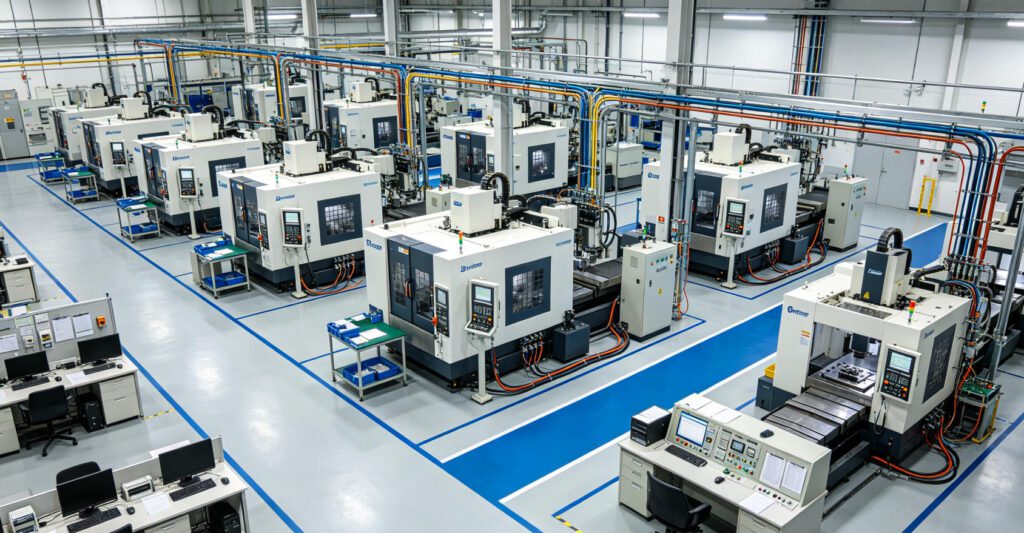
En la distribución eléctrica industrial, una elección errónea entre un SAI monofásico y uno trifásico puede dar lugar a dos problemas muy distintos. Uno de ellos es el de “un caballo pequeño tirando de un carro grande”: utilizar un SAI monofásico UPS para accionar a la fuerza motores trifásicos, lo que provoca una sobrecarga instantánea y quema el inversor. La otra es la de “un caballo grande tirando de un carro pequeño”: un SAI trifásico que soporta cargas monofásicas muy desequilibradas, lo que provoca una sobrecarga de corriente en el neutro y el sobrecalentamiento del transformador.
Los ingenieros de BKPOWER se encuentran con frecuencia con dos problemas sobre el terreno: ① Los departamentos de compras adquieren SAI monofásicos basándose en criterios de “potencia similar”, pero al recibir el producto descubren que los equipos de la línea de producción requieren una alimentación trifásica de 380 V y no se pueden conectar; ② Los centros de datos utilizan SAI trifásicos para alimentar numerosos servidores monofásicos, pero, debido a una distribución desigual de la carga, la corriente de una fase supera el valor nominal de 120%, lo que activa la reducción de potencia de protección del SAI. La causa fundamental: la diferencia entre los SAI monofásicos y los trifásicos no es meramente la “potencia”, sino que son fundamentalmente diferentes. formas de potencia, arquitecturas topológicas y compatibilidad de carga.
II. Las características eléctricas de los SAI monofásicos frente a los trifásicos
1. Forma de la potencia: onda sinusoidal simple frente a campo magnético giratorio
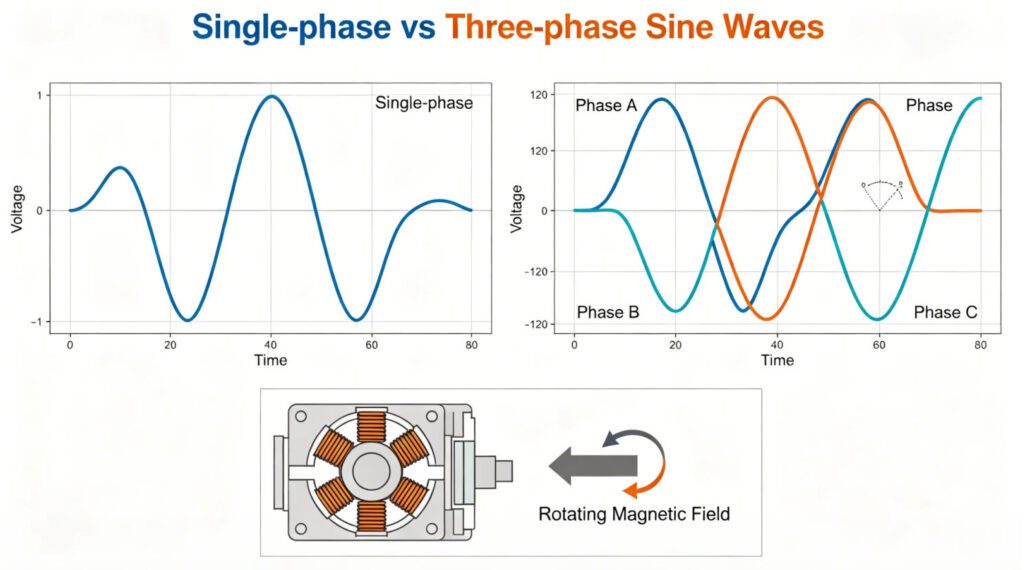
Un SAI monofásico emite una única onda sinusoidal (L-N, 220 V), adecuada para cargas resistivas (ordenadores, iluminación, calefactores). El SAI trifásico genera tres ondas sinusoidales con una diferencia de fase de 120° (L1-L2-L3, tensión de línea de 380 V), cuyo campo magnético combinado es un campo magnético giratorio—la base física de los motores asíncronos trifásicos, los compresores de gran tamaño y el funcionamiento de los husillos de las máquinas CNC.
Conclusión principal: Cualquier carga industrial que contenga motores trifásicos debe utilizar un SAI trifásico. Los SAI monofásicos no pueden generar campos magnéticos rotatorios. Forzar el accionamiento de un motor trifásico mediante inversores monofásicos provoca pulsaciones de par, sobrecalentamiento y caídas de rendimiento superiores a 50%.
2. Eficiencia en la transmisión de energía: por qué el sistema trifásico es el estándar en el sector industrial
Con la misma sección transversal de los conductores, los sistemas trifásicos transmiten √3 veces (aproximadamente 1,732 veces) la potencia de los sistemas monofásicos, mientras que las pérdidas en el cobre solo aumentan en 50%. Esto significa que:
- Carga de 10 kW: en monofásico se necesita un cable de 10 mm²; en trifásico, solo se necesitan 4 mm² por fase
- Línea industrial de 100 kW: un SAI monofásico requiere una corriente de 500 A (cables y disyuntores de gran tamaño); un SAI trifásico solo necesita 152 A por fase
- Los armónicos de la corriente de entrada del rectificador de un SAI trifásico son más fáciles de cancelar mediante la tecnología multipulso (rectificación de 12 pulsos, THDi <10%).
Para equipos de uso industrial como el BKPOWER SAI de frecuencia de red BK-G33, la entrada trifásica es la estándar; una entrada monofásica con una potencia de 60 kVA consumiría una corriente de 273 A, lo que superaría los límites de carga de las tomas de corriente y los interruptores estándar.
3. Trampa de corriente neutra: el arte del equilibrio en los SAI trifásicos con cargas monofásicas
Cuando un SAI trifásico alimenta equipos monofásicos, si la distribución de la carga trifásica es desigual, el neutro (N) transporta una corriente desequilibrada. En casos graves, la corriente del neutro puede alcanzar 1,732 veces la corriente de fase, lo que provoca:
- Sobrecalentamiento del cable neutro (el diseño estándar utiliza 50% del área del conductor de fase para el neutro, lo que supone una sobrecarga grave)
- Desviación del punto neutro del transformador de salida, asimetría de la tensión trifásica
- El aumento de los armónicos en la tensión de salida afecta a los equipos de precisión
Soluciones de SAI trifásicas de BKPOWER: ① Para la topología 3/3 (salida trifásica), distribuir las cargas monofásicas de manera uniforme entre las tres fases; ② En casos en los que predominen las cargas monofásicas, se recomienda SAI con topología 3/1 (entrada trifásica, salida monofásica) para evitar problemas relacionados con la corriente del neutro.
Ⅲ. SAI de 3/1 frente a 3/3: selección de la topología para los SAI de frecuencia de red de BKPOWER
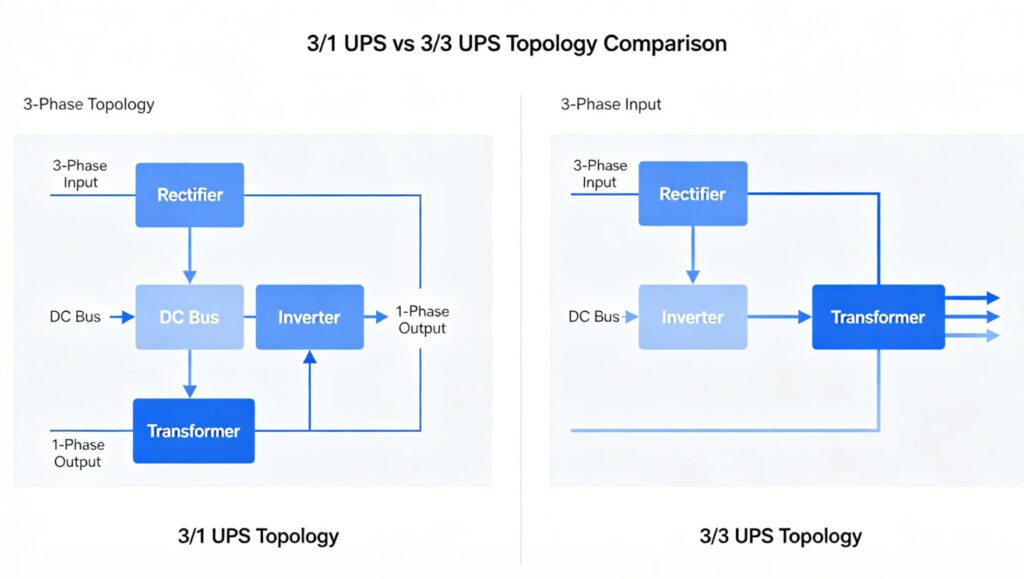
Los usuarios industriales suelen pasar por alto un aspecto fundamental: el propio SAI trifásico se divide en 3/1 (entrada trifásica/salida monofásica) y 3/3 (entrada trifásica/salida trifásica) topologías. Una selección errónea de la topología provoca pérdidas igualmente irreversibles.
1. SAI 3/1: Protección centralizada con entrada trifásica y salida monofásica
El SAI 3/1 se conecta a la red eléctrica trifásica de 380 V en la parte frontal, procesa la corriente internamente mediante un rectificador y un inversor, y proporciona una salida monofásica de 220 V. Entre sus ventajas se incluyen:
- Resuelve problemas relacionados con cargas monofásicas de alta potencia: Cuando las cargas monofásicas superan los 10 kW (límite del SAI monofásico), el SAI 3/1 se alimenta de la red trifásica, evitando así una corriente monofásica excesiva.
- Corriente de entrada equilibrada: El rectificador trifásico consume energía de manera uniforme a través de tres vías, lo que reduce la contaminación armónica de la red eléctrica
- Optimización de costes: En comparación con la adquisición de tres unidades de SAI monofásicas en paralelo, un SAI 3/1 permite ahorrar espacio y reducir los costes de mantenimiento
Escenarios aplicables: Grandes centros de datos monofásicos (los servidores funcionan a 220 V monofásicos), grupos de equipos médicos monofásicos y sistemas de alimentación centralizada para instrumentos de prueba monofásicos.
2. SAI 3/3: el estándar industrial para entrada y salida trifásicas
El SAI 3/3 cuenta con entrada y salida trifásicas, lo que lo convierte en la opción más habitual en entornos industriales. El BKPOWER BK-G33, SAI de frecuencia de red de 100 kVA utiliza esta topología, que presenta las siguientes características:
- Accionamiento directo de motor trifásico: No requiere conversión; suministra directamente corriente trifásica de 380 V para alimentar motores, compresores y grupos de bombas
- Salida integrada transformador de aislamiento: El transformador Δ-Y del SAI de frecuencia de red de BKPOWER logra el aislamiento eléctrico entre entrada y salida, al tiempo que bloquea las corrientes de secuencia cero de tercer armónico.
- Redundancia paralela más sencilla: El funcionamiento en paralelo de los SAI trifásicos solo requiere la sincronización de fases; el funcionamiento en paralelo de los SAI monofásicos también requiere la sincronización del potencial del neutro.
- Admite cargas asimétricas 100%: Los modelos de gama alta de BKPOWER permiten diferencias de carga trifásicas de hasta 100%, manteniendo al mismo tiempo el equilibrio de la tensión de salida
3. Matriz de decisión para la selección de la topología
| Características de carga | Topología recomendada | Referencia de modelos de BKPOWER | Motivo principal |
|---|---|---|---|
| Motores y compresores trifásicos puros | 3/3 SAI | BK-G33 60-400 kVA | Accionamiento directo, no requiere conversión |
| Grupos monofásicos de alta potencia (>10 kW) | 3/1 UPS | Serie BK-G33 3/1 | Evita las sobrecorrientes monofásicas |
| Cargas mixtas (trifásicas + monofásicas) | 3/3 SAI + PDU monofásica | BK-G33 100 kVA | Primaria trifásica, distribución monofásica a través de una PDU |
| Desequilibrio trifásico >50% | SAI de 3/3, frecuencia de red | Serie BK-GH33 | Transformador de frecuencia de red con gran capacidad de compensación de desequilibrios |
| Centros de datos (servidores monofásicos) | 3/1 o 3/3 + PDU de rack | BK-G33 100-200 kVA | Selecciona en función de la arquitectura de distribución |
Ⅳ. Diferencias técnicas entre los SAI monofásicos y trifásicos de frecuencia de red
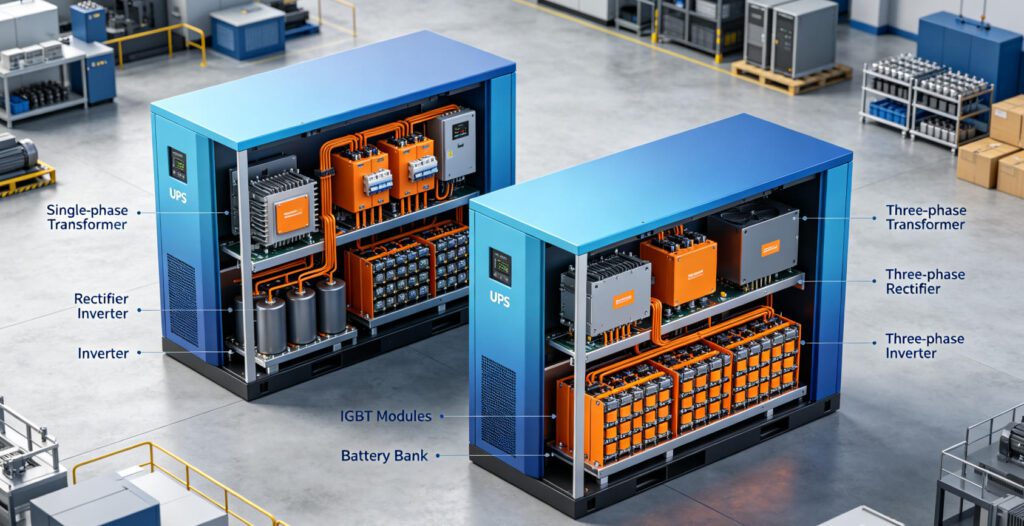
Los SAI de frecuencia de red de BKPOWER presentan diferencias técnicas significativas en su implementación entre las arquitecturas monofásicas y trifásicas, lo que afecta directamente a la fiabilidad en entornos industriales:
| Dimensión técnica | SAI monofásico a frecuencia de red | SAI trifásico a frecuencia de red (BKPOWER BK-G33) |
|---|---|---|
| Topología del rectificador | Rectificación monofásica de puente completo/medio puente | Rectificación trifásica de 6 pulsos/12 pulsos |
| Tensión del bus de CC | 192 V CC (16 celdas) | 384 V CC (32 celdas) o más |
| Estructura del inversor | Inversor de puente completo monofásico | Inversor trifásico de puente completo (3 conjuntos de IGBT) |
| Transformador de salida | Transformador de aislamiento monofásico | Transformador de aislamiento trifásico Δ-Y |
| Conducción neutra | Salida directa de la línea N | Línea N derivada del neutro en Y del transformador, resistente al desequilibrio |
| Capacidad de sobrecarga | 125%-150% (dependiendo del modelo) | 150% durante 1 minuto (norma industrial) |
| Capacidad paralela | 2-4 viviendas (complejo) | 6-8 unidades (sincronización de fase simple) |
| Capacidad habitual | 1-20 kVA | 10-400 kVA |
Idea clave: El transformador de aislamiento Δ-Y del SAI trifásico a frecuencia de red no es solo un elemento de conversión de tensión, sino que también es un filtro armónico de secuencia cero. Los armónicos de tercer orden (3.º, 9.º, 15.º…) generan corrientes circulantes en el devanado Δ y no se propagan hacia el lado de la red eléctrica, una capacidad de protección de la red que los SAI monofásicos no pueden ofrecer.
Ⅴ. Selección de escenarios industriales: cuándo es obligatorio el uso de un SAI trifásico
En los siguientes casos, un SAI trifásico no es “mejor”, sino la “única” opción:
1. La carga incluye motores trifásicos (>3 kW)
Los motores industriales a partir de 3 kW utilizan de forma generalizada una alimentación trifásica de 380 V. Los SAI monofásicos no pueden accionarlos directamente. La conversión mediante inversores aumenta el coste, la complejidad y los puntos de fallo. El BKPOWER BK-G33 60 kVA Puede soportar directamente el arranque de un motor trifásico de 15 kW (teniendo en cuenta una corriente de arranque de entre 5 y 7 veces la corriente nominal).
2. La potencia total supera los 20 kVA
Los SAI monofásicos alcanzan sus límites técnicos y económicos por encima de los 20 kVA. Un SAI monofásico de 100 kVA consume una corriente de entrada de 455 A, lo que requiere interruptores y cables especiales de alta intensidad, mientras que un SAI trifásico de 100 kVA consume solo 152 A por fase, utilizando componentes de distribución industrial estándar.
3. Redundancia paralela necesaria (N+1)
La tecnología de redundancia en paralelo de los SAI trifásicos está consolidada; seis unidades en paralelo permiten alcanzar una redundancia 5+1. El funcionamiento en paralelo de los SAI monofásicos debe resolver los problemas de diferencia de potencial en el neutro, lo que supone una fiabilidad reducida y suele limitarse a cuatro unidades.
4. Conexión a la red trifásica
La distribución en las instalaciones industriales suele utilizar una entrada de servicio trifásica de 380 V. El uso forzado de un SAI monofásico implica consumir energía de solo una de las tres fases, lo que provoca un grave desequilibrio trifásico en la red eléctrica y puede acarrear sanciones por parte de la compañía eléctrica. Un SAI trifásico equilibra de forma natural el consumo de energía, cumpliendo así con las normas de la red eléctrica.
Ⅵ. Escenarios de aplicación razonables para los SAI monofásicos
Los SAI monofásicos no son una tecnología obsoleta; siguen siendo la mejor opción en los siguientes casos:
- Hogar y pequeña oficina: Cargas <3 kVA, monofásico, 220 V, «plug-and-play»
- Equipos monofásicos distribuidos: Como cajeros automáticos, sistemas de vigilancia de seguridad y equipos médicos monofásicos (excepto tomógrafos computarizados)
- Estabilización de tensión monofásica en el lado de entrada: En combinación con BKPOWER estabilizadores monofásicos para proteger los instrumentos de precisión
- Derivaciones monofásicas a valle de un SAI trifásico: A través de armarios de distribución con SAI trifásicos, circuitos derivados monofásicos para la zona de oficinas energía de reserva
Ⅶ. Coordinación del SAI trifásico BKPOWER con estabilizadores y transformadores
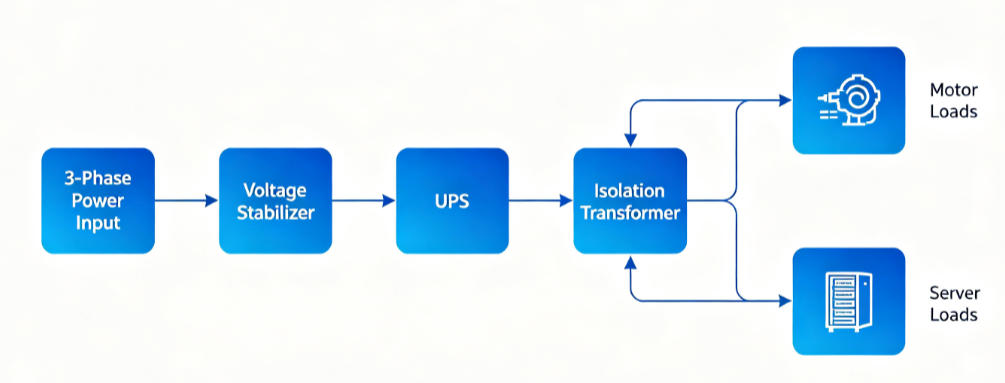
La protección de la alimentación eléctrica industrial es una disciplina de la ingeniería de sistemas. BKPOWER recomienda dos arquitecturas habituales:
Arquitectura A: Línea industrial trifásica de alta potencia (topología 3/3)
Red eléctrica trifásica → Regulador de tensión trifásico sin contacto → BK-G33 SAI de 100 kVA, 3/3 → Transformador de aislamiento trifásico (opcional) → Motores trifásicos/línea de producción
Arquitectura B: Centro de datos monofásico (topología 3/1)
Red trifásica → Trifásico sin contacto regulador de tensión → SAI BK-G33 de 100 kVA, 3/1 → PDU monofásicas para rack → Servidores monofásicos
Ambas arquitecturas utilizan un front-end estabilizadores para absorber las puntas de tensión de la red eléctrica, lo que reduce la frecuencia de descarga de la batería del SAI y prolonga la vida útil total del sistema en más de un 30%.
Fuentes de referencia
| Organización de origen | Tipo de recurso | URL |
|---|---|---|
| Comisión Electrotécnica Internacional (IEC) | Norma IEC 60038 sobre sistemas de alimentación trifásicos | https://www.iec.ch |
| IEEE | Norma IEEE 141 sobre distribución de energía industrial | https://www.ieee.org |
| Administración de Normalización de China (SAC) | Norma nacional GB/T 7260 sobre sistemas de alimentación ininterrumpida (SAI) | https://www.sac.gov.cn |
| Centro de productos de BKPOWER | Especificaciones técnicas del SAI trifásico a frecuencia de red | https://bkpowers.com/products/ups-system/ |
| Blog técnico de BKPOWER | Cómo funciona un sistema de alimentación ininterrumpida | https://bkpowers.com/service/unveiling-the-uninterruptible-power-supply/ |
Artículos recomendados
Después de leer este artículo, quizá te interese también echar un vistazo a:
- Cómo calcular los vatios: Guía para el dimensionamiento de la potencia de los SAI industriales — Calcular con precisión la potencia y la corriente de una carga trifásica
- Cómo funciona un sistema de alimentación ininterrumpida — Comprender los transformadores de doble conversión, de derivación y de aislamiento
- Ventajas de los SAI industriales y guía sobre la frecuencia de red — Análisis en profundidad de las siete ventajas fundamentales de los SAI de frecuencia de red
- Guía de conversión y dimensionamiento de baterías de SAI: de kWh a Ah — Métodos de configuración del banco de baterías de un SAI trifásico
- Productos de reguladores de tensión sin contacto — Soluciones de protección contra sobretensiones en el lado de entrada
Producto recomendado
PREGUNTAS FRECUENTES
Pregunta 1. ¿Puede un SAI trifásico alimentar cargas monofásicas?
Sí, pero hay que tener en cuenta el equilibrio de carga. Cuando un SAI 3/3 alimenta cargas monofásicas, distribuye las cargas de manera uniforme entre las tres fases para evitar una corriente de neutro excesiva. Si las cargas monofásicas superan los 70%, considera la topología 3/1 (entrada trifásica, salida monofásica) o añade un equilibrador trifásico. La serie BK-G33 de BKPOWER admite cargas desequilibradas de 100%, pero un desequilibrio grave a largo plazo sigue afectando a la vida útil del transformador.
Pregunta 2. ¿En qué se diferencian las configuraciones de las baterías de los SAI monofásicos y trifásicos?
Los SAI monofásicos suelen utilizar bancos de baterías de 192 V CC (16 × 12 V en serie). Los SAI trifásicos a frecuencia de red suelen utilizar 384 V CC (32 celdas en serie) o una tensión superior. Una tensión más alta implica una corriente menor para la misma potencia, lo que reduce las pérdidas en los cables, pero duplica el número de baterías. Los SAI trifásicos de BKPOWER admiten opciones de baterías de litio, lo que reduce el número de celdas en los sistemas de 384 V y prolonga la vida útil hasta más de 10 años.
Pregunta 3. Mi fábrica solo cuenta con equipos monofásicos. ¿Necesito un SAI trifásico?
Si la potencia total es inferior a 10 kVA y todos los equipos son monofásicos, basta con un SAI monofásico. Sin embargo, si la potencia total supera los 20 kVA, incluso con cargas monofásicas, se debe considerar un SAI 3/1 (entrada trifásica, salida monofásica). Motivos: ① Un SAI monofásico de más de 20 kVA consume una corriente excesiva (>90 A), lo que dificulta la distribución; ② Un SAI 3/1 consume de forma uniforme de las tres fases, evitando el desequilibrio trifásico de la red; ③ El funcionamiento en paralelo de un SAI monofásico de alta potencia resulta complicado; el funcionamiento en paralelo de un SAI 3/1 es más fiable.
Pregunta 4. ¿Existe alguna diferencia en la conmutación en bypass entre los SAI 3/3 y 3/1?
Sí. El bypass de 3/3 del SAI se conecta directamente a la red trifásica; la conmutación solo requiere sincronizar las fases trifásicas. El bypass de 3/1 del SAI, aunque tiene entrada trifásica, tiene salida monofásica, lo que hace que la lógica de conmutación sea más compleja: la salida monofásica del inversor debe sincronizarse con la fase de la red que se utilice para el bypass. El SAI de frecuencia de red de BKPOWER utiliza tecnología DSP de sincronización de fase digital para lograr una conmutación sin interrupciones en menos de 4 ms; es compatible con ambas topologías.
Pregunta 5. ¿Es más sencilla la redundancia en paralelo de un SAI trifásico que la de un SAI monofásico?
Sí. El funcionamiento en paralelo de los SAI trifásicos solo requiere sincronizar las fases y la frecuencia; las líneas neutras se conectan de forma natural a través de los puntos neutros en Y del transformador. El funcionamiento en paralelo de los SAI monofásicos debe resolver además los problemas de diferencia de potencial del neutro (cada SAI puede tener diferentes potenciales de referencia del neutro), lo que suele limitar el funcionamiento en paralelo a cuatro unidades. Los SAI trifásicos de BKPOWER admiten un funcionamiento en paralelo de entre 6 y 8 unidades, lo que permite alcanzar fácilmente arquitecturas redundantes N+1 o N+N.