Bienvenue chez BKPOWER !












Onduleurs monophasés ou triphasés : guide de sélection pour l'industrie
CONSEILS : Le choix entre un onduleur monophasé et un onduleur triphasé détermine la fiabilité de l'alimentation électrique industrielle. Découvrez les topologies 3/1 et 3/3 des systèmes d'onduleurs à fréquence réseau BKPOWER.
Ⅰ. Le coût d'un mauvais choix : pourquoi les applications industrielles doivent-elles faire la distinction entre les onduleurs monophasés et triphasés ?

Dans le domaine de la distribution électrique industrielle, un mauvais choix entre un onduleur monophasé et un onduleur triphasé peut entraîner deux types de problèmes distincts. Le premier est celui du “ petit cheval tirant une grosse charrette ” : l'utilisation d'un onduleur monophasé UPS pour entraîner de force des moteurs triphasés, ce qui entraîne une surcharge immédiate et la destruction du variateur. L’autre cas est celui du “ gros cheval tirant une petite charrette ” : un onduleur triphasé alimentant des charges monophasées fortement déséquilibrées, ce qui provoque une surcharge du courant de neutre et une surchauffe du transformateur.
Les ingénieurs de BKPOWER sont fréquemment confrontés à deux problèmes sur le terrain : ① Les services d’approvisionnement achètent des onduleurs monophasés en se basant sur des critères de “ puissance similaire ”, pour découvrir à la livraison que les équipements de la chaîne de production nécessitent une alimentation triphasée de 380 V et ne peuvent donc pas être raccordés ; ② Les centres de données utilisent des onduleurs triphasés pour alimenter de nombreux serveurs monophasés, mais en raison d’une répartition inégale de la charge, le courant d’une phase dépasse la valeur nominale du modèle 120%, ce qui déclenche le déclassement de protection de l’onduleur. La cause profonde : la différence entre les onduleurs monophasés et triphasés ne réside pas simplement dans la “ puissance nominale ”, mais dans des caractéristiques fondamentalement différentes. formes de puissance, architectures topologiques et compatibilité de charge.
II. Les principes électriques des onduleurs monophasés et triphasés
1. Forme de la puissance : onde sinusoïdale simple vs champ magnétique tournant
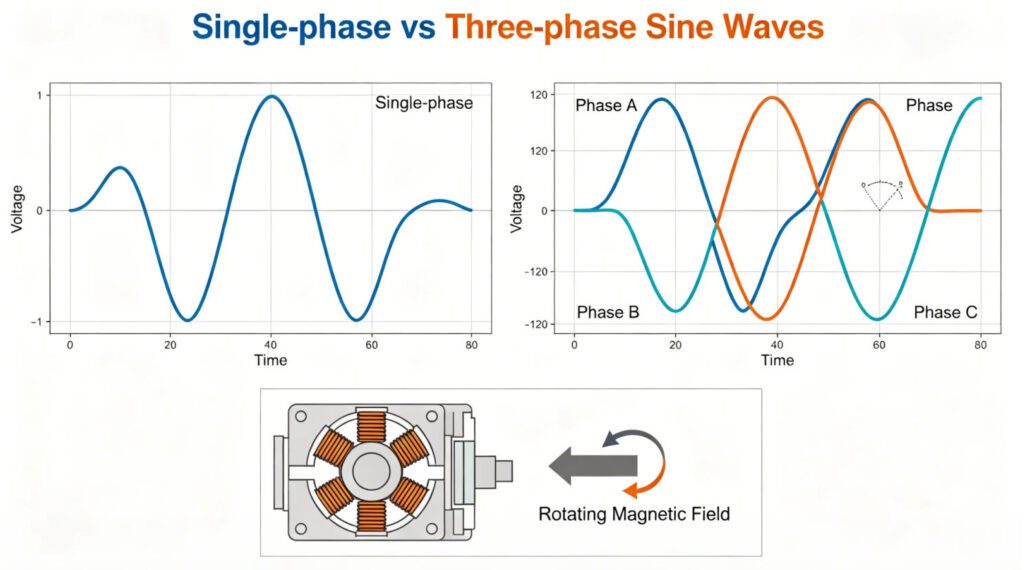
Un onduleur monophasé délivre une seule onde sinusoïdale (L-N, 220 V), adaptée à charges résistives (ordinateurs, éclairage, radiateurs). L'onduleur triphasé génère trois ondes sinusoïdales présentant un déphasage de 120° (L1-L2-L3, tension de ligne de 380 V), dont le champ magnétique combiné est un champ magnétique tournant—le principe physique à la base des moteurs asynchrones triphasés, des grands compresseurs et du fonctionnement des broches des machines à commande numérique.
Conclusion principale : Toute charge industrielle équipée de moteurs triphasés doit être alimentée par un onduleur triphasé. Les onduleurs monophasés ne peuvent pas générer de champs magnétiques tournants. Le fait de faire fonctionner de force un moteur triphasé à l'aide d'onduleurs monophasés entraîne des pulsations de couple, une surchauffe et des baisses de rendement supérieures à 50%.
2. Rendement de la transmission d'énergie : pourquoi le triphasé est la norme dans le secteur industriel
À section de conducteur égale, les réseaux triphasés transmettent √3 fois (environ 1,732 fois) la puissance des systèmes monophasés, tandis que les pertes dans le cuivre n'augmentent que de 50%. Cela signifie que :
- Charge de 10 kW : en monophasé, il faut un câble de 10 mm² ; en triphasé, il suffit de 4 mm² par phase
- Ligne industrielle de 100 kW : un onduleur monophasé nécessite un courant de 500 A (câbles et disjoncteurs de gros calibre) ; un onduleur triphasé ne nécessite que 152 A par phase
- Les harmoniques du courant d'entrée du redresseur d'un onduleur triphasé sont plus faciles à éliminer grâce à la technologie multipulsée (redressement à 12 impulsions, THDi < 10%)
Pour les équipements de qualité industrielle tels que le BKPOWER Onduleur BK-G33 à fréquence réseau, l'alimentation triphasée est la norme ; une alimentation monophasée d'une puissance de 60 kVA entraînerait un courant de 273 A, ce qui dépasserait les limites de charge des prises et des disjoncteurs standard.
3. Piège de courant neutre : l'art de l'équilibrage d'un onduleur triphasé avec des charges monophasées
Lorsqu'un onduleur triphasé alimente des équipements monophasés, si la répartition de la charge triphasée est inégale, le conducteur neutre (N) est soumis à un courant déséquilibré. Dans les cas les plus graves, le courant du neutre peut atteindre 1,732 fois le courant de phase, ce qui a entraîné :
- Surchauffe du conducteur neutre (la conception standard utilise une section de conducteur de phase de 50% pour le neutre, ce qui entraîne une surcharge importante)
- Dérive du point neutre du transformateur de sortie, asymétrie de tension triphasée
- Augmentation des harmoniques de la tension de sortie affectant les équipements de précision
Solutions d'onduleurs triphasés BKPOWER : ① Pour une topologie 3/3 (sortie triphasée), répartissez les charges monophasées de manière uniforme entre les trois phases ; ② Dans les cas où les charges sont principalement monophasées, il est recommandé de Onduleur à topologie 3/1 (entrée triphasée, sortie monophasée) afin d'éviter les problèmes liés au courant de neutre.
Ⅲ. Onduleurs 3/1 vs 3/3 : choix de la topologie pour les onduleurs BKPOWER à fréquence réseau
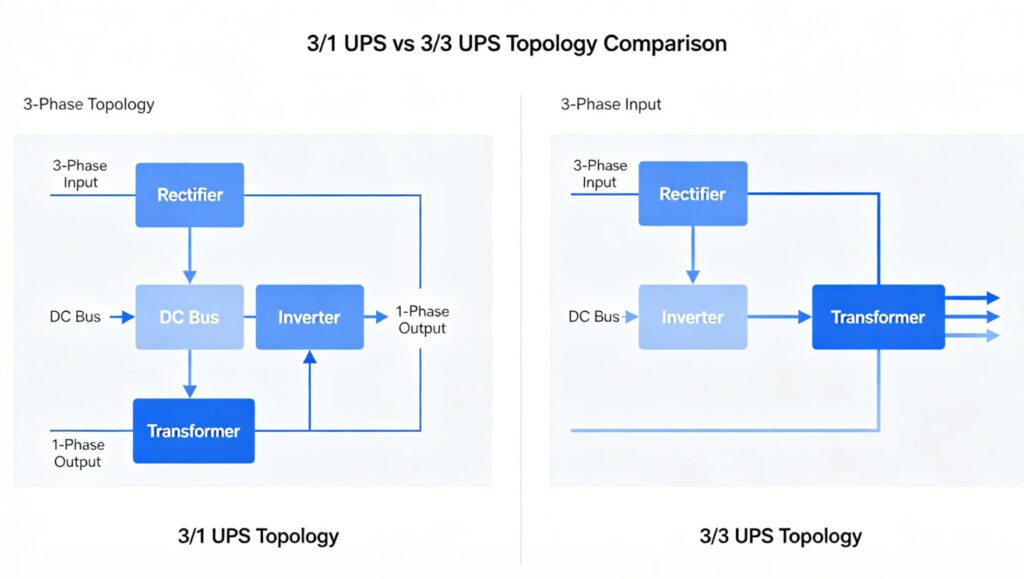
Les utilisateurs industriels négligent souvent un aspect essentiel : l'onduleur triphasé lui-même se divise en 3/1 (entrée triphasée / sortie monophasée) et 3/3 (entrée triphasée / sortie triphasée) topologies. Le choix d'une topologie inadaptée entraîne des pertes tout aussi irréversibles.
1. Onduleur 3/1 : protection centralisée avec entrée triphasée et sortie monophasée
L'onduleur 3/1 se raccorde au réseau triphasé de 380 V à l'entrée, traite le courant en interne via un redresseur et un onduleur, puis fournit une tension monophasée de 220 V en sortie. Ses avantages sont les suivants :
- Résout les problèmes liés aux charges monophasées de forte puissance: Lorsque les charges monophasées dépassent 10 kW (limite de l'onduleur monophasé), l'onduleur 3/1 s'alimente à partir du réseau triphasé, ce qui évite un courant monophasé excessif
- Courant d'entrée symétrique: Le redresseur triphasé prélève le courant de manière équilibrée sur les trois phases, ce qui réduit la pollution harmonique du réseau électrique
- Optimisation des coûts: Par rapport à l'achat de trois onduleurs monophasés montés en parallèle, un seul onduleur 3/1 permet de gagner de la place et de réduire les coûts de maintenance
Scénarios applicables : Grands centres de données monophasés (les serveurs fonctionnent en monophasé à 220 V), groupes d'équipements médicaux monophasés, alimentation électrique centralisée pour les instruments de test monophasés.
2. Onduleur 3/3 : la norme industrielle pour les entrées et sorties triphasées
3/3 L'onduleur dispose d'une entrée et d'une sortie triphasées, ce qui correspond à la norme absolue dans les environnements industriels. Le BKPOWER BK-G33, onduleur à fréquence réseau de 100 kVA utilise cette topologie, qui présente les caractéristiques suivantes :
- Entraînement direct d'un moteur triphasé: Aucune conversion nécessaire ; fournit directement une tension triphasée de 380 V pour alimenter les moteurs, les compresseurs et les groupes motopompes
- Sortie intégrée transformateur d'isolement: Le transformateur Δ-Y de l'onduleur BKPOWER fonctionnant à la fréquence du réseau assure l'isolation électrique entre l'entrée et la sortie tout en bloquant les courants de séquence zéro de troisième harmonique
- Redondance parallèle simplifiée: Le fonctionnement en parallèle des onduleurs triphasés ne nécessite qu'une synchronisation des phases ; le fonctionnement en parallèle des onduleurs monophasés nécessite également une synchronisation du potentiel du neutre
- Prend en charge les charges asymétriques 100%: Les modèles haut de gamme BKPOWER permettent des déséquilibres de charge triphasés allant jusqu'à 100% tout en maintenant l'équilibre de la tension de sortie
3. Matrice de décision pour le choix de la topologie
| Caractéristiques de charge | Topologie recommandée | Référence du modèle BKPOWER | Raison principale |
|---|---|---|---|
| Moteurs/compresseurs triphasés purs | 3/3 onduleurs | BK-G33 60-400 kVA | Entraînement direct, aucune conversion nécessaire |
| Groupes monophasés de forte puissance (> 10 kW) | 3/1 UPS | Série BK-G33 3/1 | Éviter les surintensités monophasées |
| Charges mixtes (triphasées + monophasées) | 3/3 onduleurs + PDU monophasée | BK-G33 100 kVA | Alimentation triphasée en amont, distribution monophasée via un PDU |
| Déséquilibre triphasé >50% | Onduleur 3/3 à fréquence réseau | Série BK-GH33 | Transformateur à fréquence de réseau doté d'une forte capacité de résistance au déséquilibre |
| Centres de données (serveurs monophasés) | 3/1 ou 3/3 + PDU de rack | BK-G33 100-200 kVA | Sélectionner en fonction de l'architecture de distribution |
Ⅳ. Différences techniques entre les onduleurs monophasés et triphasés fonctionnant à la fréquence du réseau
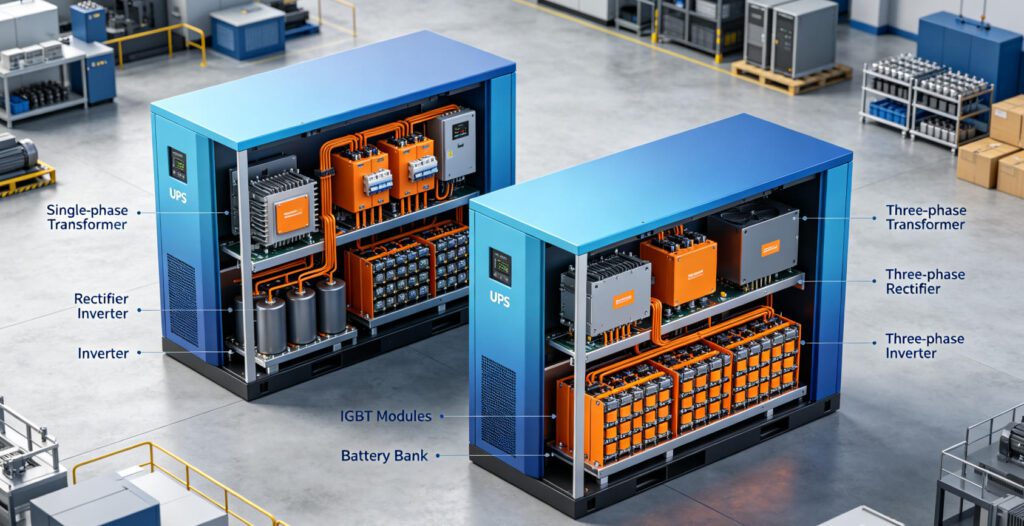
Les onduleurs BKPOWER fonctionnant à la fréquence du réseau présentent des différences techniques importantes entre les architectures monophasées et triphasées, ce qui a une incidence directe sur la fiabilité dans les environnements industriels :
| Dimension technique | Onduleur monophasé à fréquence réseau | Onduleur triphasé à fréquence réseau (BKPOWER BK-G33) |
|---|---|---|
| Topologie du redresseur | Redressement monophasé en pont complet ou demi-pont | Redressement triphasé à 6 impulsions/12 impulsions |
| Tension du bus CC | 192 Vcc (16 cellules) | 384 Vcc (32 cellules) ou plus |
| Structure de l'onduleur | Onduleur monophasé en pont complet | Onduleur triphasé en pont complet (3 ensembles d'IGBT) |
| Transformateur de sortie | Transformateur d'isolement monophasé | Transformateur d'isolement triphasé Δ-Y |
| Tenue de route neutre | Sortie directe sur la ligne N | Ligne N dérivée d'un neutre en Y du transformateur, résistante aux déséquilibres |
| Capacité de surcharge | 125%-150% (selon le modèle) | 150% pendant 1 minute (norme industrielle) |
| Capacité parallèle | 2 à 4 logements (complexe) | 6 à 8 unités (synchronisation de phase simple) |
| Capacité type | 1 à 20 kVA | 10 à 400 kVA |
Point clé : Le transformateur d'isolation Δ-Y de l'onduleur triphasé à fréquence réseau n'est pas seulement un élément de conversion de tension : c'est également un filtre harmonique de séquence zéro. Les harmoniques de troisième ordre (3e, 9e, 15e…) génèrent des courants circulants dans l'enroulement en Δ et ne se propagent pas vers le réseau, ce qui constitue une capacité de protection du réseau qu'un onduleur monophasé ne peut pas offrir.
Ⅴ. Choix des applications industrielles : quand un onduleur triphasé est indispensable
Dans les cas suivants, un onduleur triphasé n'est pas “ le meilleur ” choix, mais le “ seul ” choix possible :
1. Charge comprenant des moteurs triphasés (> 3 kW)
Les moteurs industriels d'une puissance supérieure ou égale à 3 kW fonctionnent tous avec une alimentation triphasée de 380 V. Les onduleurs monophasés ne peuvent pas les alimenter directement. La conversion via des onduleurs augmente le coût, la complexité et le nombre de points de défaillance. Le BKPOWER BK-G33 60 kVA peut prendre en charge directement le démarrage d'un moteur triphasé de 15 kW (en tenant compte d'un courant de démarrage de 5 à 7 fois supérieur au courant nominal).
2. La puissance totale dépasse 20 kVA
Les onduleurs monophasés atteignent leurs limites techniques et économiques au-delà de 20 kVA. Un onduleur monophasé de 100 kVA consomme un courant d'entrée de 455 A, ce qui nécessite des disjoncteurs et des câbles spéciaux à haut courant, tandis qu'un onduleur triphasé de 100 kVA ne consomme que 152 A par phase et utilise des composants de distribution industrielle standard.
3. Redondance parallèle requise (N+1)
La technologie de redondance en parallèle des onduleurs triphasés est bien établie ; six unités en parallèle permettent d'atteindre une redondance de type « 5+1 ». Le fonctionnement en parallèle des onduleurs monophasés doit résoudre les problèmes liés à la différence de potentiel du neutre ; sa fiabilité est faible et il est généralement limité à quatre unités.
4. Raccordement au réseau triphasé
Les installations industrielles sont généralement alimentées par une prise de courant triphasée de 380 V. L'utilisation forcée d'un onduleur monophasé implique de ne puiser de l'énergie que sur une seule des trois phases, ce qui entraîne un grave déséquilibre triphasé du réseau et peut donner lieu à des pénalités de la part du fournisseur d'électricité. Un onduleur triphasé équilibre naturellement la consommation d'énergie, conformément aux normes du réseau.
Ⅵ. Cas d'utilisation pertinents pour les onduleurs monophasés
Les onduleurs monophasés ne sont pas une technologie obsolète ; ils restent le meilleur choix dans les cas suivants :
- Particuliers et petites entreprises: Charges < 3 kVA, monophasé 220 V, prêt à l'emploi
- Équipements monophasés distribués: Tels que les distributeurs automatiques de billets, les systèmes de vidéosurveillance, les équipements médicaux monophasés (à l'exception des scanners)
- Stabilisation de la tension monophasée en amont: Associé à BKPOWER stabilisateurs monophasés pour protéger les instruments de précision
- Branches monophasées en aval d'un onduleur triphasé: Via des armoires de distribution UPS triphasées, dérivation de circuits monophasés pour les bureaux alimentation de secours
Ⅶ. Coordination de l'onduleur triphasé BKPOWER avec des stabilisateurs/transformateurs
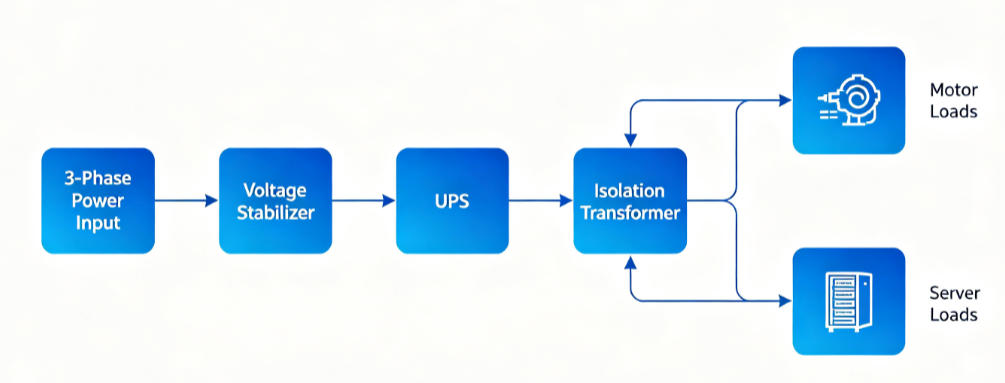
La protection électrique industrielle relève de l'ingénierie des systèmes. BKPOWER recommande deux architectures types :
Architecture A : Ligne industrielle triphasée à haute puissance (topologie 3/3)
Alimentation triphasée → Régulateur de tension triphasé sans contact → BK-G33 100 kVA 3/3, onduleur → Transformateur d'isolement triphasé (facultatif) → Moteurs triphasés / chaîne de production
Architecture B : Centre de données monophasé (topologie 3/1)
Alimentation triphasée → Triphasé sans contact régulateur de tension → Onduleur BK-G33 100 kVA 3/1 → PDU monophasées pour rack → Serveurs monophasés
Ces deux architectures utilisent un front-end stabilisateurs pour absorber les pics de tension du réseau, ce qui réduit la fréquence de décharge des batteries de l'onduleur et prolonge la durée de vie globale du système de plus de 30%.
Sources de référence
| Organisation source | Type de ressource | URL |
|---|---|---|
| Commission électrotechnique internationale (CEI) | Norme relative aux réseaux électriques triphasés CEI 60038 | https://www.iec.ch |
| IEEE | Norme IEEE 141 relative à la distribution électrique industrielle | https://www.ieee.org |
| Administration chinoise de la normalisation (SAC) | Norme nationale GB/T 7260 relative aux onduleurs | https://www.sac.gov.cn |
| Centre de produits BKPOWER | Caractéristiques techniques d'un onduleur triphasé à fréquence réseau | https://bkpowers.com/products/ups-system/ |
| Blog technique de BKPOWER | Fonctionnement d'un onduleur | https://bkpowers.com/service/unveiling-the-uninterruptible-power-supply/ |
Articles recommandés
Après avoir lu cet article, vous pourriez également souhaiter découvrir :
- Comment calculer la puissance en watts : guide de dimensionnement des onduleurs industriels — Calculer avec précision la puissance et le courant de charge triphasés
- Fonctionnement d'un onduleur — Comprendre les transformateurs à double conversion, les transformateurs de dérivation et les transformateurs d'isolation
- Avantages des onduleurs industriels et guide sur la fréquence du réseau — Analyse approfondie des sept principaux avantages des onduleurs fonctionnant à la fréquence du réseau
- Conversion des kWh en Ah pour les batteries d'onduleurs et guide de dimensionnement — Méthodes de configuration d'un parc de batteries pour onduleurs triphasés
- Produits de régulation de tension sans contact — Solutions de protection contre les surtensions en amont
Produit recommandé
FAQ
Q1. Un onduleur triphasé peut-il alimenter des charges monophasées ?
Oui, mais il faut tenir compte de l'équilibrage de charge. Lorsqu'un onduleur 3/3 alimente des charges monophasées, répartissez les charges de manière uniforme sur les trois phases afin d'éviter un courant de neutre excessif. Si les charges monophasées dépassent 70%, envisagez une topologie 3/1 (entrée triphasée, sortie monophasée) ou ajoutez un équilibreur triphasé. La série BK-G33 de BKPOWER prend en charge des charges déséquilibrées jusqu'à 100%, mais un déséquilibre important à long terme affecte tout de même la durée de vie du transformateur.
Q2. Quelles sont les différences de configuration des batteries entre les onduleurs monophasés et triphasés ?
Les onduleurs monophasés utilisent généralement des batteries de 192 Vcc (16 × 12 V en série). Les onduleurs triphasés à fréquence réseau utilisent couramment une tension de 384 Vcc (32 cellules en série) ou supérieure. Une tension plus élevée implique un courant plus faible à puissance égale, ce qui réduit les pertes dans les câbles, mais double le nombre de batteries. Les onduleurs triphasés BKPOWER prennent en charge les batteries au lithium, ce qui permet de réduire le nombre de cellules dans les systèmes à 384 V et de prolonger la durée de vie à plus de 10 ans.
Q3. Mon usine ne dispose que d'équipements monophasés. Ai-je besoin d'un onduleur triphasé ?
Si la puissance totale est inférieure à 10 kVA et que tous les équipements sont monophasés, un onduleur monophasé suffit. Toutefois, si la puissance totale dépasse 20 kVA, même avec des charges monophasées, il convient d’envisager un onduleur 3/1 (entrée triphasée, sortie monophasée). Motifs : ① Un onduleur monophasé d'une puissance supérieure à 20 kVA consomme un courant excessif (> 90 A), ce qui complique la distribution ; ② Un onduleur 3/1 prélève le courant de manière équilibrée sur les trois phases, évitant ainsi tout déséquilibre triphasé du réseau ; ③ Le fonctionnement en parallèle d'onduleurs monophasés de forte puissance est difficile ; le fonctionnement en parallèle d'onduleurs 3/1 est plus fiable.
Q4. Y a-t-il une différence au niveau de la commutation en dérivation entre les onduleurs 3/3 et 3/1 ?
Oui. Le bypass 3/3 de l'onduleur se connecte directement au réseau triphasé ; la commutation nécessite uniquement la synchronisation des phases triphasées. Le bypass 3/1 de l'onduleur, bien qu'il dispose d'une entrée triphasée, présente une sortie monophasée, ce qui rend la logique de commutation plus complexe : la sortie monophasée de l'onduleur doit se synchroniser avec la phase du réseau utilisée pour le bypass. L'onduleur à fréquence réseau BKPOWER utilise la technologie numérique DSP de verrouillage de phase pour obtenir une commutation transparente en moins de 4 ms ; les deux topologies sont prises en charge.
Q5. La redondance en parallèle des onduleurs triphasés est-elle plus simple que celle des onduleurs monophasés ?
Oui. Le fonctionnement en parallèle des onduleurs triphasés nécessite uniquement la synchronisation des phases et de la fréquence ; les lignes de neutre se connectent naturellement via les points neutres en Y des transformateurs. Le fonctionnement en parallèle des onduleurs monophasés doit en outre résoudre les problèmes de différence de potentiel du neutre (chaque onduleur pouvant avoir des potentiels de référence du neutre différents), ce qui limite généralement le fonctionnement en parallèle à quatre unités. Les onduleurs triphasés BKPOWER prennent en charge un fonctionnement en parallèle de 6 à 8 unités, permettant ainsi de mettre facilement en place des architectures redondantes de type N+1 ou N+N.