Bem-vindo à BKPOWER!





Elevator Emergency Power: Meet Building Safety Codes
TIPS:Modern building safety codes mandate uninterrupted elevator operation during emergencies. Sistemas UPS industriais provide the critical bridge between power failure and passenger safety. This article explores how advanced energia de reserva technologies ensure EN 81-20 compliance while delivering intelligent leveling capabilities. Discover why industrial-grade solutions outperform standard battery backups in high-rise applications.
Ⅰ. Introduction: The Critical Link Between Power and Safety
Elevators stop when power fails. Passengers get trapped. Building codes now forbid this scenario. The solution lies in advanced power systems.
Sistemas UPS industriais have evolved beyond simple battery backups. They now serve as intelligent safety devices. Modern elevators require seamless power transitions. Traditional generators take 10 seconds to start. This delay violates safety standards. UPS technology fills this gap instantly.
Building owners face strict compliance requirements. EN 81-20 mandates specific safety features. NFPA 101 regulates emergency power. Local jurisdictions add their own rules. Non-compliance risks fines and liability. More importantly, it endangers lives.
BKPOWER engineers understand these challenges. We design elevator UPS solutions that exceed code requirements. Our systems deliver more than energia de reserva. They provide intelligent leveling functions. This ensures passenger safety in all scenarios.
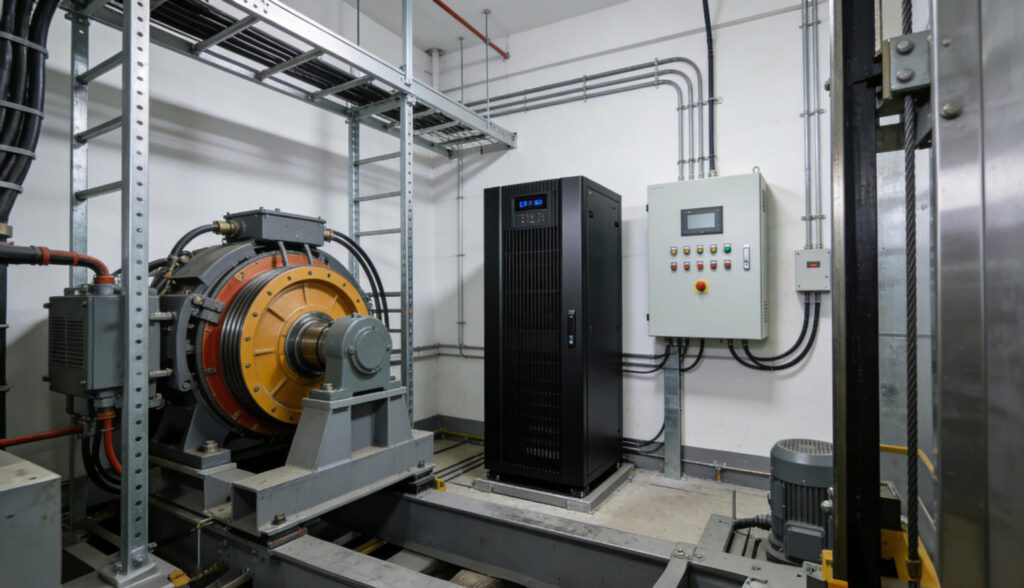
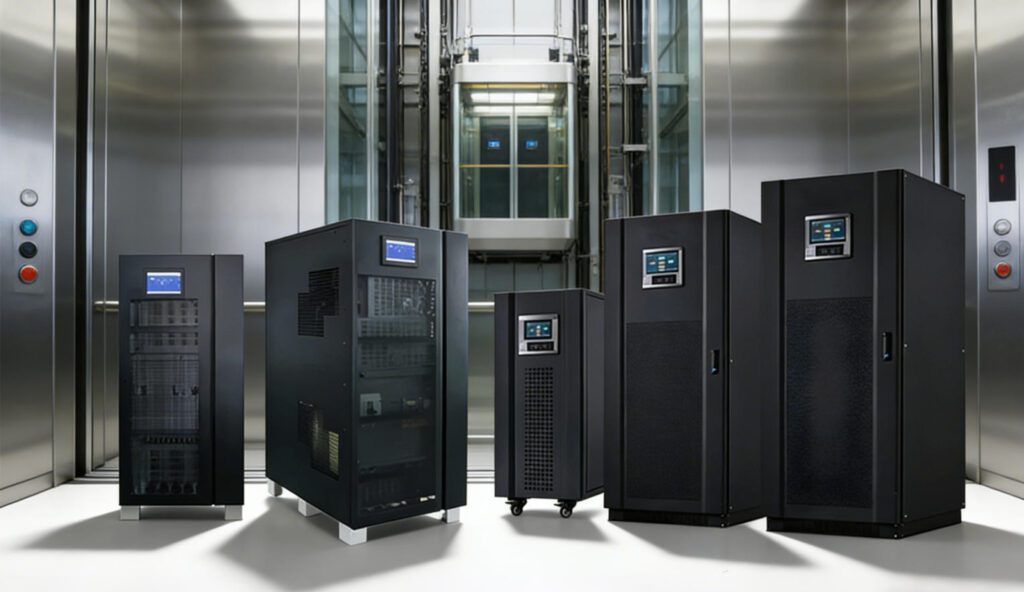
Figure 1: Industrial UPS installation in elevator machine room showing compact footprint
Ⅱ. Understanding Building Safety Codes and Standards
The regulatory landscape is complex. Multiple standards govern elevator emergency power. Understanding them ensures proper system design.
1. The EN 81-20 Framework
This European standard sets global benchmarks. It specifies requirements for elevator construction and installation. Safety rules cover electrical systems and emergency operations.
EN 81-20 requires automatic rescue capabilities. Elevators must move passengers to safety within specific timeframes. The standard mandates uninterruptible power for control systems. Lighting must remain operational during failures.
The code specifies performance criteria. Power transitions must not exceed defined limits. Doors must open reliably after power restoration. Communication systems require continuous operation.
2. NFPA 101 and Life Safety
The Life Safety Code classifies elevators differently. It distinguishes between emergency use and normal operation. Energia de reserva requirements vary by classification.
Firefighters’ elevators need 2-hour power supplies. Hospital elevators require similar endurance. Residential buildings follow different rules. Understanding these distinctions is crucial.
3. Local Jurisdiction Requirements
Cities often exceed national standards. New York mandates specific runtime calculations. Chicago requires seismic ratings. California demands environmental compliance.
Building departments inspect installations. They verify industrial Sistema UPS specifications. Field testing confirms performance claims. Documentation must prove code compliance.
Ⅲ. Industrial UPS vs. Standard Backup Solutions
Not all UPS systems suit elevator applications. Industrial designs differ significantly from commercial units.
1. Startup Current Handling
Elevator motors draw massive inrush currents. Standard UPS units fail under these loads. Sistemas UPS industriais handle 300% overloads. They sustain this for 60 seconds minimum.
The transformer-based design provides isolation. It filters electrical noise from the grid. Motors receive clean power. This extends equipment life.
2. Duty Cycle Considerations
Commercial UPS units handle occasional outages. Elevator applications require frequent cycling. Industrial designs tolerate constant switching. They manage multiple starts per hour without degradation.
3. Environmental Resilience
Machine rooms experience temperature extremes. Dust and vibration affect electronics. Industrial UPS enclosures meet IP54 ratings. They operate in -10°C to +50°C ranges. Conformal coating protects circuit boards.
Standard office UPS units fail in these conditions. They require climate-controlled environments. Industrial systems thrive where elevators actually operate.
| Caraterística | UPS comercial | Industrial UPS for Elevators |
|---|---|---|
| Capacidade de sobrecarga | 110-125% | 150-300% |
| Operating temperature | 0-40°C | -10-50°C |
| Tempo de comutação | 4-8 ms | <4 ms |
| Duty cycle | Occasional | Contínuo |
| Motor starting | Not rated | High inrush capable |
Table 1: Commercial vs. Industrial UPS specifications for elevator applications
Ⅳ. Intelligent Leveling Technology
Power restoration creates challenges. The car may stop between floors. Passengers cannot exit safely. Intelligent leveling solves this problem.
1. Emergency Leveling Function
When power fails, the car stops immediately. The UPS maintains control systems. Within 3 milliseconds, battery power activates. The system determines car position. It calculates direction to nearest floor.
BKPOWER controllers use encoder feedback. They know exact car location. The system checks door zones. It identifies if leveling is possible.
2. Load-Compensated Movement
Empty cars behave differently from loaded ones. The UPS system measures current draw. It determines car weight distribution. The controller adjusts torque accordingly.
This prevents roll-back during leveling. It ensures smooth acceleration. Passengers experience minimal discomfort. The car reaches floor level accurately.
3. Door Release Protocols
EN 81-20 mandates specific door operations. Power must remain stable during opening. The UPS ensures voltage regulation. Doors open fully before power transfer completes.
If the car is outside the door zone, the system moves it. Passengers cannot force doors open prematurely. Safety circuits remain energized throughout.
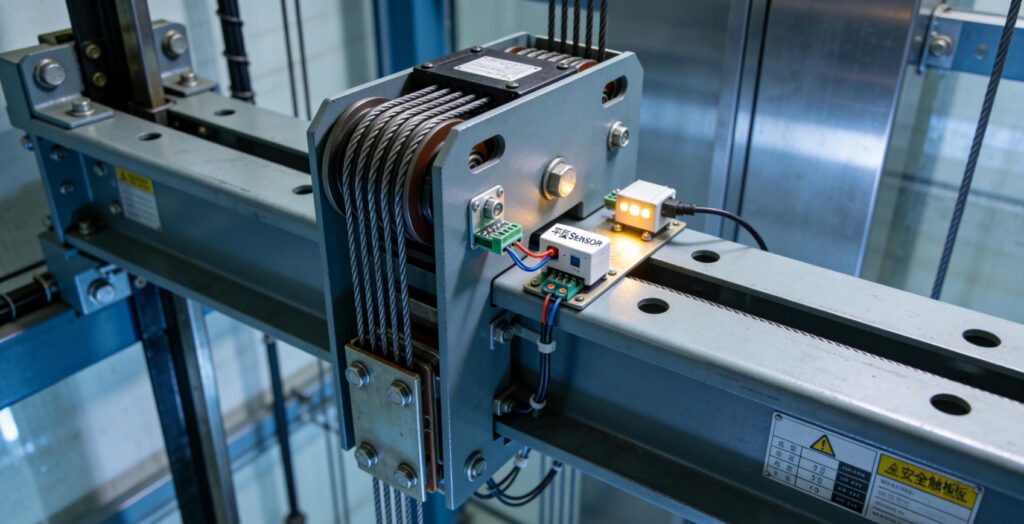
Figure 2: Elevator leveling sensors and safety components ensuring precise floor alignment
Ⅴ. System Architecture and Components
A complete elevator UPS system contains multiple subsystems. Each plays a critical role in safety.
1. Power Conversion Module
Double-conversion topology provides isolation. The rectifier converts AC to DC. The inverter produces clean AC output. Batteries connect to the DC bus.
This design eliminates transfer switches. There is no break during power transitions. The elevator control system never sees disturbances.
2. Battery Management
Valve-regulated lead-acid (VRLA) batteries offer reliability. Lithium-ion options provide higher density. The charging system maintains optimal levels.
Temperature compensation extends battery life. The UPS monitors individual cells. It balances charges across the string. Predictive algorithms warn of impending failures.
3. Control Interface
Modern elevators use serial communication. The UPS connects to the building management system. It reports status via Modbus or BACnet. Monitorização remota tracks battery health.
Dry contacts interface with fire alarm systems. The UPS receives emergency shutdown commands. It coordinates with generator starting sequences.
Ⅵ. Compliance Verification and Testing
Installation requires rigorous validation. Authorities demand proof of performance.
1. Runtime Calculations
Engineers calculate load profiles. They account for worst-case scenarios. Full-load operation requires more capacidade da bateria. The calculations include safety margins.
NFPA requires 90-minute minimum runtime. Some jurisdictions demand 2 hours. Hospital applications may need 4 hours. The UPS must maintain full elevator functionality throughout.
2. Transfer Time Measurement
Technicians use oscilloscopes to verify switching. The power transition must remain under 4 milliseconds. Voltage sags cannot exceed specified limits.
Recorders capture waveform data. They document compliance with EN 81-20. This evidence supports permit approvals.
3. Functional Testing
inspectors witness rescue operations. They simulate power failures. The elevator must complete leveling cycles. Doors must open and close properly. Lights remain illuminated throughout.
Semi-annual testing confirms continued compliance. Batteries undergo discharge testing. Connections receive thermal scanning.
Ⅶ. Application Scenarios and Case Studies
Different building types require tailored solutions. BKPOWER adapts systems to specific needs.
1. High-Rise Commercial Towers
A 50-story office building in Chicago faced compliance issues. The local code required 2-hour backup for all elevators. Traditional generators occupied valuable parking space.
BKPOWER installed sistemas UPS industriais in each machine room. The footprint measured only 800×600 mm. Batteries provided 120 minutes of runtime. The solution saved 200 square meters of space.
The system integrated with fire alarms. During emergencies, elevators recalled to lobby. Power remained stable throughout evacuation procedures.
2. Estabelecimentos de cuidados de saúde
A 600-bed hospital required zero-failure backup. Patient transport elevators moved critical cases. Operating room supplies traveled via service lifts.
The UPS solution provided instantaneous transfer. Generator startup took 8 seconds. The bridge power prevented any interruption. Surgical schedules continued without delay.
The system included maintenance bypasses. Technicians could service units without stopping elevators. This ensured 100% availability.
3. Residential Complexes
High-rise apartments present unique challenges. Residents include elderly and disabled individuals. Stranded occupants create liability risks.
BKPOWER systems provided automatic leveling within 15 seconds. Passengers never remained trapped. The UPS charged from normal building power. No additional electrical service was required.
Installation occurred during off-peak hours. Residents experienced no disruptions. The system paid for itself through insurance premium reductions.
Ⅷ. Economic Analysis and Long-Term Value
Code compliance involves investment. However, UPS systems deliver returns beyond safety.
1. Custo total de propriedade
Initial purchase prices range by capacity. A 40 kVA sistema UPS industrial costs approximately $15,000-25,000. Installation adds $3,000-5,000. Battery replacement occurs every 5-7 years.
Generator systems require higher capital expenditure. They need fuel tanks and exhaust systems. Maintenance costs exceed UPS systems by 40%. Fuel storage creates ongoing expenses.
2. Insurance and Liability
Underwriters recognize UPS protection. Premium discounts often reach 10-15%. The reduction covers system costs within 3-5 years.
Liability exposure decreases significantly. Trapped passenger lawsuits cost hundreds of thousands. UPS prevention eliminates this risk.
3. Eficiência operacional
UPS systems condition power continuously. They filter surges and sags. Elevator electronics last longer. Drive systems experience fewer failures.
Energy savings accumulate. Regenerative drives return power to batteries. The UPS captures this energy. Building consumption decreases by 3-5%.
Ⅸ. Installation Best Practices
Proper implementation ensures code compliance. Follow these guidelines for successful deployment.
1. Preparação do local
Machine rooms require adequate ventilation. The UPS generates heat during charging. Ambient temperature must not exceed 30°C. Vibration isolation prevents mechanical stress.
Electrical rooms need seismic bracing. Batteries require spill containment. seismic zones demand special racks. installers must verify floor loading capacity.
2. Electrical Integration
Service entrance requires coordination. The UPS connects between main panels and elevator controllers. Disconnects must be accessible. Labeling must meet NEC requirements.
Grounding systems require special attention. Isolated ground conductors prevent noise. Earth resistance must measure below 5 ohms.
3. Commissioning Procedures
Initial startup follows strict protocols. Batteries receive commissioning charges. Load testing validates capacity. Documentation records baseline performance.
Training sessions teach building staff. They learn alarm recognition. They understand emergency procedures. Manuals remain on-site for reference.
Ⅹ. Future Developments and Smart Integration
Technology continues advancing. BKPOWER develops next-generation capabilities.
1. Lithium-Ion Integration
New battery chemistries offer advantages. They charge 3 times faster than lead-acid. They provide 3,000+ cycles. The footprint reduces by 60%.
Battery management systems monitor cell temperatures. They prevent thermal runaway. Safety certifications ensure code compliance.
2. Predictive Analytics
IoT sensors track system health. Cloud algorithms predict failures. Maintenance occurs before breakdowns. This extends equipment life.
Machine learning optimizes charging patterns. It considers utility rates. It schedules charging during off-peak hours. Operating costs decrease further.
3. Grid-Interactive Features
Advanced UPS systems support demand response. They discharge batteries during peak pricing. They stabilize building loads. Utilities offer rebates for this service.
Virtual power plant participation creates revenue. The UPS becomes an asset, not just a cost. Grid resilience improves building-wide.
Conclusão
Elevator UPS technology transforms building safety. Sistemas UPS industriais provide the reliability that modern codes demand. They bridge the gap between generator startup and power failure instantly.
EN 81-20 compliance requires more than basic energia de reserva. Intelligent leveling functions ensure passenger safety. Precise control systems deliver code-compliant performance. Building owners avoid liability while protecting occupants.
BKPOWER delivers proven solutions. Our systems install in buildings worldwide. We understand local codes and international standards. We engineer for your specific requirements.
Don’t wait for enforcement actions. Don’t risk passenger safety. Install compliant elevator UPS systems today. Contact BKPOWER for technical consultation. Our engineers design solutions for your building type. Ensure safety. Ensure compliance. Ensure peace of mind.
Referências
- Comissão Eletrotécnica Internacional (CEI)Sítio Web oficial: www.iec.ch
- Underwriters Laboratories (UL)Sítio Web oficial: www.ul.com
- Comité Europeu de Normalização (CEN)Sítio Web oficial: www.cen.eu
- Administração da Normalização da China (SAC)Sítio Web oficial: www.sac.gov.cn
- Aliança Tecnológica da Indústria de Armazenamento de Energia de Zhongguancun (CNESA)Sítio Web oficial: www.cnESA.org
- Organização Internacional de Normalização (ISO)Sítio Web oficial: www.iso.org