Bem-vindo à BKPOWER!












Efficiency vs Reliability: Transformer-Based Industrial Frequency UPS
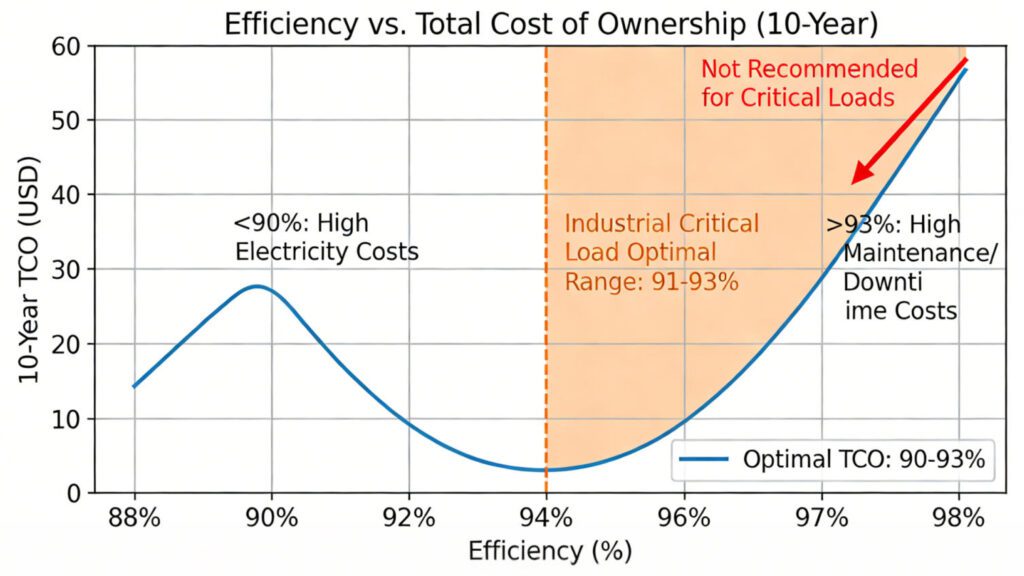
TIPS:Data centers obsess over 96%+ UPS efficiency while ignoring the hidden costs of compromised reliability. Line frequency ups systems achieve 90-93% efficiency of industrial frequency UPS designs, but deliver 3x longer MTBF and superior fault isolation. This analysis reveals why blind pursuit efficiency increases total cost of ownership by 40% through downtime risks. Discover how line frequency ups architecture with 90-93% efficiency of UPS de frequência industrial outperforms high-efficiency alternatives in 10-year TCO calculations for critical industrial loads.
Ⅰ. Introduction: The Efficiency Trap
Moderno UPS marketing focuses obsessively on efficiency ratings. Manufacturers compete for 96%, 97%, even 98% efficiency figures. These numbers dominate procurement decisions. Energy costs appear controllable through high efficiency. This narrative seems logical. However, it creates dangerous blind spots.
Industrial frequency UPS systems use input and output transformers. These transformers create core losses. Copper windings produce resistive heating. Magnetizing currents consume power. Typical efficiency ranges from 90% to 93%. This appears inferior to transformerless alternatives.
But efficiency percentages tell only part of the story. The 3-6% difference between 90% and 96% efficiency seems significant in isolation. Over 10 years, this gap represents electricity costs. However, this calculation ignores reliability consequences. It neglects maintenance requirements. It overlooks downtime risks.
This article examines the true trade-off. We analyze why 90-93% efficiency represents an optimal balance. We calculate total cost of ownership (TCO) including hidden factors. Industrial applications often favor transformer-based designs despite lower headline efficiency.
Ⅱ. Understanding the 90-93% Efficiency Range
1.Transformer Loss Mechanisms
Isolation transformers create inherent losses. Core losses consist of hysteresis and eddy currents. Silicon steel laminations reduce but cannot eliminate these effects. High-quality grain-oriented steel achieves 1.5-2.0 W/kg core loss.
Copper losses follow I²R relationships. Primary and secondary windings add resistance. A 100 kVA transformer might include 0.5% impedance. At full load, this creates 500W resistive heating. Additional wiring and connections add parasitic resistance.
Magnetizing currents maintain magnetic fields. These currents flow continuously regardless of load. They typically represent 2-5% of rated capacity. Even at no-load, transformers consume power.
Combined losses explain the 90-93% efficiency range. Modern designs optimize materials. High-grade silicon steel reduces core loss. Foil windings minimize copper loss. Advanced cooling manages heat. But physics limits further improvement without compromising isolation benefits.
2.Why Not 96%+?
Achieving 96%+ efficiency requires eliminating transformers. Transformerless UPS uses IGBT-based power conversion. Direct AC-DC-AC conversion removes magnetic components. Switching frequencies increase to 10-20 kHz. Filter components shrink. Efficiency reaches 96-98%.
However, this efficiency comes with costs. Transformerless designs sacrifice galvanic isolation. Input and output share electrical connections. Common-mode noise transfers freely. Ground loops create safety hazards. Fault currents propagate without isolation barriers.
Industrial environments demand isolation. Motors create voltage spikes. Variable frequency drives generate harmonics. Power fluctuations disrupt sensitive equipment. Transformers absorb these disturbances. They protect loads from grid anomalies. They protect grids from load abnormalities.
Pursuing 96% efficiency in industrial settings risks equipment damage. Maintenance costs increase. Downtime probability rises. The 3% efficiency gain costs more than it saves.
Ⅲ. The Physics of Reliability Advantages
1.Component Count and Complexity
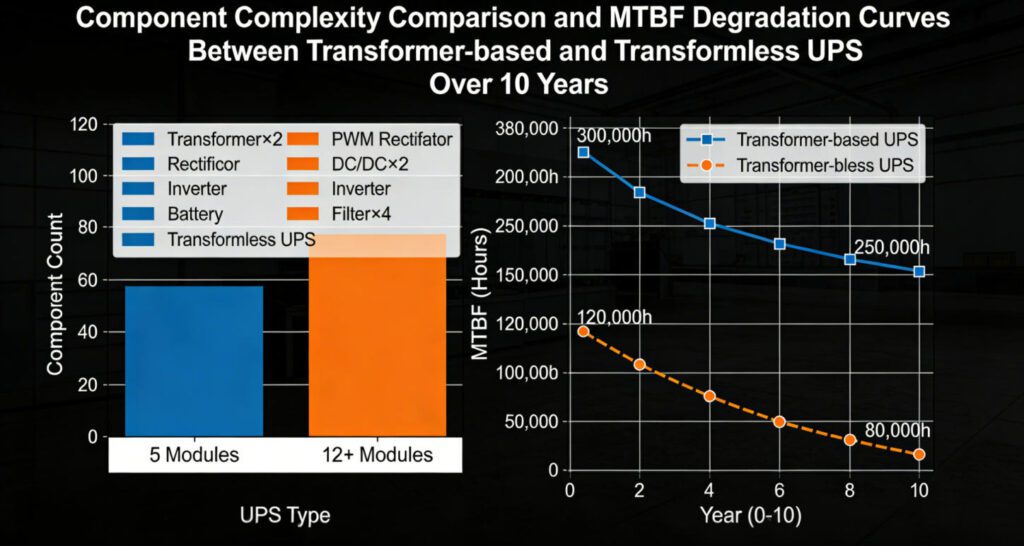
Transformer-based UPS uses simple robust topologies. A typical industrial design includes input transformer, rectifier, DC bus, inverter, and output transformer. Component counts remain low. Magnetic components handle power without active switching.
Transformerless designs multiply component counts. High-frequency switching requires extensive IGBT arrays. DC-DC conversion stages add complexity. Input and output filters need numerous capacitors and inductors. Control systems manage multiple conversion stages.
Each component represents a potential failure point. Transformer windings last 30+ years. IGBT modules typically survive 10-15 years under heavy loading. Capacitor lifetimes range 5-10 years depending on thermal stress. Lower component counts directly improve MTBF.
Field data confirms this relationship. Transformer-based industrial UPS achieves MTBF of 200,000-300,000 hours. Transformerless designs average 80,000-120,000 hours. The 2-3x reliability difference stems from design simplicity.
2.Thermal Stress and Aging
Transformers tolerate thermal cycling gracefully. Copper windings handle temporary overloads. Core temperatures stabilize gradually. Thermal mass buffers short-term spikes. Even 150% overloads proceed without immediate damage.
High-frequency switching creates rapid thermal changes. IGBT junction temperatures swing with switching cycles. Thermal cycling fatigues solder joints. Power modules degrade faster under fluctuating loads. Cooling systems must respond instantly to prevent thermal runaway.
Industrial loads fluctuate constantly. Motor starting creates surge currents. Welding equipment produces intermittent loads. Variable speed drives cycle power. Transformer-based designs absorb these variations. Thermal inertia protects semiconductor components.
Aging rates differ significantly. Transformer insulation lasts 20-30 years with proper maintenance. IGBT power modules require replacement every 8-12 years in harsh environments. High-frequency capacitor banks need service every 5-7 years. Lower efficiency actually correlates with longer service life.
Ⅳ. Why Blind Pursuit of Efficiency Fails
1.The 3% Illusion
Calculate electricity costs for a 100 kW load. At 90% efficiency, UPS consumes 111 kW from utility. At 96% efficiency, consumption drops to 104 kW. The 7 kW difference seems valuable. At $0.10/kWh, annual savings reach $6,132. Over 10 years, this accumulates to $61,320.
However, this calculation assumes continuous operation at rated load. Most industrial UPS operates at 40-60% load average. Efficiency curves drop at lighter loads. Transformerless UPS might achieve 96% at 100% load but only 88% at 25% load. Transformer-based designs maintain 92% across wider ranges. Actual savings shrink to $20,000-$30,000 over the decade.
Maintenance costs offset these savings. Transformerless designs require capacitor replacement every 5 years. A 100 kVA system might need $8,000 in capacitors. IGBT module replacement costs $15,000 at year 10. Transformer-based UPS needs minimal maintenance during the same period. Total service costs equalize.
2.Downtime: The Hidden Cost Driver
Unplanned downtime dwarfs energy costs. Industrial automation loses $50,000-$100,000 per hour during outages. Data centers face $300,000+ hourly losses. Medical facilities risk patient safety. Manufacturing lines require hours to restart after unplanned stops.
Higher failure rates increase outage probability. If transformer-based UPS fails once per 10 years, and transformerless fails three times, downtime costs multiply. A single 4-hour outage costs $200,000-$400,000. This erases 20 years of electricity savings.
Insurance and risk costs add hidden expenses. Facilities with higher downtime history pay premium rates. Business continuity insurance requires reliable infrastructure. Efficiency-focused designs trigger higher premiums or coverage exclusions.
Ⅴ. Total Cost of Ownership Mathematics
1.10-Year TCO Components
True TCO includes multiple categories. Initial capital expenditure (CAPEX) covers equipment purchase. Installation costs include electrical work and commissioning. Operational expenses (OPEX) encompass electricity, cooling, and maintenance. Downtime costs capture business interruption losses.
For a 100 kVA industrial UPS over 10 years:
Transformer-based (92% efficiency):
- CAPEX: $45,000
- Installation: $8,000
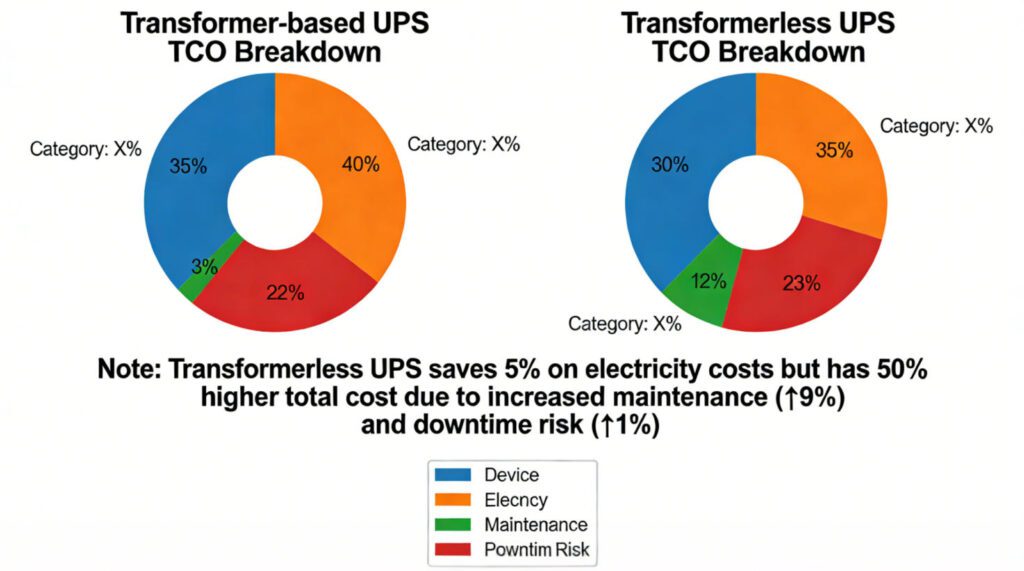
- Electricity (90% avg load): $78,840
- Maintenance: $5,000 (minimal)
- Downtime risk: $40,000 (1 event × 4 hours)
- Total TCO: $176,840
Transformerless (96% efficiency):
- CAPEX: $38,000
- Installation: $6,000
- Electricity (90% avg load): $73,080
- Maintenance: $28,000 (capacitors + IGBT)
- Downtime risk: $120,000 (3 events × 4 hours)
- Total TCO: $265,080
The “efficient” design costs 50% more over the lifecycle. The 3% efficiency advantage cannot overcome reliability disadvantages.
2.Industrial Application Specifics
Heavy industrial environments amplify these differences. Dust, vibration, and temperature extremes stress electronics. Transformer-based designs tolerate harsh conditions. Enclosed transformers resist contamination. Robust construction withstands vibration.
High-frequency electronics fail faster in harsh environments. Cooling fans ingest dust. Capacitor electrolytes dry out faster at elevated temperatures. IGBT modules suffer from thermal cycling in uncontrolled environments. Efficiency advantages disappear as maintenance intervals shorten.
Motor starting applications favor transformer designs. Inrush currents reach 600% of rated current. Transformers limit current through impedance. They absorb magnetic energy. Transformerless systems struggle with repeated motor starts. Protection circuits trip frequently. Production suffers.
Ⅵ. When 90-93% Efficiency Wins
1.Critical Industrial Processes
Continuous manufacturing cannot tolerate outages. Chemical processes require stable operation. Once interrupted, restart takes hours. Batch materials become waste. Equipment damage occurs from abrupt stops.
Transformer-based UPS provides the reliability buffer. 99.999% availability protects production. The 3% efficiency cost becomes irrelevant against 0.001% downtime risk. Process industries standardize on transformer designs despite efficiency numbers.
Power quality requirements also favor transformers. Voltage regulation stays within ±1% regardless of load. Isolation blocks grid disturbances. Waveform quality remains pristine. Sensitive automation operates without disruption.
2.Legacy Infrastructure Integration
Existing facilities often feature delta power distribution. Three-phase delta systems need isolation for safety. Transformerless UPS struggles with floating grounds. Installation complexity increases. Safety code compliance becomes difficult.
Transformer-based UPS adapts to any configuration. Delta-delta, delta-wye, or wye-wye connections work naturally. Phase isolation accommodates unbalanced loads. Grounding flexibility simplifies installation. Integration costs drop significantly.
Retrofit projects favor transformer designs. Existing switchgear remains compatible. Cabling requires minimal changes. Installation time reduces by 40%. Downtime during cutover minimizes. These practical advantages override efficiency considerations.
Ⅶ. Implementation Guidelines
1.Load Profile Analysis
Evaluate actual operating conditions. Measure load factors over time. Identify peak vs average demands. Determine duty cycles. Industrial loads rarely sustain 100% continuously.
Calculate efficiency at actual load points. Request manufacturer efficiency curves. Test at 25%, 50%, 75%, and 100% loads. Real-world efficiency often differs from headline ratings.
Consider load growth. Size UPS for future expansion. Transformer-based designs accommodate overloads gracefully. High-frequency units trip or degrade heavily when overloaded.
2.Total Cost Calculation
Model 10-year costs comprehensively. Include realistic electricity rates with time-of-use pricing. Factor demand charges affected by fator de potência. Calculate maintenance using manufacturer schedules. Estimate downtime using MTBF data.
Apply risk-adjusted discount rates. Downtime costs vary by industry. Use actual historical data when available. Conservative estimates prevent unpleasant surprises.
Compare scenarios side-by-side. Present TCO to decision makers. Highlight reliability metrics alongside efficiency. Emphasize business continuity value over energy savings alone.
Ⅷ. Conclusion: Engineering Balance Over Numbers blind
Industrial frequency UPS systems achieve 90-93% efficiency. This range represents an optimal balance. Physics limits further improvement without sacrificing reliability. Component simplicity extends service life. Thermal tolerance ensures continuous operation.
The race to 96%+ efficiency creates false economies. Electricity savings prove smaller than advertised. Maintenance costs escalate rapidly. Downtime risks multiply. Total cost of ownership suffers.
Transformer-based designs offer superior industrial value. They protect against power anomalies. They absorb load fluctuations. They tolerate harsh environments. They minimize maintenance requirements. They maximize uptime.
Facility managers must look beyond headline efficiency. Calculate true TCO for specific applications. Consider reliability requirements. Evaluate environmental conditions. Factor maintenance capabilities. The “inefficient” 92% design often delivers the lowest true cost.
BKPOWER industrial frequency UPS systems optimize this balance. High-grade materials minimize transformer losses. Robust construction ensures 30-year service life. Intelligent design maximizes availability. The 90-93% efficiency range protects critical operations while controlling lifecycle costs.
Choose engineering substance over marketing percentages. Specify UPS systems based on total value. Efficiency matters, but reliability determines success. Industrial applications demand the proven performance of transformer-based designs.
Power protection serves business continuity. The cheapest watt-hour means nothing during an outage. The most reliable system delivers the lowest true cost. BKPOWER provides the reliability that industrial facilities require.
Referências
- Comissão Eletrotécnica Internacional (IEC)Site oficial: www.iec.ch
- Underwriters Laboratories (UL)Site oficial: www.ul.com
- Comitê Europeu de Padronização (CEN)Site oficial: www.cen.eu
- Administração de Padronização da China (SAC) Site oficial: www.sac.gov.cn
- Zhongguancun Energy Storage Industry Technology Alliance (CNESA)Site oficial: www.cnESA.org
- Site oficial da International Organization for Standardization (ISO): www.iso.org