Welcome to BKPOWER!












kVA to Amps Conversion: UPS & Transformer Sizing Guide
Looking to select the right UPS power system or dry-type transformer for your data center or industrial equipment? Mastering kVA to Amps conversion is the critical first step to ensure electrical safety. This guide provides practical engineering insights into kVA to Amps conversion methods for both single-phase and three-phase systems, combined with essential UPS power supply sizing strategies. Learn how to avoid common sizing mistakes and quickly match 10-100KVA dry-type autotransformers and isolation transformers to ensure stable, reliable power protection for your mission-critical equipment.
I. Understanding kVA and Amps: The Foundation of Power System Design
1. Why kVA to Amps Conversion Determines Equipment Safety
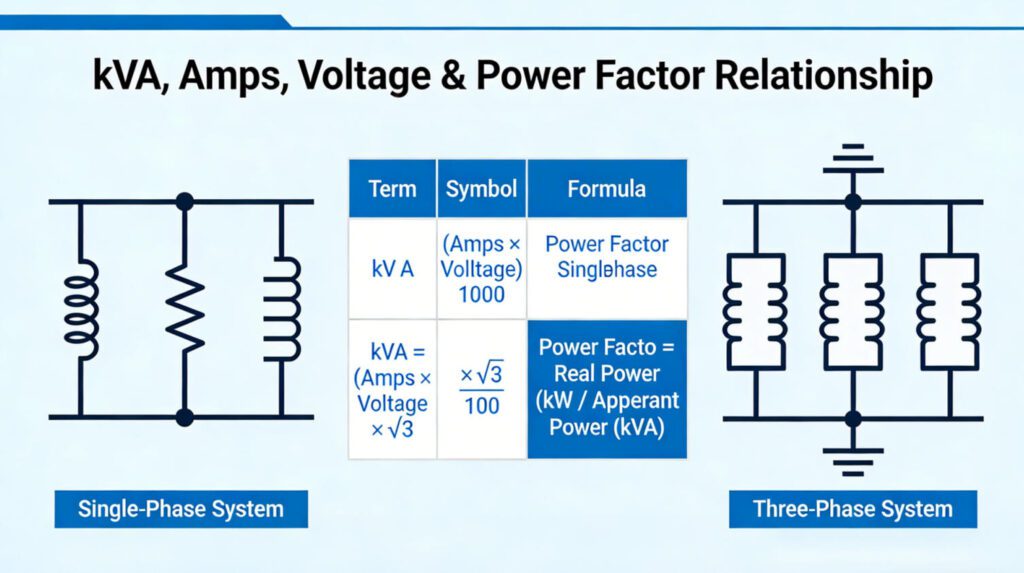
In electrical engineering, kVA (kilovolt-ampere) represents apparent power, while current (amperes, A) directly dictates cable sizing, breaker ratings, and protection settings. A common engineering mistake? Focusing solely on kVA ratings while ignoring actual current requirements. This leads to cable overheating, nuisance breaker trips, and equipment damage.
For BKPOWER’s specialized 10-100KVA dry-type transformers and UPS power systems, accurate kVA to Amps conversion enables engineers to:
- Optimize cable selection: Avoid over-design costs or under-design hazards
- Match protection devices: Ensure breaker ratings align with load characteristics
- Plan for expansion: Reserve 20% capacity for future load growth
- Improve energy efficiency: Reduce reactive losses through power factor correction
2. Key Concepts Overview
| Term | Definition | Engineering Significance |
|---|---|---|
| Apparent Power (kVA) | Product of voltage and current | Equipment capacity baseline |
| Active Power (kW) | Real work-performing power | Basis for electricity billing |
| Reactive Power (kVAR) | Power exchanged in fields | Affects system efficiency |
| Power Factor (PF) | Ratio of kW to kVA | Reflects energy utilization |
Engineering Tip: Industrial loads typically have 0.8 PF. Modern Online UPS systems achieve 0.9+ PF, while Double Conversion UPS using IGBT technology can reach near-unity power factor.
II. Single-Phase kVA to Amps Conversion in Practice
1. Basic Formula and Applications
Single-phase systems dominate residential, small commercial, and Tower UPS applications. The core formula:
I=V×PFS×1000
Where:
- I = Current (A)
- S = Apparent Power (kVA)
- V = Voltage (V)
- PF = Power Factor (typically 0.8-1.0)
2. Practical Calculation Example
Case Study: 10KVA Dry-Type Isolation Transformer Selection
A laboratory needs backup power systems for precision instruments. They select a BKPOWER 10KVA dry-type isolation transformer, 230V system, 0.9 PF.
Calculation: I=230×0.910×1000=20710000≈48.3A
Selection Recommendations:
- Cable size: 6mm² copper (50A capacity)
- Breaker: 63A Type C (1.25x safety margin)
- Grounding: Independent earth for isolation transformer output
3. Single-Phase Quick Reference Table
| kVA Rating | 120V Current (A) | 230V Current (A) | 240V Current (A) | Recommended Application |
|---|---|---|---|---|
| 5 | 41.7 | 21.7 | 20.8 | Small server room |
| 10 | 83.3 | 43.5 | 41.7 | Medical equipment |
| 15 | 125.0 | 65.2 | 62.5 | Industrial control |
| 20 | 166.7 | 87.0 | 83.3 | Commercial building |
| 30 | 250.0 | 130.4 | 125.0 | Data center UPS |
Note: Calculations based on 0.9 PF. Adjust for actual load characteristics.
III. Three-Phase kVA to Amps Conversion and Engineering Applications
1. Line-to-Line vs Line-to-Neutral Voltage
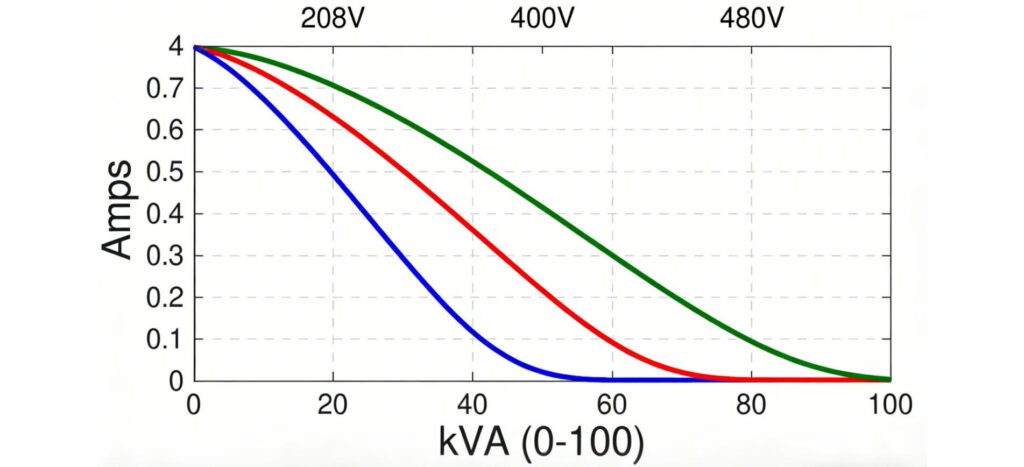
Three-phase systems power industrial facilities and large UPS systems. Understanding the difference between Line-to-Line (VL−L ) and Line-to-Neutral (VL−N ) voltage is critical:
- Line-to-Line: Voltage between phases (e.g., 400V, 480V)
- Line-to-Neutral: Voltage from phase to neutral (e.g., 230V, 277V)
2. Three-Phase Formulas Explained
Line-to-Line Calculation (Most Common):I=3×VL−L×PFS×1000=1.732×VL−L×PFS×1000
Line-to-Neutral Calculation (Special Loads):I=3×VL−N×PFS×1000
3. Industrial Calculation Case Study
Case Study: 50KVA Dry-Type Autotransformer Selection
A manufacturing facility powers CNC machines using a BKPOWER 50KVA dry-type autotransformer, 400V line-to-line, 0.85 PF.
Calculation: I=1.732×400×0.8550×1000=588.950000≈84.9A
Engineering Notes:
- Autotransformers offer higher efficiency than isolation types (98% vs 95%)
- Suitable for non-sensitive load voltage transformation
- Thermal overload relay required (85A setting, matching motor starting current)
4. Three-Phase Quick Reference Table (0.8 PF)
| kVA Rating | 208V Current (A) | 400V Current (A) | 480V Current (A) | Application |
|---|---|---|---|---|
| 10 | 34.7 | 18.0 | 15.0 | Small production line |
| 25 | 86.7 | 45.1 | 37.6 | Commercial building |
| 50 | 173.4 | 90.2 | 75.1 | Industrial equipment |
| 75 | 260.1 | 135.3 | 112.7 | Data center |
| 100 | 346.8 | 180.4 | 150.3 | Large manufacturing |
IV. Coordinated Sizing Strategy for UPS and Transformers
1. UPS Types and kVA Matching
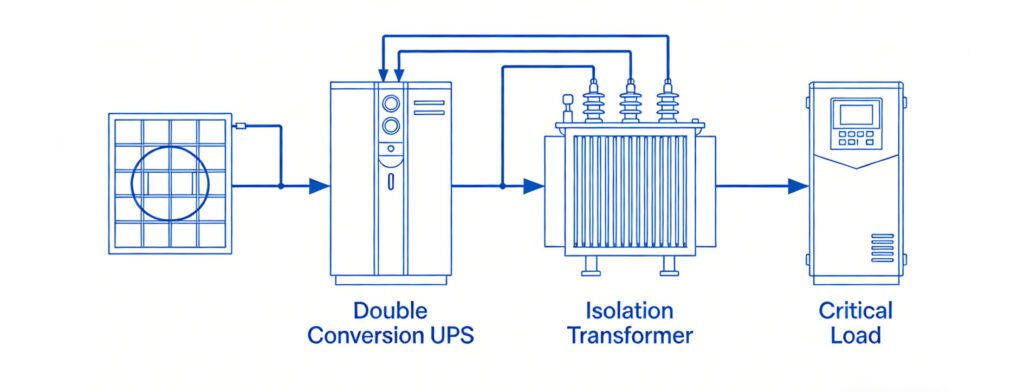
Different UPS power technologies require different transformer considerations:
| UPS Type | Topology | Power Factor | Transformer Sizing Notes |
|---|---|---|---|
| Standby UPS | Offline switching | 0.6-0.7 | Account for inrush current during transfer |
| Line-Interactive | Buck-boost | 0.7-0.8 | Consider voltage regulation range |
| Double Conversion UPS | AC-DC-AC | 0.9-1.0 | Low harmonic content, high transformer utilization |
| Online UPS | Dual conversion | 0.9-0.99 | Zero transfer time, requires isolation transformer |
2. Transformer-to-UPS Capacity Ratio
Golden Rule: Transformer Rating ≥ UPS Rating × 1.25
Example: Sizing isolation transformer for 80KVA Double Conversion UPS
- UPS apparent power: 80KVA
- Recommended transformer: 100KVA (BKPOWER standard)
- Calculated current (400V, 0.95 PF): I=1.732×400×0.95100×1000≈151.9A
3. Harmonic Mitigation and K-Factor Transformers
Modern UPS systems using IGBT rectifiers improve power factor but generate high-frequency harmonics. For THD >5%, specify:
- K-Factor Transformers: Designed for non-linear loads, K-13 or K-20 ratings handle harmonic currents without overheating
- Shielded Isolation Transformers: Suppress common-mode noise for sensitive medical equipment
V. Common Sizing Mistakes and Solutions
1. Mistake 1: Ignoring Inrush Current
Motor loads draw 5-7x rated current at startup. Sizing transformers by steady-state current alone causes voltage sag, triggering UPS bypass or transformer protection.
Solutions:
- Specify soft starters or variable frequency drives (VFD)
- Oversize transformers by 30% minimum
- For frequent starting, select dry-type transformers with high short-term overload capacity
2. Mistake 2: Confusing kVA with kW
Users often equate equipment power (kW) with transformer capacity (kVA), ignoring power factor effects.
Correct Approach: SkVA=PFPkW
Example: 50kW motor load (0.8 PF) requires: S=0.850=62.5kVA→Select 63KVA or 75KVA unit
3. Mistake 3: Neglecting Environmental Factors
Dry-type transformer ratings assume 40°C ambient. High temperature or altitude requires derating:
| Environmental Condition | Derating Factor | Mitigation |
|---|---|---|
| Altitude >1000m | 0.5% per 100m | Specify enhanced insulation |
| Temperature >40°C | 1% per °C | Forced air cooling or upsizing |
| Humidity >95% | Condensation risk | Increase IP rating |
VI. BKPOWER Dry-Type Transformer Selection Guide
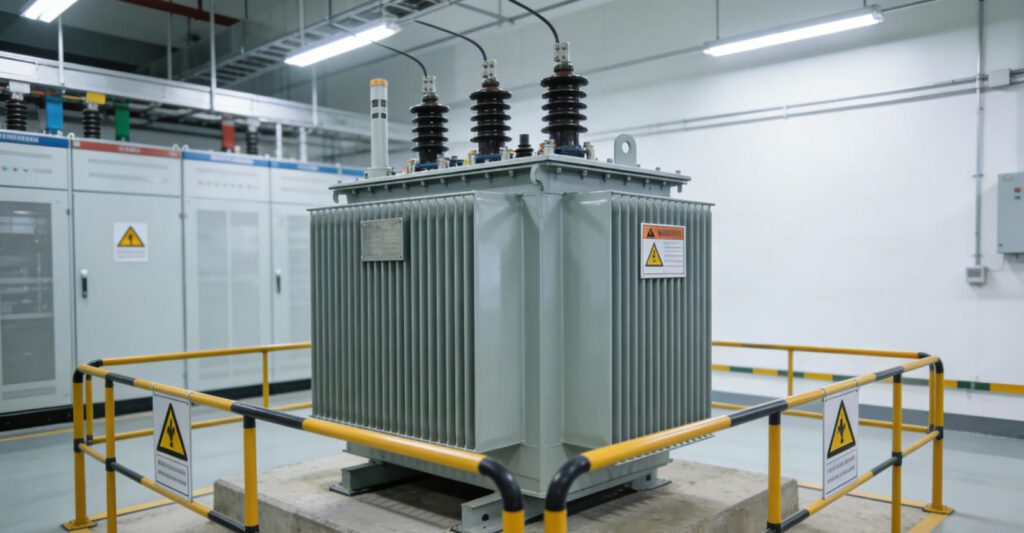
1. 10-100KVA Product Portfolio
Based on these calculation principles, BKPOWER offers comprehensive dry-type transformer solutions:
Dry-Type Autotransformer Series (10-100KVA)
- Voltage classes: 380V/400V/415V/480V
- Connection: Dyn11 or Yyn0
- Efficiency: ≥98%
- Applications: Voltage conversion, energy saving, motor starting
Dry-Type Isolation Transformer Series (10-100KVA)
- Insulation: Class F or H
- Dielectric strength: 3kV/1min
- Applications: Medical IT systems, data centers, industrial automation
2. Technical Support and Customization
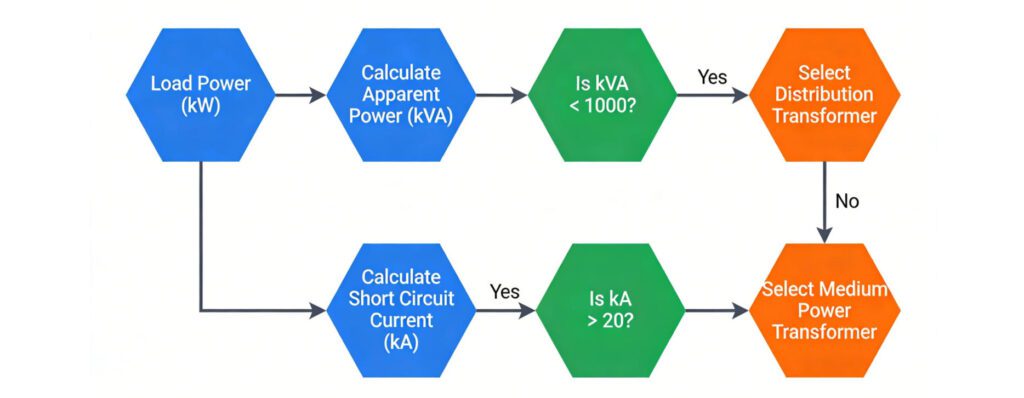
For specialized applications (marine, wind power, rail transit), BKPOWER provides:
- Custom voltage combinations
- K-Factor harmonic withstand designs
- IP rating upgrades (up to IP54)
- Temperature monitoring and smart early warning systems
VII. Conclusion and Action Items
Accurate kVA to Amps conversion underpins reliable power system operation. Whether configuring Online UPS for data centers or selecting dry-type transformers for industrial lines, follow these principles:
- Always reserve 20-25% safety margin
- Distinguish single-phase from three-phase calculations
- Account for power factor effects on actual current
- Plan harmonic mitigation for non-linear loads
- Apply derating factors for environmental conditions
BKPOWER’s 10-100KVA dry-type autotransformer and isolation transformer series, combined with precision sizing tools and engineering support, deliver reliable protection for your critical power applications.
References
- International Electrotechnical Commission (IEC)Official website: www.iec.ch
- Underwriters Laboratories (UL)Official website: www.ul.com
- European Committee for Standardization (CEN)Official website: www.cen.eu
- Standardization Administration of China (SAC)Official website: www.sac.gov.cn
- Zhongguancun Energy Storage Industry Technology Alliance (CNESA)Official website: www.cnESA.org
- International Organization for Standardization (ISO)Official website: www.iso.org