Welcome to BKPOWER!












KVA to Amps Conversion: A Comprehensive Guide
TIPS:Converting kVA to Amps is essential for sizing UPS System, Transformer, and Voltage Stabilizer equipment correctly. This comprehensive guide provides the complete formulas for single-phase and three-phase systems, detailed conversion tables, and real-world BKPOWER product examples. Learn how power factor affects your calculations and why accurate conversion prevents costly equipment failures.
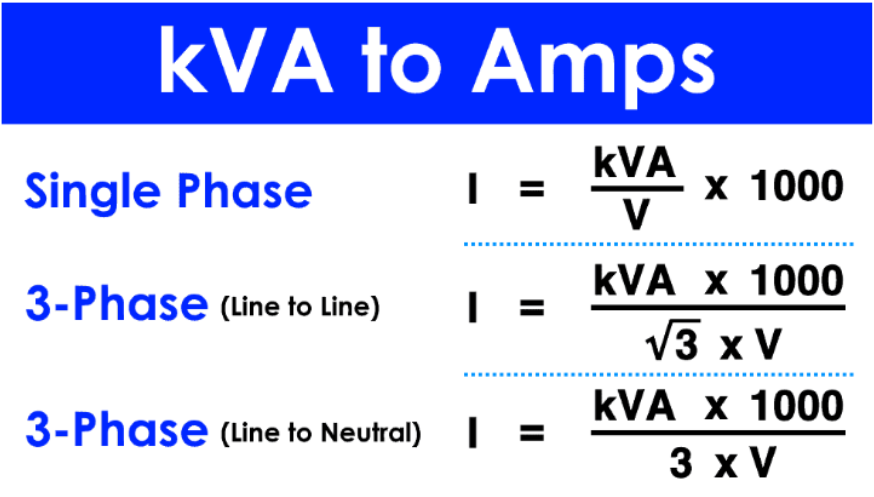
Ⅰ. kVA to Amps Conversion: The Complete Technical Guide
Every electrical project begins with a critical calculation. How much current will your equipment draw? The answer determines breaker sizing, cable selection, and Transformer rating. Get it wrong and you face overheating, tripped breakers, or equipment failure.
kVA (kilovolt-ampere) measures apparent power. It includes both real power and reactive power. Amps (amperes) measures actual current flow. Converting between them requires knowing voltage and system type.
This guide provides complete formulas, conversion tables, and practical examples. Whether you size a UPS System for a data center or select a Transformer for industrial loads, these calculations ensure safe, efficient power distribution.

Ⅱ. Understanding kVA, kW, and Amps
1. What Is kVA?
kVA measures apparent power. It represents the total power flowing through a circuit. This includes both active power (doing useful work) and reactive power (maintaining electromagnetic fields).
The formula is simple:
kVA = (V × I) / 1000
For single-phase systems, V is line-to-neutral voltage. For three-phase systems, V is line-to-line voltage and the result is multiplied by √3.
Equipment like Transformer, UPS System, and generators are rated in kVA. This rating determines the maximum current the equipment can supply without overheating.
2. What Is kW?
kW (kilowatt) measures real power. This is the actual power consumed by the load. It performs useful work like running motors, lighting lamps, or heating elements.
The relationship between kVA and kW involves power factor:
kW = kVA × Power Factor
A Voltage Stabilizer with 10 kVA rating and 0.8 power factor delivers only 8 kW of real power. The remaining 2 kVA is reactive power that oscillates between source and load.
3. What Are Amps?
Amps measures electrical current. It indicates how many electrons flow past a point per second. Breakers, cables, and busbars are all rated in Amps.
Converting kVA to Amps answers the practical question: “What size breaker do I need?” It also determines cable gauge, panel capacity, and protection device rating.

Ⅲ. kVA to Amps Formulas by System Type
1. Single-Phase Systems
Single-phase power uses one alternating voltage waveform. It is common in residential and small commercial applications.
Formula:
I = (kVA × 1000) / V
Where:
- I = Current in Amps
- kVA = Apparent power in kilovolt-amperes
- V = Voltage in volts (line-to-neutral)
Example: A 5 kVA UPS System at 230V:
I = (5 × 1000) / 230 = 21.74 Amps
You would select a 25A or 32A breaker with appropriate safety margin.
2. Three-Phase Line-to-Line Systems
Three-phase power uses three voltage waveforms offset by 120°. It is standard for industrial and large commercial applications. Line-to-line voltage is measured between any two phase conductors.
Formula:
I = (kVA × 1000) / (√3 × V)
Where √3 ≈ 1.732
Example: A 100 kVA Transformer at 400V:
I = (100 × 1000) / (1.732 × 400) = 144.34 Amps
Standard breaker selection would be 160A or 200A depending on load characteristics.
3. Three-Phase Line-to-Neutral Systems
In some configurations, loads connect between phase and neutral rather than phase-to-phase. This requires a different formula.
Formula:
I = (kVA × 1000) / (3 × V)
Where V is line-to-neutral voltage.
Example: A 30 kVA Voltage Stabilizer at 230V line-to-neutral:
I = (30 × 1000) / (3 × 230) = 43.48 Amps per phase
4. Incorporating Power Factor
Real-world loads have power factors less than 1. This affects actual current draw. The complete formula including power factor:
Single-Phase:
I = (kVA × 1000 × PF) / V
Three-Phase Line-to-Line:
I = (kVA × 1000 × PF) / (√3 × V)
Three-Phase Line-to-Neutral:
I = (kVA × 1000 × PF) / (3 × V)
Where PF = Power Factor (typically 0.7 to 1.0)
Example with PF: A 50 kVA generator at 400V three-phase with PF = 0.85:
I = (50 × 1000 × 0.85) / (1.732 × 400) = 61.27 Amps
This is lower than the 72.17 Amps calculated without power factor. Using the wrong formula can lead to oversized or undersized equipment.

Ⅳ. Complete Conversion Tables
1. Single-Phase Conversion Table (230V)
| kVA | Amps (No PF) | Amps (PF=0.8) | Amps (PF=0.9) | Typical Application |
|---|---|---|---|---|
| 1 | 4.35 | 3.48 | 3.91 | Small office UPS |
| 3 | 13.04 | 10.43 | 11.74 | Home backup power |
| 5 | 21.74 | 17.39 | 19.57 | Small server room |
| 10 | 43.48 | 34.78 | 39.13 | Commercial UPS |
| 15 | 65.22 | 52.17 | 58.70 | Medical equipment |
| 20 | 86.96 | 69.57 | 78.26 | Industrial control |
| 30 | 130.43 | 104.35 | 117.39 | Factory automation |
| 50 | 217.39 | 173.91 | 195.65 | Large data center |
2. Three-Phase Conversion Table (400V Line-to-Line)
| kVA | Amps (No PF) | Amps (PF=0.8) | Amps (PF=0.9) | Typical Application |
|---|---|---|---|---|
| 10 | 14.43 | 11.55 | 12.99 | Small workshop |
| 25 | 36.08 | 28.87 | 32.48 | Commercial building |
| 50 | 72.17 | 57.74 | 64.95 | Industrial plant |
| 75 | 108.25 | 86.60 | 97.43 | Manufacturing line |
| 100 | 144.34 | 115.47 | 129.91 | Large factory |
| 160 | 230.94 | 184.75 | 207.85 | Heavy industry |
| 250 | 360.84 | 288.68 | 324.76 | Power distribution |
| 500 | 721.69 | 577.35 | 649.52 | Substation |
3. Three-Phase Conversion Table (480V Line-to-Line)
| kVA | Amps (No PF) | Amps (PF=0.8) | Amps (PF=0.9) | Typical Application |
|---|---|---|---|---|
| 10 | 12.03 | 9.62 | 10.83 | US commercial |
| 25 | 30.07 | 24.06 | 27.06 | US industrial |
| 50 | 60.14 | 48.11 | 54.13 | Factory equipment |
| 75 | 90.21 | 72.17 | 81.19 | Processing plant |
| 100 | 120.28 | 96.23 | 108.25 | Large facility |
| 160 | 192.45 | 153.96 | 173.21 | Heavy machinery |
| 250 | 300.70 | 240.56 | 270.63 | Power grid |
| 500 | 601.41 | 481.13 | 541.26 | Industrial park |

Ⅴ. Power Factor: The Critical Variable
1. What Is Power Factor?
Power factor measures how efficiently electrical power is converted into useful work. It ranges from 0 to 1.
- PF = 1.0: Purely resistive load (heaters, incandescent lamps). All power is real power.
- PF = 0.8–0.9: Typical inductive load (motors, Transformer, fluorescent lights). Some power is reactive.
- PF = 0.6–0.7: Poor power factor (lightly loaded motors, old ballasts). Significant reactive power.
Reactive power does no useful work. It oscillates between source and load, causing additional current flow. This is why a 10 kVA UPS System with PF = 0.8 delivers only 8 kW of real power but still draws full current.
2. Why Power Factor Matters for kVA to Amps
Ignoring power factor leads to incorrect current calculations. Consider a 50 kVA Transformer at 400V:
- Without PF: 72.17 Amps
- With PF = 0.8: 57.74 Amps
- With PF = 0.9: 64.95 Amps
Using the no-PF formula for a PF = 0.8 load results in 25% oversized breakers and cables. This wastes money. Using PF = 1.0 assumptions for PF = 0.7 loads creates undersized equipment that overheats.
3. Improving Power Factor
Power factor correction reduces reactive power. Capacitor banks offset inductive reactance. This brings PF closer to 1.0.
Benefits include:
- Reduced current for the same real power
- Smaller cables and breakers
- Lower energy losses (I²R)
- Avoided utility penalties for low PF
BKPOWERVoltage Stabilizer systems with integrated power factor correction maintain PF above 0.95. This optimizes current draw and reduces infrastructure costs.
Ⅵ. Practical Applications with BKPOWER Products
1. Sizing a BKPOWER UPS System
A data center needs to protect 80 kW of server load at 400V three-phase. The server power supplies have PF = 0.9.
Step 1: Calculate kVA requirement kVA = kW / PF = 80 / 0.9 = 88.89 kVA
Step 2: Add 20% safety margin 88.89 × 1.2 = 106.67 kVA
Step 3: Select standard rating Choose BKPOWER 120 kVA UPS System
Step 4: Calculate current I = (120 × 1000) / (1.732 × 400) = 173.21 Amps
Step 5: Select protection 200A breaker with 240 mm² cable
2. Selecting a BKPOWER Transformer
A factory needs to step down 11 kV to 400V for a 500 kW motor load. Motor PF = 0.85.
Step 1: Calculate kVA kVA = 500 / 0.85 = 588.24 kVA
Step 2: Add 25% for motor starting current 588.24 × 1.25 = 735.3 kVA
Step 3: Select standard rating Choose BKPOWER 800 kVA Transformer
Step 4: Calculate primary current (11 kV) I = (800 × 1000) / (1.732 × 11000) = 41.99 Amps
Step 5: Calculate secondary current (400V) I = (800 × 1000) / (1.732 × 400) = 1,154.73 Amps
3. Configuring a BKPOWER Voltage Stabilizer
A hospital needs stable 230V single-phase power for MRI equipment. Load is 15 kVA. Input voltage varies ±20%.
Step 1: Calculate current I = (15 × 1000) / 230 = 65.22 Amps
Step 2: Select stabilizer rating Choose BKPOWER 20 kVA Voltage Stabilizer (30% margin)
Step 3: Verify input current at low voltage At 184V (230V – 20%), input current increases: I_in = (20 × 1000) / 184 = 108.70 Amps
Step 4: Select input protection 125A breaker with appropriate cable

Ⅶ. Common Mistakes and How to Avoid Them
1. Ignoring Power Factor
Mistake: Using kVA = kW and assuming PF = 1.0 Consequence: Undersized equipment for inductive loads Solution: Always verify load power factor from nameplates or measurements
2. Wrong Voltage Assumption
Mistake: Using line-to-neutral voltage for three-phase calculations Consequence: Current overestimated by 73% (√3 factor) Solution: Verify whether voltage is line-to-line or line-to-neutral
3. Forgetting Safety Margins
Mistake: Selecting equipment at exact calculated kVA Consequence: No capacity for load growth or starting currents Solution: Add 20–25% margin for continuous loads, 50%+ for motor starting
4. Mixing Single-Phase and Three-Phase
Mistake: Applying single-phase formula to three-phase systems Consequence: Current underestimated by 73% Solution: Use √3 factor for all three-phase line-to-line calculations
5. Neglecting Temperature Derating
Mistake: Using standard ratings at high ambient temperatures Consequence: Equipment overheating in tropical or enclosed environments Solution: Apply IEEE C57.91 derating factors for temperature and altitude
Ⅷ. Conclusion
Accurate kVA to Amps conversion is fundamental to electrical system design. It ensures proper UPS System sizing, correct Transformer selection, and reliable Voltage Stabilizer performance. This guide provided complete formulas for single-phase and three-phase systems, detailed conversion tables, and practical BKPOWER product examples.
Remember the key principles. Always verify system voltage and type. Never ignore power factor. Apply appropriate safety margins. Use standardized ratings rather than exact calculations.
BKPOWER provides UPS System, Transformer, and Voltage Stabilizer solutions engineered for accurate power delivery. Our technical team assists with load calculations, equipment selection, and system design. Learn more professional power solutions at www.bkpowers.com.
Reference
FAQ
How do I convert kVA to amps for single-phase power?
Use the formula: I = (kVA × 1000) / V. For example, a 10 kVA load at 230V draws (10 × 1000) / 230 = 43.48 Amps. Always verify actual operating voltage as it affects the result significantly.
What is the three-phase kVA to amps formula?
For line-to-line voltage: I = (kVA × 1000) / (√3 × V), where √3 ≈ 1.732. For a 50 kVA transformer at 400V: (50 × 1000) / (1.732 × 400) = 72.17 Amps. For line-to-neutral: I = (kVA × 1000) / (3 × V).
Why does power factor affect kVA to amps conversion?
Power factor represents efficiency of power usage. A PF of 0.8 means only 80% of apparent power is real power. Including PF in the formula gives actual current draw: I = (kVA × 1000 × PF) / V. Ignoring PF can lead to 20-30% equipment sizing errors.
How much safety margin should I add when sizing equipment?
Add 20-25% for continuous loads like lighting and servers. Add 50% or more for motor starting currents. For a calculated 80 kVA load, select 100 kVA equipment minimum. BKPOWER engineers recommend 30% margin for critical applications.
Can I use the same kVA to amps formula for generators and transformers?
Yes. Both generators and transformers are rated in kVA. The same formulas apply. However, generators typically have lower power factors (0.7-0.8) than transformers. Always check the nameplate PF for accurate conversion.