Bienvenue chez BKPOWER !












Importance of Galvanic Isolation in Medical UPS
TIPS:Galvanic isolation stands as a critical safety feature in medical UPS systems. Transformer based UPS technology provides essential electrical separation between utility power and sensitive medical equipment. This article explores why galvanic isolation matters for patient safety and how transformer based UPS solutions protect MRI and CT scanners. Understanding these concepts ensures compliance with IEC 60601-1 standards while maintaining uninterrupted diagnostic operations.
Ⅰ. Introduction
Patient safety demands uncompromising power quality. Medical environments present unique electrical hazards that standard UPS systems cannot address. Galvanic isolation provides the crucial barrier between dangerous utility power and vulnerable patients.
Medical imaging equipment like MRI and CT scanners requires specialized protection. These machines cost millions of dollars. More importantly, they connect directly to patients during diagnostic procedures. Any electrical fault poses serious risks.
Transformer based UPS systems offer the solution. They provide galvanic isolation that transformerless designs cannot match. This article examines the technical foundations, regulatory requirements, and practical applications of isolated medical power systems.
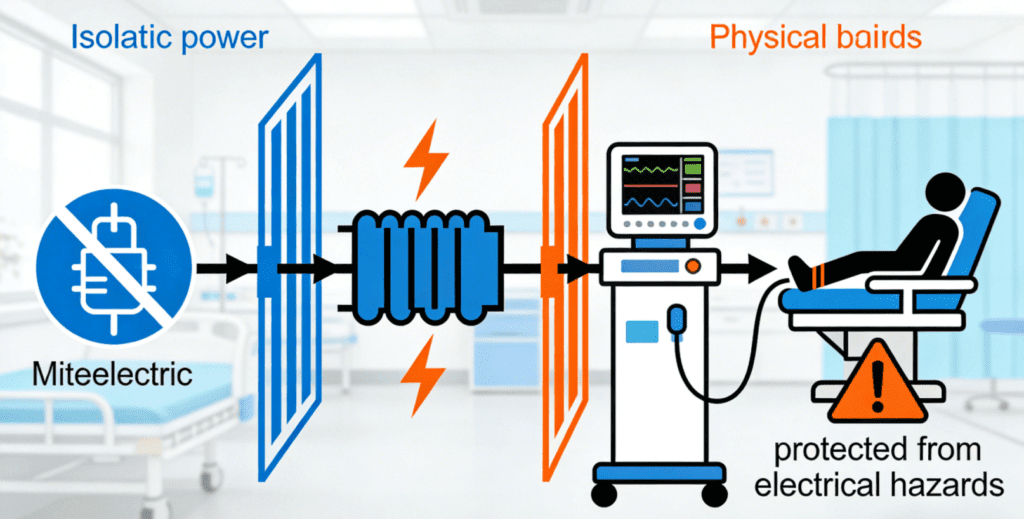
Figure 1: Galvanic isolation creates a physical barrier between utility power and medical equipment. This prevents electrical hazards from reaching patients.
Ⅱ. Fundamentals of Galvanic Isolation
1. What Galvanic Isolation Means
Galvanic isolation refers to the absence of direct electrical connection between two circuits. An transformateur d'isolement achieves this through magnetic coupling rather than electrical conduction. Primary and secondary windings share a common magnetic core. They do not share a physical electrical path.
This separation blocks direct current (DC) and breaks ground loops. It allows alternating current (AC) power transfer while preventing fault currents from flowing through. The transformer acts as a protective barrier.
Medical applications demand this protection. Patients often have reduced skin resistance during procedures. They may connect directly to monitoring equipment. Any stray current can cause microshocks or macroshocks. Isolation transformers reduce leakage currents to safe levels.
2. Isolation Transformer Design
Medical grade isolation transformers feature specific design elements. They use high-grade silicon steel cores. This minimizes eddy current losses and improves efficiency.
Winding configurations matter. Separate primary and secondary windings provide basic isolation. Shielded windings offer enhanced protection. Electrostatic shields between windings block high-frequency noise and transients.
Insulation systems must withstand high voltages. Medical transformers typically feature 4kV or higher isolation ratings. This exceeds standard industrial requirements. The enhanced margin ensures patient safety under fault conditions.
3. Comparison with Transformerless Technologies
Transformerless UPS systems dominate data center applications. They offer higher efficiency and smaller footprints. However, they lack true galvanic isolation.
These systems rely on electronic switching and capacitors. They cannot provide the same level of electrical separation. Common mode noise passes through more easily. Ground loops remain unbroken.
Medical environments require the additional protection. The weight and efficiency trade-offs prove worthwhile. Patient safety outweighs operational considerations.
Ⅲ. MRI and CT Scanner Power Requirements
1. Unique Load Characteristics
Medical imaging equipment presents challenging power profiles. CT scanners illustrate this perfectly. A typical CT unit operates continuously at 20kW. However, during X-ray tube activation, power demand spikes to 90kW or higher. These peaks occur multiple times per minute. Each lasts only milliseconds.
MRI systems show similar behavior. Gradient amplifiers draw massive instantaneous currents. The magnetic field requires stable power. Even minor voltage sags affect image quality.
Standard UPS systems struggle with these loads. They must handle high crest factors. The ratio of peak to average current exceeds typical IT loads. Transformer based UPS designs accommodate these demands better than alternatives.
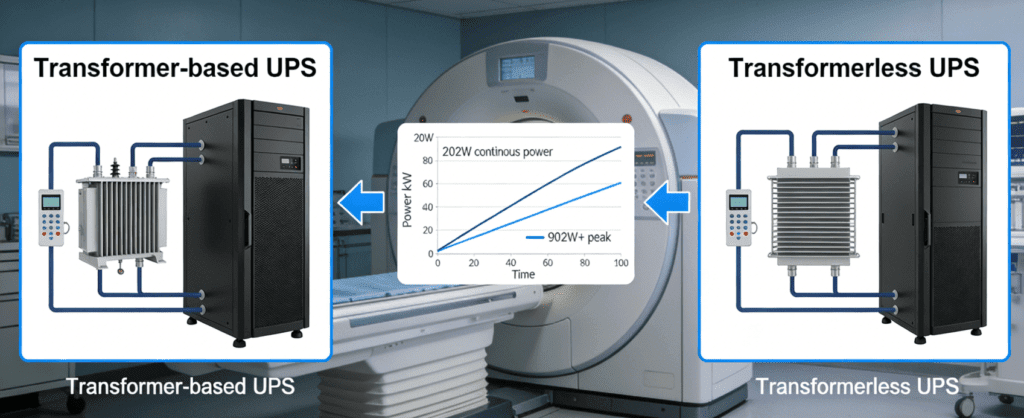
Figure 2: CT scanners demand high crest factor power with 90kW+ peaks against 20kW continuous draw. Transformer-based UPS handles these dynamics better than transformerless alternatives.
2. Harmonic Generation Issues
MRI scanners generate significant harmonic distortion. The pulsed nature of gradient amplifiers creates non-linear loads. Total Harmonic Distortion (THDi) can reach 30-40%. This exceeds typical computer loads.
Harmonics cause problems throughout the electrical system. They heat neutral conductors. They trip protective devices unexpectedly. They reduce system efficiency.
Transformer based UPS systems handle harmonics better. The inherent inductance of the output transformer filters high-frequency components. This provides cleaner power to sensitive imaging equipment.
3. Voltage Regulation Requirements
Medical imaging requires tight voltage regulation. CT scanners typically specify ±6% voltage stability during peak loads. MRI systems demand similar precision.
Transformer based UPS offers superior voltage regulation. The output transformer provides inherent buck/boost capability. This compensates for input voltage variations. It maintains stable output regardless of utility conditions.
Isolation transformers provide additional benefits. They block voltage spikes and transients. They attenuate common mode noise. These disturbances often originate from other hospital equipment.
Ⅳ. Medical Safety Standards and Compliance
1. IEC 60601-1 Requirements
The international standard IEC 60601-1 governs medical electrical equipment. It specifies strict limits for patient leakage current. These limits protect against electric shock hazards.
Type CF (Cardiac Floating) equipment must limit leakage current to 10 microamps. Type BF (Body Floating) equipment allows up to 100 microamps. Even Type B (Basic) equipment requires less than 500 microamps.
Standard UPS systems typically exhibit 1000-3000 microamps of leakage current. This far exceeds medical limits. They cannot safely power patient-connected equipment.
Transformer based UPS with medical grade isolation reduces leakage current dramatically. Properly designed systems achieve less than 100 microamps. This complies with Type BF requirements. Some designs meet the stricter Type CF standards.
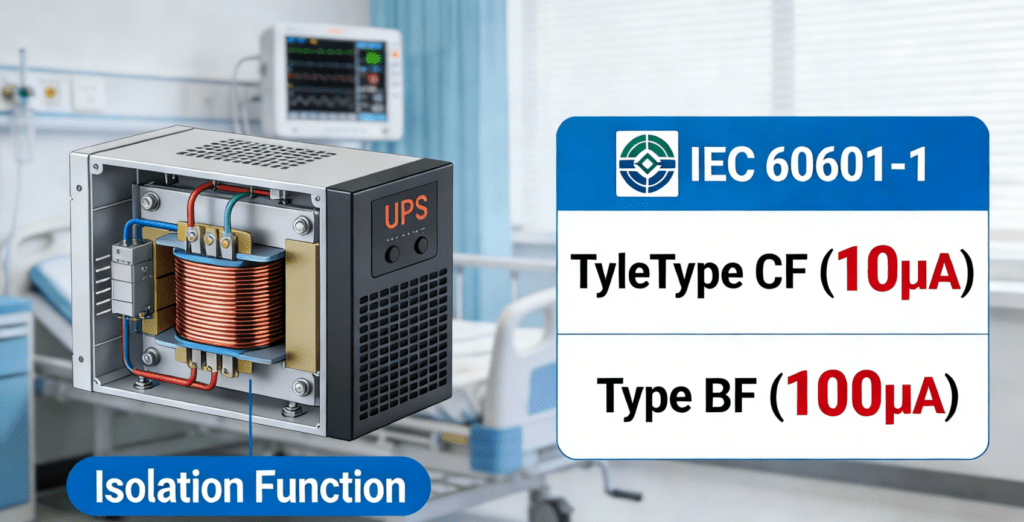
Figure 3: IEC 60601-1 mandates strict leakage current limits. Transformer-based UPS provides the isolation necessary to meet Type CF (10µA) and Type BF (100µA) requirements.
2. Patient Proximity Classifications
Medical standards classify equipment based on patient contact. Patient-connected devices physically attach to patients. Examples include infusion pumps and ECG electrodes. These require the highest isolation levels.
Patient vicinity equipment operates near patients but does not touch them. This includes imaging systems and monitors. They still require isolation but face less stringent limits.
Equipment rooms house support systems like UPS units. These connect to patient vicinity equipment through power distribution. The isolation must span the entire chain.
Transformer based UPS installed in equipment rooms provides primary isolation. This protects the entire downstream distribution system. It ensures that faults cannot propagate to patient areas.
3. Microshock Prevention
Microshocks represent a subtle danger in medical environments. Small currents flowing directly to the heart can cause ventricular fibrillation. Currents as low as 50 microamps prove lethal under certain conditions.
These currents bypass normal skin resistance. They flow through internal electrodes or conductive catheters. Pacemakers and infusion lines create pathways directly to the heart.
Galvanic isolation blocks these current paths. The isolation transformer prevents ground loops from forming. It ensures that fault currents flow to protective earth rather than through patients.
Hospital-grade isolation transformers incorporate special monitoring. They detect insulation degradation before it becomes dangerous. Alarms alert staff to potential hazards.
Ⅴ. Applications in Medical Imaging Suites
1. Radiology Department Architecture
Modern radiology departments integrate multiple imaging modalities. CT, MRI, PET, and angiography systems share common infrastructure. Each requires reliable isolated power.
Centralized transformer based UPS configurations serve entire departments. Large units (100-500 kVA) provide economies of scale. They consolidate battery systems and maintenance points.
Distributed architectures use smaller units near each modality. This reduces cable runs and voltage drop. It improves redundancy through physical separation.
Either approach requires proper isolation. The UPS must provide medical grade output regardless of capacity. Multiple transformer stages may cascade to achieve required isolation levels.
2. Mobile Imaging Considerations
Mobile MRI and CT units serve remote locations. These trailers require self-contained power systems. They face challenging grounding conditions. Site electrical quality varies dramatically.
Transformer based UPS protects mobile units from site deficiencies. Isolation transformers block voltage imbalances and grounding issues. They provide consistent power quality regardless of input conditions.
Mobile units also require noise reduction. Medical grade isolation transformers operate quietly. This matters when equipment shares patient spaces. Silent operation improves patient comfort during scans.
3. Hybrid Operating Rooms
Hybrid operating rooms combine surgical capabilities with imaging. These facilities support complex procedures. They demand the highest power reliability.
Multiple modalities may operate simultaneously. Angiography systems work alongside CT or MRI. Power disturbances affect patient outcomes directly.
Transformer based UPS with isolation serves as the power foundation. It coordinates with hospital generators. It provides seamless transitions during utility failures. Most importantly, it maintains isolation integrity throughout all operating modes.
Ⅵ. Selecting Medical Grade Transformer Based UPS
1. Capacity Sizing Guidelines
Proper sizing ensures adequate protection. MRI and CT scanners require careful analysis. The UPS must handle peak power demands. It must also accommodate harmonic currents.
General guidelines suggest oversizing by 25-30% above nameplate ratings. This accommodates peak loads and inrush currents. It provides headroom for future equipment additions.
Transformer based UPS typically offers better overload tolerance. The output transformer handles temporary overloads without damage. This proves valuable during imaging sequences.
Cooling considerations matter. Medical UPS often installs in equipment rooms. These spaces may lack precision cooling. Transformers add heat load. Adequate ventilation ensures long component life.
2. Monitoring and Alarm Systems
Modern medical UPS includes comprehensive monitoring. Staff must know system status at all times. Critical alarms require immediate attention.
Standard monitoring includes battery status, load levels, and input conditions. Medical applications add isolation monitoring. Insulation resistance measurements detect transformer degradation.
Remote connectivity enables centralized oversight. Facility managers monitor multiple UPS units from one location. Integration with building management systems streamlines operations.
Alarm prioritization distinguishes critical from informational events. Patient safety alarms require instant response. Maintenance alerts allow scheduled intervention.
Ⅶ. Conclusion
Galvanic isolation represents a fundamental requirement for medical UPS systems. It protects patients from electrical hazards while ensuring continuous diagnostic capability. Transformer based UPS technology provides this essential isolation.
MRI and CT scanners demand specialized power protection. Their unique load characteristics challenge standard UPS designs. High crest factors, harmonic generation, and strict voltage regulation require transformer based solutions.
IEC 60601-1 compliance mandates low leakage currents. These limits protect patients from microshock hazards. Only properly designed transformer based UPS systems achieve these requirements consistently.
Healthcare facilities must prioritize isolation when selecting UPS equipment. The investment in transformer based solutions pays dividends through improved safety, enhanced reliability, and regulatory compliance. Patient lives depend on these critical power protection decisions.
Références
- Commission électrotechnique internationale (CEI)Site officiel : www.iec.ch
- Underwriters Laboratories (UL)Site officiel : www.ul.com
- Comité européen de normalisation (CEN)Site officiel : www.cen.eu
- Standardization Administration of China (SAC) Site web officiel : www.sac.gov.cn
- Zhongguancun Energy Storage Industry Technology Alliance (CNESA)Site web officiel : www.cnESA.org
- Organisation internationale de normalisation (ISO)Site officiel : www.iso.org