Welcome to BKPOWER!












State Grid Hubei UPS Project: Industrial-Grade Case for Smart Grid Reliability
Ⅰ. Project Overview
- Enterprise Background
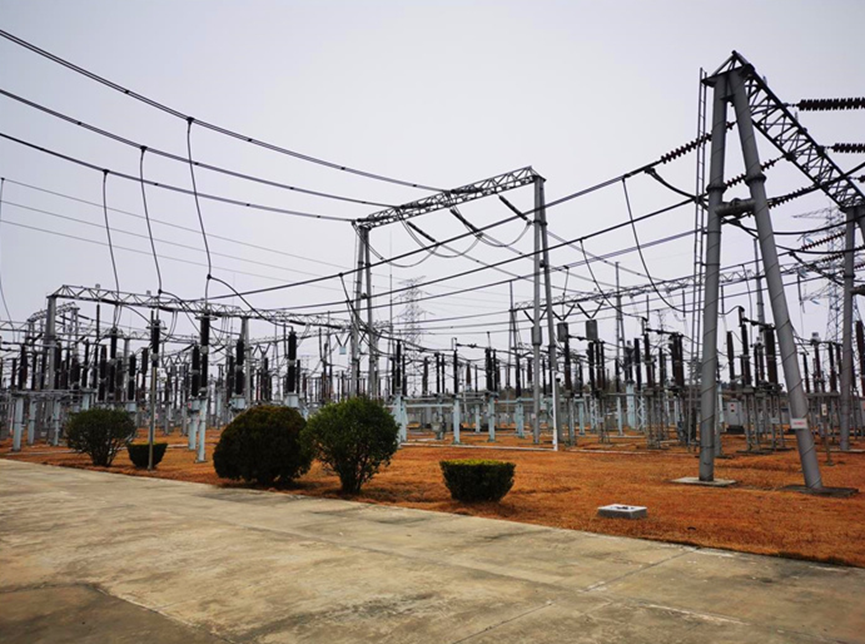
- State Grid Hubei Electric Power Co., Ltd. (Hubei State Grid), a wholly-owned subsidiary of State Grid Corporation of China, manages Hubei’s power grid construction and operation.
- It serves 58 million users via 31 subsidiaries and 83 county-level power supply enterprises, with an annual power supply of >200 billion kWh, acting as Central China’s power hub.
- Power System Upgrade Needs
- Business Continuity: 7×24 operation of power dispatching automation stations is critical to avoid province-wide control failures.
- Equipment Compatibility: Accommodate diverse loads (e.g., MOCVD equipment, NMR instruments).
- Environmental Challenges: High-temperature/humidity in the Jianghan Plain causes overheating in traditional UPS systems.
Ⅱ. Core Challenges
- Power Quality & Reliability
- Harmonic Interference: THDi reaches 6.8% from non-linear loads, affecting relay protection accuracy.
- Instantaneous Overload: Fault recorder startup currents exceed 5,000A, triggering shutdowns in conventional UPS.
- O&M Pain Points
- Decentralized Deployment: 237 sites with independent UPS systems cause 4+ hour response times.
- Battery Aging: Lead-acid batteries (3,000 cycles) incur ¥8M annual replacement costs.
- Energy Efficiency Bottlenecks
- Low Efficiency: Traditional UPS operates at 85%, costing ¥120M annually in electricity.
- Carbon Reduction Target: Meet Hubei’s 20% carbon emission cut under the 14th Five-Year Plan.
Ⅲ. Solution: BKPOWER Industrial-Grade UPS System
- Technical Architecture
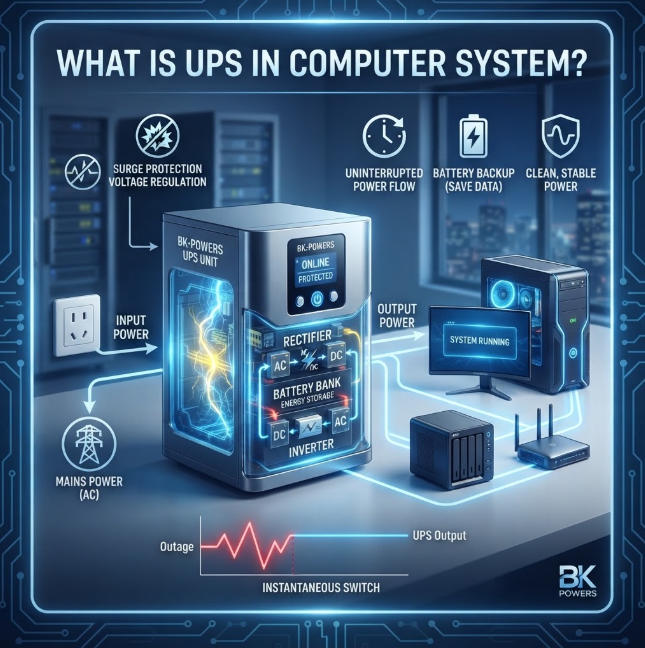
- Dual-Conversion Online Technology:
- Input PF > 0.99, THDi < 3%, output THD < 1%.
- Intelligent Parallel Control:
- 4×100kVA UPS in parallel (400kVA total), N+1 redundancy, ±1% load balancing.
- Dual-Conversion Online Technology:
- Implementation Strategy
- Power Quality Governance: DSP modules reduce THDi to <2%.
- Modular Expansion: 30% capacity reserve for future upgrades.
- Smart O&M: Remote SOH monitoring via Hubei State Grid’s energy management platform.
Ⅳ. Project Achievements
- Reliability Improvements
- 99% Availability: <5 minutes of unplanned downtime annually.
- Faster Fault Response: Self-diagnosis cuts MTTR to ≤30 minutes (70% improvement).
- Energy Efficiency Gains
- Harmonic Mitigation: THDi reduction saves ¥24M/year in electricity.
- Battery Longevity: Lithium iron phosphate batteries (10,000 cycles) cut maintenance costs by 75%.