Welcome to BKPOWER!












kWh to mAh Conversion for Battery Backup Systems: Industrial Sizing Guide
TIPS:When you size a battery backup system for an industrial UPS, you face a unit mismatch. The UPS datasheet shows energy in kWh. The battery supplier lists capacity in mAh. Converting between these units is not optional. It is the first step in accurate procurement. A wrong conversion leads to undersized batteries. That means runtime shortfalls during outages. This guide explains how to convert kWh to mAh for battery backup systems. It covers the formulas, real-world corrections, and industrial sizing workflows used by BKPOWER engineers daily. We also show you how to apply these kWh to mAh conversions to data centers, solar storage, telecom shelters, and manufacturing floors.

Ⅰ. Why kWh to mAh Conversion Matters in Industrial Power
- The Unit Mismatch Problem
kWh measures energy. It tells you how much work a battery can perform. mAh measures charge. It tells you how long a battery can deliver current at a given voltage. You cannot compare them directly. You need voltage as the bridge. Without this bridge, a procurement team might order 10,000 mAh cells for a 5 kWh UPS. The result is a system that dies in minutes instead of hours.
Industrial buyers often receive quotes in mixed units. A UPS vendor quotes in kWh. A battery distributor quotes in mAh. A solar integrator quotes in Ah. You must normalize everything to one unit before you can compare apples to apples. This is where the kWh to mAh conversion becomes critical.
- Where This Conversion Applies
Data center UPS modules use 48V battery banks. Solar storage systems use 12V, 24V, or 48V banks. Telecom shelters use 48V DC plants. Industrial automation uses 24V DC backup. Marine and RV systems use 12V or 24V banks. Each scenario requires converting the energy demand in kWh to the battery capacity in mAh or Ah. This ensures the battery bank meets the runtime specification.
In developing regions, grid instability forces factories to rely on battery backup for hours. A textile mill in Southeast Asia might need 4 hours of UPS runtime. A hospital in Africa might need 8 hours. Without accurate kWh to mAh conversion, these facilities risk critical load failures.
Ⅱ. The Core Formulas: kWh to mAh and Back
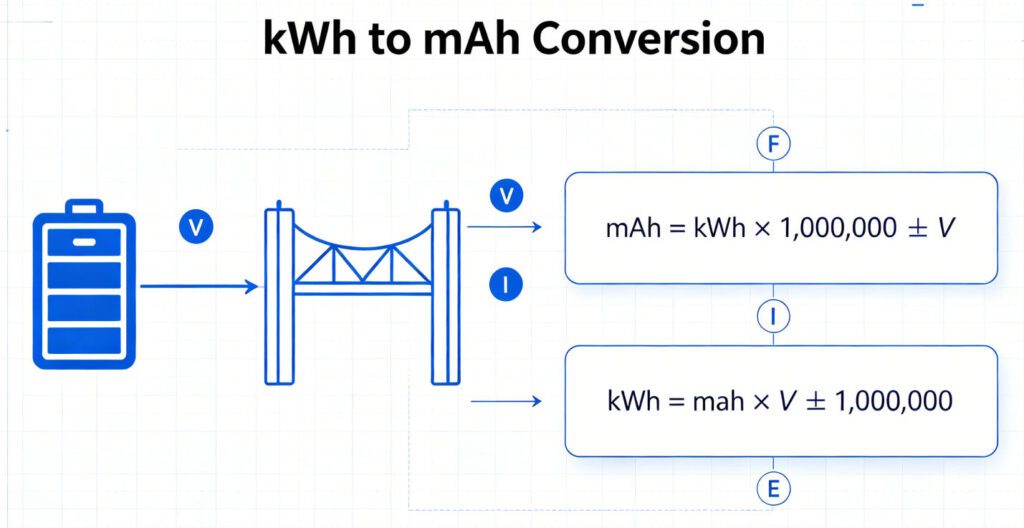
1.kWh to mAh
Use this formula when you know the energy demand and the battery voltage.
mAh equals kWh times 1,000,000 divided by V.
Example: A 2 kWh UPS battery bank at 48V.
2 times 1,000,000 equals 2,000,000. 2,000,000 divided by 48 equals 41,667 mAh. That is 41.67 Ah.
2.Wh to mAh
For smaller systems, use Wh instead of kWh.
mAh equals Wh times 1,000 divided by V.
Example: A 500 Wh portable power station at 12V.
500 times 1,000 equals 500,000. 500,000 divided by 12 equals 41,667 mAh.
3.Reverse: mAh to kWh
Use this when you have a battery spec and need to know the stored energy.
kWh equals mAh times V divided by 1,000,000.
Example: A 100 Ah lithium battery at 12.8V.
100,000 mAh times 12.8 equals 1,280,000. 1,280,000 divided by 1,000,000 equals 1.28 kWh.
4.kWh to Ah
For large industrial systems, Ah is more practical than mAh.
Ah equals kWh times 1,000 divided by V.
Example: A 10 kWh solar battery at 48V.
10 times 1,000 equals 10,000. 10,000 divided by 48 equals 208.3 Ah.
5.Quick Reference Table
| kWh | Voltage | mAh | Ah | | 0.5 | 12V | 41,667 | 41.7 | | 1.0 | 12V | 83,333 | 83.3 | | 2.0 | 24V | 83,333 | 83.3 | | 5.0 | 48V | 104,167 | 104.2 | | 10.0 | 48V | 208,333 | 208.3 | | 20.0 | 48V | 416,667 | 416.7 |
Ⅲ. Real-World Corrections: Why the Math Is Never Perfect
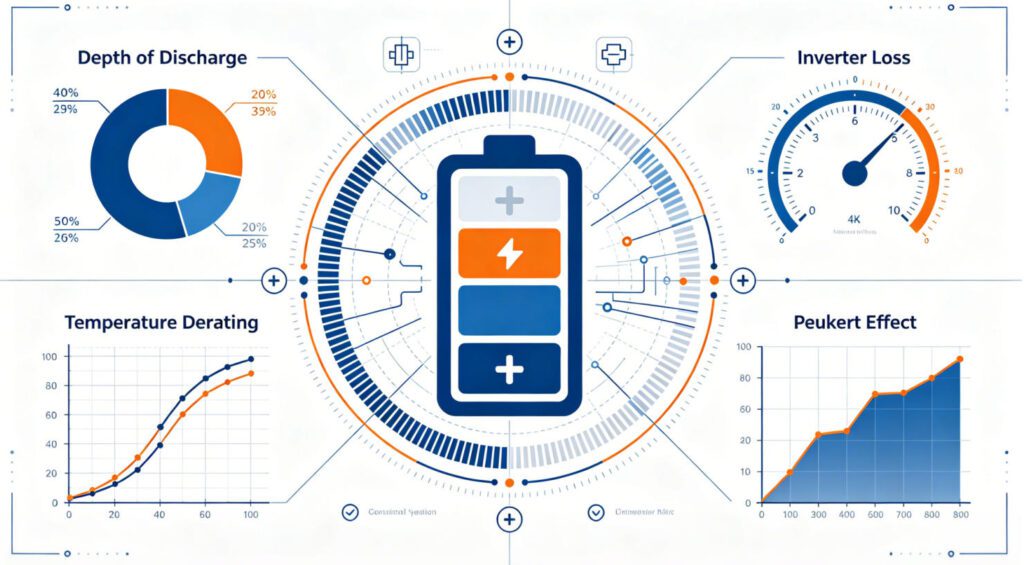
1.Depth of Discharge (DoD)
You cannot use 100 percent of the battery capacity. Lead-acid batteries should not discharge below 50 percent. Lithium-ion batteries tolerate 80 to 90 percent. If your calculation says you need 100 Ah, you must buy 200 Ah of lead-acid capacity. For lithium, buy 125 Ah. This correction alone can double or halve your battery order.
DoD also affects battery life. A lead-acid battery cycled to 50 percent DoD lasts 500 to 800 cycles. The same battery cycled to 80 percent DoD lasts only 200 cycles. For daily cycling applications like solar, lithium is the clear winner.
2.Inverter and Conversion Losses
The inverter that turns DC battery power into AC load power is not 100 percent efficient. Typical UPS inverters run at 92 to 96 percent efficiency. You must divide your calculated capacity by the efficiency factor. If you need 100 Ah net and your inverter is 94 percent efficient, buy 106.4 Ah gross.
Some systems also include a DC-DC converter. This adds another 2 to 5 percent loss. Charge controllers in solar systems lose 3 to 8 percent. Add all these losses together before you finalize your battery size.
3.Peukert’s Law
Battery capacity changes with discharge rate. A 100 Ah battery delivers 100 Ah only at the 20-hour rate. At the 1-hour rate, the same battery might deliver only 60 Ah. High-rate discharge reduces usable capacity. For UPS systems with high discharge currents, apply a Peukert correction factor of 1.1 to 1.3.
Peukert’s law is especially important for industrial UPS. A 10 kW load on a 48V system draws 208A. That is a 2C rate for a 100 Ah battery. At 2C, the usable capacity drops to 70 to 80 percent. Your 100 Ah battery behaves like a 75 Ah battery under this load.
4.Temperature Derating
Battery capacity drops as temperature falls. At 0 degrees Celsius, a lead-acid battery loses 20 to 30 percent capacity. At minus 20 degrees Celsius, it loses 50 percent. Lithium iron phosphate (LiFePO4) performs better in cold but still derates. Always size for the lowest expected operating temperature.
High temperatures also damage batteries. Above 35 degrees Celsius, lead-acid life halves for every 8 degrees of rise. Lithium batteries degrade faster above 45 degrees. Install batteries in climate-controlled rooms whenever possible.
5.End-of-Life Factor
Batteries do not die suddenly. They fade. A lithium battery at end-of-life retains 70 to 80 percent of original capacity. If your system needs 100 Ah on day one, it needs 125 Ah by year 8. Size for end-of-life, not day-one capacity. This extends system life and avoids mid-cycle replacements.
Ⅳ. Step-by-Step Sizing Workflow for Industrial UPS
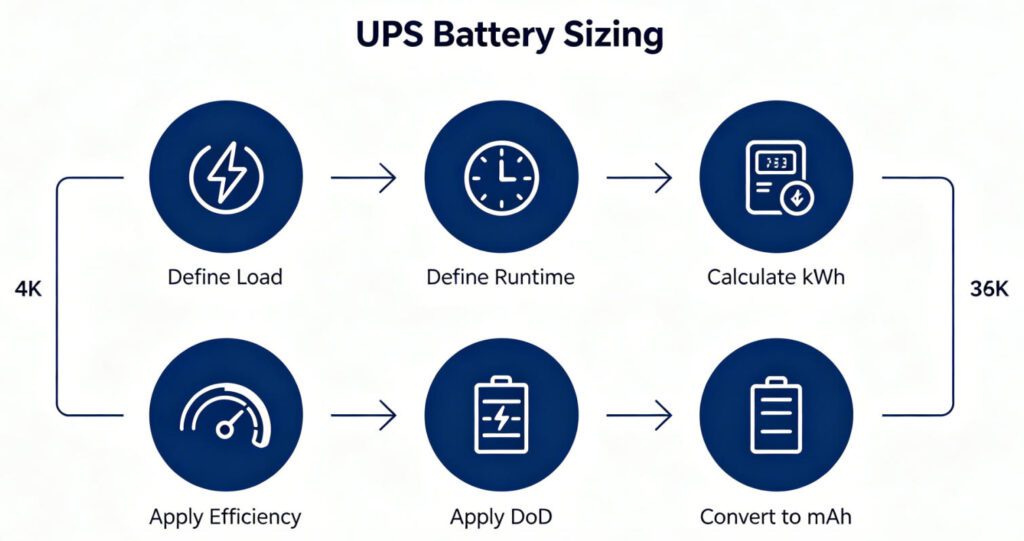
1.Define the Load in kW
List every device the UPS will protect. Sum the wattage. Convert to kilowatts. Example: 5 servers at 400W each plus 2 switches at 150W each equals 2,300W. That is 2.3 kW. Add 20 percent for future growth. Revised load equals 2.76 kW.
2.Define Required Runtime
How long must the UPS sustain the load? For data centers, 10 to 15 minutes is enough for generator startup. For telecom shelters, 4 to 8 hours is common. For solar off-grid, 24 to 48 hours may be needed. For manufacturing, 30 minutes to 2 hours allows orderly shutdown.
3.Calculate Raw Energy Demand in kWh
Multiply load in kW by runtime in hours. Example: 2.76 kW times 0.5 hours equals 1.38 kWh for 30 minutes of runtime. For 4 hours of telecom backup at 2 kW, raw energy equals 8 kWh.
4.Apply Efficiency and DoD Corrections
Divide by inverter efficiency. Divide by DoD limit. Example: 1.38 kWh divided by 0.94 equals 1.468 kWh. Then divide by 0.8 DoD equals 1.835 kWh gross. For the 8 kWh telecom example at 92 percent efficiency and 50 percent DoD, gross equals 17.39 kWh.
5.Convert to mAh at System Voltage
Use the formula. Example: 1.835 kWh at 48V equals 38,229 mAh. That is 38.2 Ah. Round up to the next standard battery size. For the telecom example at 48V, 17.39 kWh equals 362,292 mAh or 362 Ah.
6.Select Battery Configuration
Choose series and parallel arrangements. Four 12V 100Ah batteries in series make 48V 100Ah. Four strings in parallel make 48V 400Ah. Ensure all batteries in a string are identical. Same brand, same model, same age. Mismatched batteries create imbalance and early failure.
Ⅴ. Battery Chemistry Comparison for Backup Systems
1.VRLA Lead-Acid
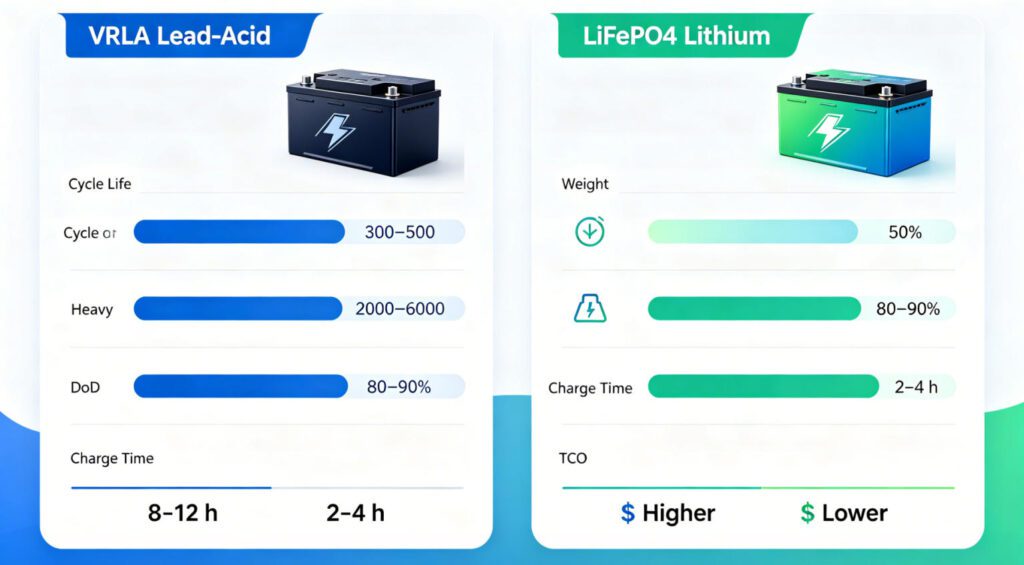
VRLA batteries cost less upfront. They last 3 to 5 years. They tolerate 50 percent DoD. They are heavy. They need ventilation. They work well in temperature-controlled rooms. For a 10 kWh system at 48V, you need about 417 Ah of VRLA capacity. They are recyclable and widely available. They are the default choice for budget-sensitive projects.
2.Lithium-Ion LiFePO4
LiFePO4 batteries cost more upfront. They last 8 to 15 years. They tolerate 80 to 90 percent DoD. They are 50 to 70 percent lighter. They charge faster. They need no ventilation. For the same 10 kWh system at 48V, you need only 260 Ah of LiFePO4 capacity. Over 10 years, the total cost of ownership is lower. They also support higher discharge rates without Peukert penalty.
3.Nickel-Cadmium and Nickel-Metal Hydride
These chemistries are rare in modern UPS systems. NiCd tolerates extreme temperatures. It is toxic and heavily regulated. NiMH offers moderate performance. It is mostly used in small consumer devices. Industrial UPS systems today choose between VRLA and LiFePO4.
4.Sodium-Ion and Emerging Chemistries
Sodium-ion batteries are emerging as a low-cost alternative. They use abundant raw materials. They are safer than lithium. They tolerate wide temperature ranges. Energy density is lower. They suit stationary storage where weight does not matter. BKPOWER monitors these technologies for future integration.
Ⅵ. Application Scenarios and Case Studies

1.Data Center UPS Module
A 20 kW rack needs 15 minutes of runtime. Raw energy equals 20 kW times 0.25 hours equals 5 kWh. With 94 percent inverter efficiency and 80 percent DoD, gross energy equals 6.65 kWh. At 48V, this equals 138,542 mAh or 138.5 Ah. A modular LiFePO4 bank with 150 Ah modules fits perfectly. BKPOWER modular UPS systems support hot-swappable battery modules. You can add capacity without downtime.
2.Solar Home Storage
A home solar system stores 10 kWh daily. At 48V, raw capacity equals 208,333 mAh. With 90 percent DoD for LiFePO4, gross equals 231,481 mAh. Four 60 Ah batteries in parallel provide 240 Ah. This covers daily usage with margin. BKPOWER solar inverters integrate with LiFePO4 banks for seamless charge and discharge management.
3.Telecom Shelter
A remote telecom shelter runs 2 kW of radio equipment. It needs 8 hours of backup. Raw energy equals 16 kWh. With 92 percent efficiency and 50 percent DoD for VRLA, gross equals 34.8 kWh. At 48V, this equals 725,000 mAh. A 750 Ah VRLA bank or a 450 Ah LiFePO4 bank is required. BKPOWER offers wide-temperature UPS systems for telecom shelters. They operate from minus 20 to 55 degrees Celsius.
4.CNC Manufacturing Backup
A CNC machine draws 5 kW. It needs 30 minutes for orderly shutdown. Raw energy equals 2.5 kWh. With 95 percent efficiency and 80 percent DoD, gross equals 3.29 kWh. At 24V, this equals 137,083 mAh. A 150 Ah LiFePO4 bank at 24V is sufficient. BKPOWER industrial UPS systems in the 10 to 200 kVA range support these loads with pure sine wave output.
5.Marine and Offshore
A fishing vessel needs 5 kWh of backup for navigation and communication. At 24V, raw capacity equals 208,333 mAh. With 80 percent DoD, gross equals 260,417 mAh. Two 150 Ah LiFePO4 batteries in parallel provide 300 Ah. This covers 6 hours of runtime at 800W average load. BKPOWER marine-grade UPS systems resist salt spray and vibration.
Ⅶ. Common Mistakes to Avoid
1.Ignoring Voltage
The most common error is forgetting voltage. 10,000 mAh at 3.7V is only 37 Wh. 10,000 mAh at 12V is 120 Wh. The same mAh number means vastly different energy at different voltages. Always include voltage in your calculations. A buyer who sees 50,000 mAh and assumes high capacity without checking voltage will be disappointed.
2.Using Nominal Voltage for the Entire Discharge Curve
A 12V lead-acid battery starts at 12.8V and ends at 10.5V. The average is about 12V. Using 12.8V for the entire calculation overestimates capacity. Using 10.5V underestimates it. Use the nominal voltage listed on the datasheet. For lithium, the nominal voltage is typically 3.2V per cell for LiFePO4 and 3.7V for NMC.
3.Forgetting the Safety Margin
Never size to 100 percent of calculated capacity. Add 10 to 20 percent margin for battery aging, temperature effects, and unexpected load spikes. A battery that is 90 percent full on day one will be 70 percent full after three years of cycling. The safety margin buys you time and reliability.
4.Mixing Series and Parallel Configurations
Batteries in series add voltage. Batteries in parallel add capacity. Four 12V 100Ah batteries in series make 48V 100Ah. Four in parallel make 12V 400Ah. Mixing these up destroys your calculation. Draw the configuration diagram before you order. Label each string clearly during installation.
5.Neglecting BMS Compatibility
Lithium batteries require a battery management system (BMS). The BMS balances cells. It protects against overcharge and overdischarge. It monitors temperature. Ensure your BMS matches your battery chemistry and voltage. A mismatched BMS can destroy a lithium battery bank in weeks.
Ⅷ. BKPOWER Factory-Direct Solutions
BKPOWER designs and manufactures UPS systems and battery backup solutions. Our engineers perform kWh to mAh conversions daily. We provide custom battery banks for data centers, telecom, solar, and industrial automation. Our LiFePO4 battery modules integrate with our online double-conversion UPS series. We offer CE, ISO 9001, and IEC 62040 certified products.
Our factory-direct model eliminates distributor markup. You get custom voltage, capacity, and firmware. You get full certification traceability. You get direct access to our R&D team. Contact BKPOWER for a free sizing consultation. We review your load profile, runtime needs, and environmental conditions. We deliver the right battery backup system the first time.
Reference Sources
- International Electrotechnical Commission (IEC)Official website: www.iec.ch
- Underwriters Laboratories (UL)Official website: www.ul.com
- European Committee for Standardization (CEN)Official website: www.cen.eu
- Standardization Administration of China (SAC)Official website: www.sac.gov.cn
- Zhongguancun Energy Storage Industry Technology Alliance (CNESA)Official website: www.cnESA.org
- International Organization for Standardization (ISO)Official website: www.iso.org
FAQ
How do I convert kWh to mAh for my UPS battery bank?
Multiply kWh by 1,000,000. Divide by the battery voltage. The result is mAh. For example, 2 kWh at 48V equals 41,667 mAh. Always apply DoD and efficiency corrections after the basic conversion.
Why does my battery deliver less capacity than the label says?
Real-world capacity depends on discharge rate, temperature, and age. Peukert’s law reduces capacity at high discharge rates. Cold temperatures reduce chemical reaction rates. After 500 cycles, a lithium battery may retain only 80 percent of original capacity.
Can I use a 12V battery for a 48V UPS system?
Yes, but you need four 12V batteries in series. This adds voltage while keeping the same Ah capacity. Never mix old and new batteries in series. Their internal resistance differences cause imbalance.
What is the difference between kWh and kVA in UPS sizing?
kWh measures energy storage. kVA measures power capacity. A UPS might be rated 10 kVA but only store 5 kWh. The kVA rating tells you the maximum load it can support. The kWh rating tells you how long it can support that load.
How does temperature affect my battery backup runtime?
At 25 degrees Celsius, a battery delivers 100 percent rated capacity. At 0 degrees Celsius, a lead-acid battery delivers 70 to 80 percent. At minus 20 degrees, it delivers 50 percent. LiFePO4 performs better but still derates. Size your bank for the coldest expected temperature.
Should I choose VRLA or lithium for my battery backup system?
Choose VRLA if upfront cost is critical and the environment is temperature-controlled. Choose LiFePO4 if you need long life, light weight, fast charging, or wide temperature tolerance. Over 10 years, LiFePO4 typically costs less in total ownership.