Welcome to BKPOWER!












The Impact of Poor Grid Quality on Industrial UPS Selection
TIPS:Poor grid quality significantly impacts industrial UPS system selection and operational reliability. Voltage fluctuations, frequency drift, and power quality disturbances require specialized UPS solutions beyond standard specifications. Understanding how grid instability affects UPS performance helps facility managers select appropriate input voltage ranges and frequency tolerances. This article analyzes common power quality issues and provides selection strategies for unstable grid UPS solutions.
Ⅰ. Introduction
Power quality varies dramatically across industrial sites. While urban commercial facilities enjoy stable grid connections, manufacturing plants in industrial zones face constant voltage disturbances. Remote locations and developing regions experience even more severe grid instability. These power quality challenges directly impact UPS performance and longevity.
An industrial UPS system designed for pristine laboratory conditions will struggle in real-world industrial environments. Understanding how poor grid quality affects UPS selection prevents costly mistakes and ensures reliable power protection.
This article examines the relationship between grid quality and UPS requirements. We analyze common power quality disturbances including voltage fluctuations, frequency drift, and harmonic distortion. We provide practical selection strategies for unstable grid UPS solutions. Whether operating in established industrial zones or remote facilities, these principles ensure your UPS investment delivers reliable protection.
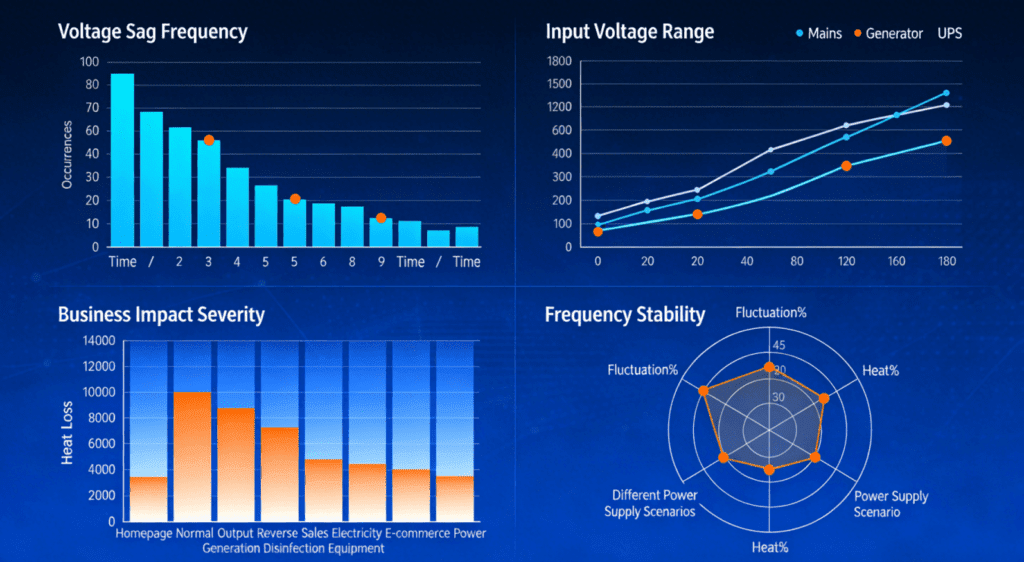
Figure 1: Analysis of power quality issues showing voltage sag frequency, input voltage range comparison, business impact severity, and frequency stability across different supply scenarios.
Ⅱ. Understanding Power Quality Challenges
1. Common Grid Quality Issues in Industrial Environments
Industrial power networks experience more disturbances than commercial or residential grids. Understanding these disturbances helps specify appropriate UPS protection.
Voltage Sags (Dips): Brief voltage reductions lasting 10ms to 1 minute. Caused by motor starting, arc furnace operations, or remote grid faults. Industrial facilities experience sags weekly, sometimes daily. Standard UPS tolerates ±10% voltage variation, but severe sags reach -30% or more.
Voltage Swells: Brief voltage increases typically following fault clearing or capacitor switching. Less common than sags but equally damaging. Swells stress equipment insulation and cause overvoltage trips.
Frequency Drift: Industrial grids with significant motor loads or distributed generation show frequency instability. Standard frequency is 50Hz or 60Hz ±0.5%. Severe industrial sites experience ±2-5Hz variation, especially when operating from generator backup.
Harmonic Distortion: Non-linear industrial loads create voltage waveform distortion. Total Harmonic Distortion (THD) exceeds 8-10% in heavy industrial environments. Standard UPS may struggle with distorted input waveforms.
Voltage Transients: Lightning strikes, switching operations, and fault conditions create high-energy spikes. Industrial sites without proper surge protection experience frequent transients exceeding 2kV.
2. Measuring Grid Quality
Before selecting UPS equipment, assess actual site conditions. IEEE 519 and IEC 61000 standards define power quality measurement methodologies.
Power Quality Analyzers: Portable instruments record voltage, current, and frequency over extended periods. Class A analyzers per IEC 61000-4-30 provide measurement uncertainties of 0.1% for voltage magnitude.
Key Parameters to Monitor:
- RMS voltage variation (min/max/average)
- Frequency stability (standard deviation)
- Voltage sag/swell magnitude and duration
- THD (voltage and current)
- Transient events (count and magnitude)
- Outage frequency and duration
Monitor for minimum one week, preferably one month. Capture seasonal variations and different operational modes. Manufacturing facilities should monitor during both production peaks and shutdowns.
3. Grid Quality Categories
Classify your site based on monitoring results:
Category 1 – Standard Grid: Voltage variation ±10%, frequency ±0.5Hz, THD <5%. Standard commercial UPS sufficient.
Category 2 – Industrial Grid: Voltage variation ±15%, frequency ±1Hz, THD 5-8%. Industrial-grade UPS with extended input ranges required.
Category 3 – Poor Grid: Voltage variation ±25%, frequency ±2Hz, THD >8%. Specialized industrial UPS with wide input tolerance essential.
Category 4 – Extreme Conditions: Voltage variation >±25%, frequency ±5Hz, frequent outages >1/month. Industrial UPS with enhanced protection plus additional power conditioning.
Most industrial facilities fall into Categories 2 or 3, requiring UPS systems beyond standard commercial specifications.
Ⅲ. Voltage Fluctuation and UPS Selection
1. Input Voltage Range Requirements
UPS input voltage range determines its ability to tolerate grid disturbances without switching to battery power. Wider ranges reduce battery cycling and improve system life.
Standard Commercial UPS: ±10% input voltage range (342-418V for 380V nominal). Suitable for Category 1 grids only. Battery engages frequently during normal grid fluctuations, reducing battery life.
Industrial UPS – Standard: ±15% range (323-437V). Handles typical industrial voltage variations. Suitable for Category 2 grids under normal conditions.
Industrial UPS – Wide Range: ±20-25% range (304-475V for ±25%). Accommodates severe sags and swells. Ideal for Category 3 grids with significant voltage instability.
The BKPOWER industrial UPS system offers ±25% input voltage range, handling voltage sags to 285V without battery discharge. This specification suits manufacturing environments with heavy motor loads and welding operations.
2. Voltage Sag Response Strategies
Voltage sags present the most common power quality challenge. UPS response determines equipment protection quality.
Passive Acceptance: Wide input voltage range allows UPS to continue normal operation through sags without battery engagement. Reduces battery cycling by 70-80% compared to standard UPS.
Active Voltage Regulation: Some advanced UPS incorporate boost/buck transformers or electronic voltage regulators. These actively correct voltage deviations, maintaining precise output even during severe input sags.
Battery Support: When sags exceed input tolerances, battery provides seamless power. Runtime depends on battery capacity and load. Frequent sags require larger battery banks or enhanced charging systems.
For sites experiencing daily sags, wide-input-range UPS pays dividends through extended battery life and reduced maintenance. Standard UPS batteries in sag-prone environments require replacement every 2-3 years versus 4-5 years for wide-range systems.
3. Overvoltage Protection Strategies
Voltage swells and temporary overvoltages also challenge UPS systems.
Input Circuit Breakers: Protect UPS from sustained overvoltage. Fast-acting electronic breakers clear faults within milliseconds, protecting downstream equipment.
Surge Suppression: Metal oxide varistors (MOVs) and transient voltage suppression (TVS) diodes clamp voltage spikes. Industrial sites require enhanced surge protection beyond standard UPS internal components.
Transfer to Bypass: Some industrial UPS bypass the rectifier-inverter chain during severe overvoltage, connecting load directly to input through protective circuits. This feature prevents inverter damage while maintaining protection.
Specifications should address both undervoltage (sags) and overvoltage (swells) conditions. Input voltage range specifications typically cover both extremes.
Ⅳ. Frequency Drift Considerations
1. Frequency Tolerance Specifications
AC equipment expects stable frequency. Frequency variations affect UPS operation and output quality.
Standard UPS Tolerance: ±0.5Hz (50Hz grid = 49.5-50.5Hz acceptable). Matches utility grid standards in developed regions. Insufficient for generator-backed systems or weak grids.
Industrial UPS Tolerance: ±2Hz (48-52Hz for 50Hz grid). Accommodates generator frequency variations and grid instability common in industrial areas.
Wide Frequency Range: ±5Hz (45-55Hz) or ±10Hz (40-60Hz). Handles extreme conditions including 50/60Hz mixed environments and severely unstable generator systems.
Generator-powered facilities particularly benefit from wide frequency tolerance. Generator frequency varies with load changes, especially during motor starting. UPS must track these variations without switching to battery constantly.
2. Generator Compatibility
Industrial facilities often rely on generators during peak demand or outages. Generator power quality differs significantly from utility grids.
Frequency Stability: Generators show ±2-3Hz frequency variation during load changes. Standard UPS may reject generator power as “out of tolerance,” refusing to transfer or constantly cycling batteries.
Voltage Regulation: Generator voltage regulation is slower and less precise than utility. Voltage swings of ±15% are common during load steps.
Waveform Distortion: Generator output shows higher harmonic distortion, especially with non-linear UPS loading.
Industrial UPS systems must be “generator-friendly,” accepting the wider voltage and frequency variations typical of standby power. Look for specifications mentioning generator compatibility or wide input ranges specific to generator applications.
3. 50/60Hz Universal Operation
Some industrial facilities require equipment that operates at both 50Hz and 60Hz. This is common for:
- International manufacturing with standardized equipment
- Marine and offshore applications
- Mobile equipment and rental units
Fixed Frequency UPS: Designed for specific grid frequency. Operating at wrong frequency causes immediate shutdown or damage. Not suitable for mixed-frequency environments.
Selectable Frequency: UPS operates at either 50Hz or 60Hz based on configuration switch. Requires manual selection and restart.
Auto-Sensing Universal: UPS automatically detects input frequency (45-65Hz range) and tracks accordingly. Output frequency matches input or converts based on setting. Ideal for flexible industrial applications.
The BKPOWER industrial UPS system features automatic frequency detection from 45-65Hz, accommodating both 50Hz and 60Hz grids without configuration changes. This flexibility supports global manufacturing operations and mixed infrastructure environments.
Ⅴ. Harmonic Distortion and Power Quality
1. THD Impact on UPS Performance
Total Harmonic Distortion affects UPS operation in multiple ways. High THD input waveforms challenge rectifier circuits and reduce efficiency.
Standard UPS rectifiers expect sinusoidal input. Distorted waveforms cause:
- Increased rectifier heating (20-30% higher losses)
- Input current distortion reflecting back to grid
- Reduced power factor
- Premature component failure
Industrial sites with VFDs, arc furnaces, and switch-mode power supplies typically see voltage THD of 5-10%, with current THD much higher. Standard UPS may operate at reduced capacity or trigger alarms in these conditions.
2. Input Power Factor Correction
Poor grid quality often correlates with poor power factor. Lagging power factor from industrial motors strains distribution systems.
Modern industrial UPS incorporates Active Power Factor Correction (PFC). Benefits include:
- Input power factor near unity (0.95-0.99)
- Reduced current draw for same load
- Lower distribution losses
- Generator compatibility (smaller generator sizing)
- Reduced harmonic distortion
Active PFC rectifiers use high-frequency switching to shape input current. This technology handles distorted input voltages better than older passive rectifiers.
Specifications to Look For:
- Input power factor >0.95
- THDi (current distortion) <5-8%
- Wide voltage range operation maintained with PFC active
The BKPOWER industrial UPS system achieves 0.95 input power factor with optional input filters, reducing upstream system loading and improving generator compatibility.
3. Isolation and Protection
Industrial UPS provides electrical isolation between grid and critical loads. This isolation protects against:
Common Mode Noise: Ground-referenced noise from industrial switching operations. Transverse Mode Noise: Line-to-line disturbances from arc furnaces and welders. Ground Loops: Prevents circulating currents through grounding systems.
The output isolation transformer in industrial frequency UPS systems provides this protection inherently. High-frequency transformerless UPS rely on electronic isolation, which may be less robust against severe transients.
For extremely poor grid quality, consider additional external power conditioning:
- Isolation transformers
- Active harmonic filters
- Voltage regulators
- Surge protection devices (SPDs)
These supplement UPS protection for the most challenging environments.
Ⅵ. Selection Strategies for Poor Grid Conditions
1. Matching UPS to Grid Category
Select UPS specifications based on your site’s grid quality category:
Category 2 (Industrial Grid):
- Input voltage range: ±15% minimum
- Frequency tolerance: ±1Hz
- THD handling: <8% without derating
- Recommended: Standard industrial UPS with enhanced specifications
Category 3 (Poor Grid):
- Input voltage range: ±20-25%
- Frequency tolerance: ±2Hz or better
- THD handling: >8% capability
- Surge protection: Enhanced internal or external SPDs
- Recommended: Wide-input-range industrial UPS like BKPOWER with ±25% tolerance
Category 4 (Extreme):
- Input voltage range: ±25% or wider
- Frequency tolerance: ±5Hz
- Additional conditioning: External voltage regulators or ferroresonant transformers
- Battery: Oversized for frequent deep discharges
- Recommended: Specialized industrial UPS plus comprehensive conditioning
2. Battery Considerations for Poor Grids
Poor grid quality increases battery cycling frequency. This affects battery sizing and technology selection.
Battery Sizing: Poor grid sites need 50-100% more battery capacity than standard sites. Frequent discharges require larger banks to maintain adequate runtime.
Battery Technology:
- VRLA: Standard choice, 3-5 year life in poor grid conditions
- Gel Cell: Better cycle life (5-7 years), higher cost
- Lithium-Ion: Longest cycle life (10+ years), highest initial cost, requires thermal management
Charging Systems: Poor grid sites need robust charging systems that can restore battery charge quickly between frequent discharges. Temperature-compensated charging is essential.
Consider battery monitoring systems that track cycle count and depth of discharge. This data helps predict remaining battery life and schedule replacement before failure.
3. Maintenance and Monitoring
Poor grid conditions accelerate equipment aging. Enhanced monitoring and maintenance ensures reliable operation.
Monitoring Requirements:
- Input voltage/frequency logging
- Battery cycle count and depth
- Temperature monitoring (ambient and internal)
- Alarm history analysis
Maintenance Schedule:
- Quarterly: Visual inspection, connection torque check
- Semi-annual: Battery testing, filter cleaning
- Annual: Deep maintenance, capacitor testing, calibration
Remote monitoring is particularly valuable for poor-grid sites. Real-time alerts allow rapid response to developing problems before they cause outages.
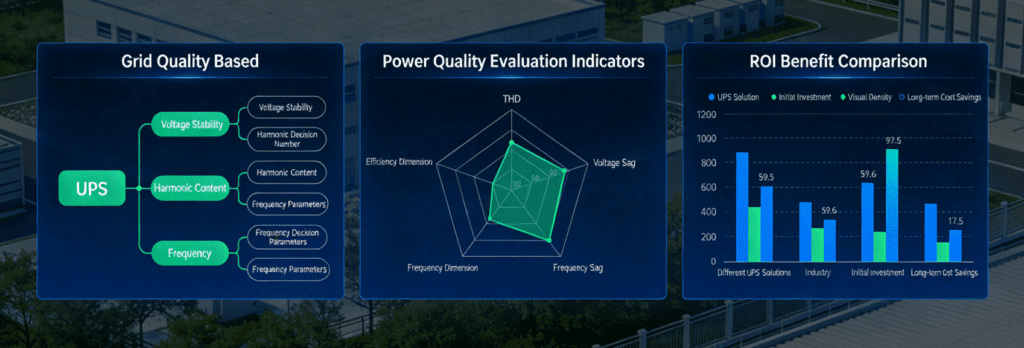
Figure 2: UPS selection strategies based on grid quality, assessment metrics for power quality evaluation, and ROI benefits of selecting appropriate UPS for challenging electrical environments.
Ⅶ. Economic Considerations
1. Total Cost of Ownership
Wide-input-range industrial UPS costs more initially than standard commercial units. However, total cost of ownership often favors industrial specifications in poor grid environments.
Initial Cost Premium: Industrial UPS with ±25% input range costs 20-30% more than standard ±10% units.
Battery Savings: Reduced cycling extends battery life by 2-3 years. For a 100kVA UPS, battery replacement cost is $8,000-12,000. Extended life saves $3,000-4,000 over 10 years.
Maintenance Reduction: Fewer battery cycles and less transfer switching reduces maintenance by 30-40%.
Downtime Avoidance: Improved reliability prevents production losses. Single avoided outage often pays for UPS premium.
For Category 3 and 4 grids, industrial UPS with wide input ranges typically deliver lower 10-year TCO despite higher initial investment.
2. Generator Sizing Impact
Wide-input-range UPS allows smaller generator sizing. Generators need only supply voltage within UPS input range, not precise nominal voltage.
Standard UPS: Generator sized for ±5% voltage regulation Wide-range UPS: Generator sized for ±15-20% regulation acceptable
This generator sizing flexibility saves capital cost and fuel consumption. For generator-backed industrial sites, wide-input UPS pays dividends multiple ways.
3. Risk Mitigation
Consider the business cost of UPS failure or inadequate protection:
Equipment Damage: Poor power quality damages PLCs, drives, and control systems. Repair costs often exceed UPS investment.
Production Loss: Manufacturing downtime costs $10,000-100,000 per hour depending on industry. Reliable UPS prevents these losses.
Quality Issues: Voltage sags cause process variations, producing scrap or rework.
Data Loss: Unprotected computers and servers lose data during outages.
Investing in appropriate UPS protection for grid conditions is risk mitigation, not just equipment purchase.
Ⅷ. Conclusion
Poor grid quality dramatically impacts industrial UPS system selection. Standard commercial UPS systems designed for stable urban grids will fail prematurely in industrial environments with voltage fluctuations, frequency drift, and harmonic distortion.
Understanding your site’s actual power quality through measurement is the first step. Categorizing grid conditions guides appropriate UPS specification. Wide input voltage ranges (±20-25%), extended frequency tolerances (±2-5Hz), and robust harmonic handling distinguish industrial UPS from commercial units.
The BKPOWER industrial UPS system exemplifies appropriate design for challenging grid conditions. With ±25% input voltage range, automatic frequency detection from 45-65Hz, and 0.95 input power factor, these systems handle the power quality challenges common in industrial environments.
Selecting UPS based on actual grid conditions—not just load requirements—ensures reliable protection and optimal total cost of ownership. In poor grid environments, industrial-grade UPS with extended specifications represents not an expense, but an investment in operational reliability and business continuity.
References
- International Electrotechnical Commission (IEC)Official website: www.iec.ch
- Underwriters Laboratories (UL)Official website: www.ul.com
- European Committee for Standardization (CEN)Official website: www.cen.eu
- Standardization Administration of China (SAC)Official website: www.sac.gov.cn
- Zhongguancun Energy Storage Industry Technology Alliance (CNESA)Official website: www.cnESA.org
- International Organization for Standardization (ISO)Official website: www.iso.org