Welcome to BKPOWER!












Home Standby Generators vs Battery Backup Systems
TIPS:Standby generators vs battery backup systems represent the two dominant approaches to emergency power protection. This guide compares standby generators vs battery backup solutions for homes and businesses in 2026. You will learn which standby generators vs battery backup option delivers the best value for your specific power needs. We analyze costs, runtime, maintenance, and environmental impact of standby generators vs battery backup technologies.

Ⅰ. Understanding Backup Power Systems
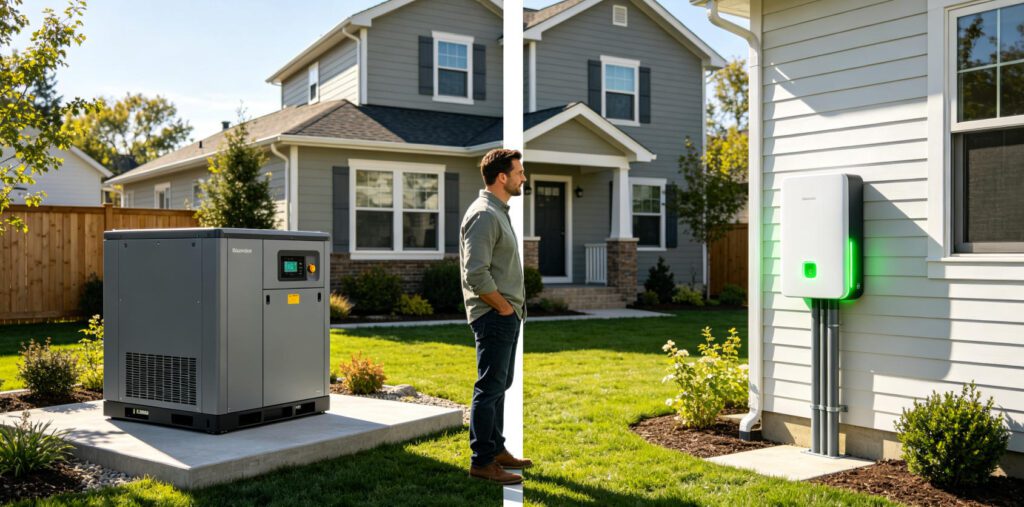
Power outages cost American businesses $150 billion annually. Homes lose food, comfort, and security. Critical facilities risk life safety. Backup power systems eliminate these risks.
Two technologies dominate the market. Standby generators burn fuel to produce electricity. Battery backup systems store electricity for later use. Each approach has distinct advantages and limitations.
The global backup power market reached $52.3 billion in 2025. Analysts project growth to $78.9 billion by 2030. This expansion reflects increasing grid instability, extreme weather events, and growing reliance on electricity-dependent technologies.
1. What Is a Standby Generator
A standby generator is an engine-driven electrical generator. It connects to your building’s electrical system through an automatic transfer switch (ATS). When grid power fails, the ATS disconnects from the grid and starts the generator. Power restores within seconds.
Key characteristics:
- Fuel types: Diesel, natural gas, propane, or gasoline
- Power range: 7kW to 150kW for residential; up to 2MW for commercial
- Startup time: 10–30 seconds after outage detection
- Runtime: Unlimited with fuel supply
- Lifespan: 20–30 years with proper maintenance
Standby generators provide whole-building power. They run air conditioners, water heaters, pumps, and all standard appliances. They are the traditional choice for reliable backup power.
2. What Is a Battery Backup System
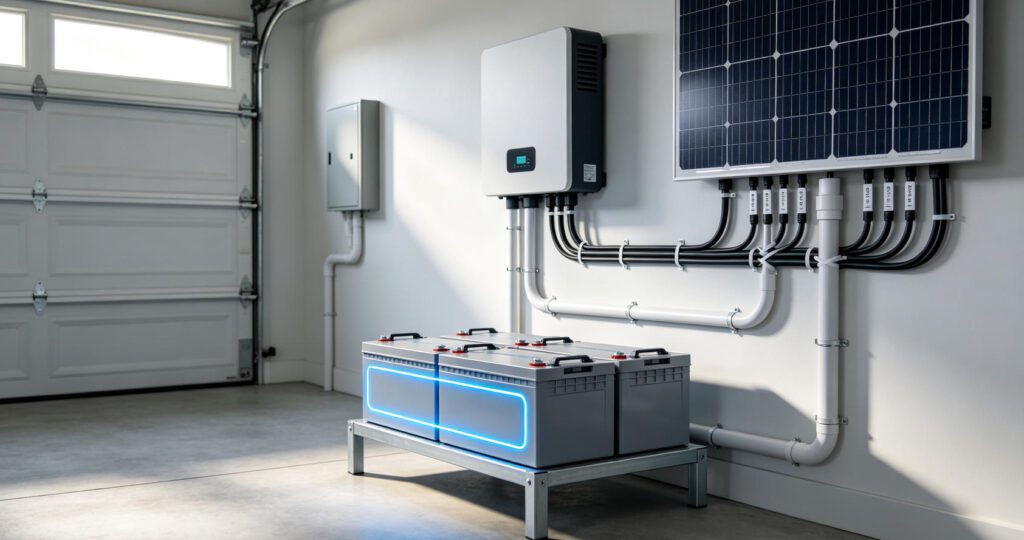
A battery backup system stores electrical energy in rechargeable batteries. It connects to your electrical panel and charges from the grid or solar panels. When grid power fails, an inverter converts DC battery power to AC household power.
Key characteristics:
- Battery types: Lithium-ion (LiFePO4) or lead-acid
- Power range: 5kW to 20kW for residential; up to 100kW for commercial
- Response time: Instantaneous (0 milliseconds)
- Runtime: 2–24 hours depending on capacity and load
- Lifespan: 10–15 years for lithium; 3–5 years for lead-acid
Battery systems excel at protecting sensitive electronics. They provide clean, stable power without voltage fluctuations. They are the modern choice for tech-savvy homeowners and businesses.
Ⅱ. How Backup Power Systems Work
1. Standby Generator Operation
Standby generators operate through a mechanical process:
Step 1: The automatic transfer switch monitors grid voltage continuously.
Step 2: When voltage drops below threshold for 2–5 seconds, the ATS signals the generator to start.
Step 3: The engine cranks and reaches operating speed (typically 1800 RPM for liquid-cooled, 3600 RPM for air-cooled).
Step 4: The ATS transfers the load from grid to generator.
Step 5: When grid power returns, the ATS waits for stable voltage (typically 30 seconds to 5 minutes).
Step 6: The ATS transfers the load back to grid and commands generator cooldown and shutdown.
This sequence takes 10–30 seconds total. During this time, connected equipment loses power. Most electronics tolerate this brief interruption. Medical equipment and servers may require UPS protection during the transfer.
2. Battery Backup System Operation
Battery systems operate through an electronic process:
Step 1: The inverter/charger monitors grid voltage continuously.
Step 2: When grid power fails, the inverter instantly switches to battery power. Transfer time is 0–4 milliseconds.
Step 3: The inverter converts DC battery voltage to clean AC power. Output waveform is pure sine wave.
Step 4: When grid power returns, the inverter synchronizes with grid frequency and transfers the load.
Step 5: The charger begins recharging batteries from grid or solar power.
This seamless transfer protects even the most sensitive electronics. There is no perceptible power interruption. Computers, medical devices, and communication equipment continue operating without interruption.
3. Hybrid Systems
Some installations combine both technologies. The battery system handles short outages and sensitive loads. The generator starts for extended outages and high-power demands. This hybrid approach optimizes cost and capability.
Explore BKPOWER’s hybrid backup power solutions
Ⅲ. Cost Comparison: Initial Investment
1. Standby Generator Costs
| Cost Component | Residential (22kW) | Commercial (100kW) |
|---|---|---|
| Generator unit | $5,000–$8,000 | $25,000–$45,000 |
| Automatic transfer switch | $800–$1,500 | $3,000–$8,000 |
| Installation labor | $2,000–$5,000 | $10,000–$25,000 |
| Fuel system (tank/piping) | $1,000–$3,000 | $5,000–$15,000 |
| Permits and inspections | $500–$1,500 | $2,000–$5,000 |
| Total installed cost | $9,300–$19,000 | $45,000–$98,000 |
Natural gas generators cost more upfront but eliminate fuel storage. Diesel generators require fuel tanks and have lower initial cost. Propane offers clean burning but requires tank installation.
2. Battery Backup System Costs
| Cost Component | Residential (13.5kWh) | Commercial (30kWh) |
|---|---|---|
| Battery modules | $8,000–$12,000 | $25,000–$40,000 |
| Inverter/charger | $2,000–$4,000 | $8,000–$15,000 |
| Installation labor | $1,500–$3,000 | $5,000–$10,000 |
| Electrical panel upgrades | $500–$2,000 | $2,000–$5,000 |
| Permits and inspections | $500–$1,000 | $1,500–$3,000 |
| Total installed cost | $12,500–$22,000 | $41,500–$73,000 |
Lithium iron phosphate (LiFePO4) batteries dominate the market. They offer longer lifespan and better safety than other lithium chemistries. Lead-acid batteries cost 50% less but require replacement every 3–5 years. citeweb_search:56#0
3. Total Cost of Ownership (10 Years)
| Cost Factor | Standby Generator (22kW NG) | Battery System (13.5kWh) |
|---|---|---|
| Initial cost | $14,000 | $17,000 |
| Fuel (10 years) | $8,000–$12,000 | $0 (if solar) or $2,000 |
| Maintenance (10 years) | $3,000–$5,000 | $500–$1,000 |
| Battery replacement | N/A | $0 (LiFePO4 lasts 15yr) |
| 10-year TCO | $25,000–$31,000 | $19,500–$20,000 |
Battery systems achieve lower total cost of ownership over 10 years. However, generators may be more economical for very long outages or high-power applications.
Ⅳ. Runtime and Capacity Analysis
1. Standby Generator Runtime
Generators provide unlimited runtime with fuel supply. Runtime depends on fuel tank capacity and consumption rate.
Fuel consumption rates (typical):
- 10kW generator: 0.8–1.2 gallons/hour (gasoline)
- 22kW generator: 2.5–3.5 therms/hour (natural gas)
- 100kW generator: 7–10 gallons/hour (diesel)
Tank sizing for 72-hour runtime:
- 22kW natural gas: Unlimited (utility connection)
- 22kW propane: 500-gallon tank
- 100kW diesel: 1,000-gallon tank
Natural gas generators connect to utility pipelines. They never run out of fuel unless the gas utility fails. This is a major advantage for extended outages.
2. Battery Backup Runtime
Battery runtime depends on capacity and load. The formula is simple:
Runtime (hours) = Battery capacity (kWh) × Depth of discharge × Efficiency / Load (kW)
Typical runtimes:
- 13.5kWh battery, 5kW load: 2–3 hours
- 13.5kWh battery, 2kW load (essential circuits): 5–7 hours
- 30kWh battery, 10kW load: 2.5–3 hours
- 30kWh battery, 3kW load: 8–10 hours
Extending runtime:
- Solar panel recharging adds 2–5kW during daylight
- Load management reduces consumption by 30–50%
- Multiple battery modules increase capacity
Battery systems cannot match generator runtime for extended outages. However, most power outages last less than 4 hours. Batteries handle 90% of outages without issue.
3. Runtime Comparison Table
| Scenario | Generator (22kW NG) | Battery (13.5kWh) |
|---|---|---|
| 2-hour outage | Unlimited | 5–7 hours (essential) |
| 8-hour outage | Unlimited | Requires solar or load shed |
| 24-hour outage | Unlimited | Requires generator or solar |
| 72-hour outage | Unlimited | Requires generator |
| Multi-day outage | Unlimited | Requires generator + solar |
Generators win on extended runtime. Batteries win on short outages and instant response. citeweb_search:56#4
Ⅴ. Maintenance Requirements
1. Standby Generator Maintenance
Generators require regular maintenance to ensure reliable startup:
Weekly: Visual inspection, check fuel level, test run (10 minutes)
Monthly: Check oil level, inspect air filter, verify battery voltage
Semi-annually: Change oil and filter, replace spark plugs (gas), inspect belts
Annually: Professional service, load bank test, coolant change (liquid-cooled)
Every 2–3 years: Replace fuel filter, inspect exhaust system
Annual maintenance cost: $300–$500 for residential; $1,500–$3,000 for commercial
Neglected generators fail when needed most. Regular maintenance is essential for reliability.
2. Battery Backup Maintenance
Battery systems require minimal maintenance:
Monthly: Visual inspection, check status lights, verify charge level
Quarterly: Clean vents and enclosure, check connections
Annually: Professional inspection, capacity test, software updates
Every 10–15 years: Replace lithium battery modules
Every 3–5 years: Replace lead-acid batteries
Annual maintenance cost: $100–$200 for residential; $500–$1,000 for commercial
Lithium batteries are essentially maintenance-free. The inverter may require firmware updates. Overall maintenance burden is significantly lower than generators.
3. Maintenance Comparison
| Task | Generator | Battery |
|---|---|---|
| Oil changes | Every 100–200 hours | Never |
| Fuel system | Inspect annually | N/A |
| Air filter | Replace annually | Clean vents quarterly |
| Spark plugs | Replace every 2 years | N/A |
| Battery replacement | Every 3–5 years (starter) | Every 10–15 years |
| Professional service | Annual required | Annual recommended |
| Annual cost | $300–$500 | $100–$200 |
Battery systems reduce maintenance burden by 60–70%. This saves time and money over the system lifespan.
Ⅵ. Environmental Impact
1. Generator Emissions
Generators produce direct emissions during operation:
Carbon dioxide (CO2):
- Natural gas: 0.4 kg/kWh
- Diesel: 0.7 kg/kWh
- Propane: 0.5 kg/kWh
- Gasoline: 0.8 kg/kWh
Other pollutants:
- Nitrogen oxides (NOx): Contribute to smog
- Particulate matter: Health hazard
- Carbon monoxide: Deadly in enclosed spaces
- Noise: 60–80 dB at 23 feet
A 22kW natural gas generator running for 24 hours produces approximately 210 kg of CO2. This is equivalent to driving a car for 500 miles.
2. Battery System Emissions
Battery systems produce no direct emissions during operation. However, they have lifecycle emissions:
Manufacturing emissions:
- Lithium-ion: 150–200 kg CO2/kWh capacity
- 13.5kWh battery: 2,000–2,700 kg CO2
- Equivalent to generator running 10–13 days
Grid charging emissions:
- Varies by region (coal vs renewable mix)
- US average: 0.4 kg CO2/kWh
- 13.5kWh charge: 5.4 kg CO2
Solar charging emissions: Near zero after panel manufacturing
Over 10 years, a battery system charged from solar produces 90% fewer emissions than a generator. Even grid-charged batteries produce 50% fewer emissions than diesel generators.
3. Noise Comparison
| System | Noise Level | Equivalent To |
|---|---|---|
| Standby generator (22kW) | 65–75 dB | Vacuum cleaner |
| Large generator (100kW) | 75–85 dB | Lawn mower |
| Battery system | 30–40 dB | Quiet library |
| Battery + cooling fans | 40–50 dB | Refrigerator |
Battery systems operate silently. This is a major advantage in residential neighborhoods and noise-sensitive commercial environments. Generators require sound-attenuating enclosures, adding $2,000–$5,000 to cost.
Ⅶ. Installation Requirements
1. Standby Generator Installation
Generators require significant infrastructure:
Space requirements:
- Clearance: 3–5 feet from building (fire code)
- Pad: Concrete slab 4–6 inches thick
- Access: Service clearance on all sides
- Ventilation: Unrestricted airflow for cooling
Electrical requirements:
- ATS installation at main panel
- Dedicated generator breaker
- Load management modules (optional)
- Grounding system per NEC Article 250
Fuel requirements:
- Natural gas: Utility connection with adequate pressure
- Propane: Tank installation with regulator and piping
- Diesel: Tank with spill containment and leak detection
Permits: Building, electrical, fuel system, noise (varies by jurisdiction)
Installation typically takes 1–3 days for residential. Commercial installations may require 1–2 weeks.
2. Battery Backup Installation
Battery systems require less infrastructure:
Space requirements:
- Indoor or outdoor installation
- Wall-mounted or floor-standing
- Temperature-controlled environment (50–86°F ideal)
- Ventilation for heat dissipation
Electrical requirements:
- Connection to main electrical panel
- Critical load subpanel (optional)
- Solar panel connection (if applicable)
- Net metering agreement (if grid-tied)
Fuel requirements: None
Permits: Electrical, building (varies by jurisdiction)
Installation typically takes 4–8 hours for residential. Commercial installations may require 1–2 days. Battery systems are significantly easier to install than generators.
3. Installation Complexity Comparison
| Factor | Generator | Battery |
|---|---|---|
| Space needed | Large (outdoor pad) | Small (wall or floor) |
| Fuel infrastructure | Required | None |
| Ventilation | Critical | Moderate |
| Noise mitigation | Required | None |
| Permits | Multiple | Fewer |
| Installation time | 1–3 days | 4–8 hours |
| Grid connection | ATS required | Inverter integrated |
Battery systems offer simpler, faster installation. This reduces labor costs and disruption.
Ⅷ. Use Case Scenarios
1. Residential Applications
Choose a generator if:
- You experience frequent multi-day outages
- You need whole-house power (HVAC, water heater, etc.)
- You have natural gas service
- You prioritize lowest upfront cost
- You can tolerate 10–30 second startup delay
Choose a battery if:
- You experience short outages (<4 hours typical)
- You have solar panels or plan to install them
- You prioritize silent operation
- You want minimal maintenance
- You have critical electronics (medical, home office)
Hybrid recommendation:
Install a battery system for short outages and sensitive loads. Add a generator for extended outages. This provides the best of both technologies.
2. Commercial Applications
Choose a generator if:
- You operate 24/7 (hospitals, data centers)
- You need >50kW continuous power
- You have on-site fuel storage
- You require NFPA 110 compliance
- Budget constraints favor lower capital cost
Choose a battery if:
- You need UPS-grade power quality
- You practice peak shaving for demand charges
- You have renewable energy goals
- You operate in noise-sensitive areas
- You want demand response revenue
Hybrid recommendation:
Batteries handle short outages and peak shaving. Generators provide long-duration backup. This combination optimizes reliability and economics.
3. Critical Facility Applications
Hospitals, data centers, and emergency services require the highest reliability:
Tier 1: Battery UPS (instant) + Generator (extended)
Tier 2: Battery UPS + Generator + Redundant generator
Tier 3: Battery UPS + Generator + Generator + Fuel cells
NEC Article 700 and NFPA 99 mandate specific requirements for life safety systems. Always consult qualified engineers for critical facility design.
Ⅸ. Decision Framework
Use this checklist to select your backup power system:
| Question | If Yes | If No |
|---|---|---|
| Outages typically <4 hours? | Battery | Generator |
| Need whole-house HVAC? | Generator | Battery |
| Have solar panels? | Battery | Either |
| Noise is a concern? | Battery | Generator |
| Maintenance budget limited? | Battery | Generator |
| Need >20kW continuous? | Generator | Battery |
| Environmental priority? | Battery | Generator |
| Lowest upfront cost? | Generator | Battery |
| 10-year lowest cost? | Battery | Generator |
Contact BKPOWER for personalized backup power assessment
Ⅹ. 2026 Market Trends and Future Outlook
1. Battery Technology Advances
Lithium iron phosphate (LiFePO4) batteries continue improving:
- Energy density: Increasing 5–8% annually
- Cycle life: Now exceeding 6,000 cycles
- Cost: Declining 10–15% per year
- Safety: Thermal runaway risk near zero
Solid-state batteries promise further improvements by 2030. These will offer higher energy density and faster charging. However, commercial availability remains 3–5 years away.
2. Generator Technology Advances
Modern generators incorporate smart features:
- Remote monitoring: Cellular and WiFi connectivity
- Predictive maintenance: AI-driven failure prediction
- Load management: Automatic load shedding
- Emissions control: Tier 4 Final compliance
- Dual-fuel capability: Natural gas and propane
These advances improve reliability and reduce environmental impact. However, the fundamental technology remains combustion-based.
3. Grid-Interactive Systems
Future backup systems will do more than emergency power:
Virtual power plants (VPP): Aggregated battery systems provide grid services. Owners earn revenue for frequency regulation and peak shaving.
Time-of-use optimization: Batteries charge during low-rate periods. They discharge during high-rate periods. This reduces electricity bills.
Microgrids: Combined solar, battery, and generator systems operate independently. They provide resilience during grid failures and optimize energy costs.
These grid-interactive capabilities improve the economics of battery systems. They transform backup power from a cost center to a revenue source.
4. Regulatory Trends
Building codes increasingly require backup power:
- California: Solar + battery required on new construction
- Florida: Generator or battery required for elevator backup
- Texas: Grid reliability standards post-2021 winter storm
- Federal: Executive Order 14057 mandates clean energy
These regulations favor battery systems in new construction. Retrofit applications may still favor generators for cost reasons.
Ⅺ. Conclusion
Standby generators and battery backup systems each serve distinct needs. Generators provide unlimited runtime and high power output. Batteries offer instant response, silent operation, and minimal maintenance.
For most residential applications in 2026, battery systems provide the best value. They handle typical outage durations. They integrate with solar. They reduce long-term costs. They align with environmental goals.
For commercial applications, the choice depends on specific requirements. Critical facilities need both technologies. Peak-shaving applications favor batteries. Long-duration backup favors generators.
The future belongs to integrated systems. Solar panels, battery storage, and smart generators work together. They optimize cost, reliability, and sustainability. They transform backup power from insurance to asset.
BKPOWER provides comprehensive backup power solutions. Our product range includes standby generators, battery backup systems, and hybrid configurations. We serve residential, commercial, and industrial clients with professional design, installation, and maintenance services.
Browse BKPOWER’s complete backup power catalog
Reference Sources
| Organization Name | Organization Type | Website | Citation Application Scenario |
|---|---|---|---|
| U.S. Energy Information Administration (EIA) | Government Energy Agency | https://www.eia.gov/ | Power outage statistics and energy market data |
| National Electrical Manufacturers Association (NEMA) | Industry Standards Organization | https://www.nema.org/ | Generator standards and backup power guidelines |
| National Fire Protection Association (NFPA) | Safety Standards Organization | https://www.nfpa.org/ | NFPA 110 emergency power standards |
| Solar Energy Industries Association (SEIA) | Industry Trade Association | https://www.seia.org/ | Battery storage market trends and solar integration |
| U.S. Department of Energy (DOE) | Government Energy Agency | https://www.energy.gov/ | Energy storage research and clean energy initiatives |
FAQ
Which is better: a standby generator or battery backup system?
A: For short outages (<4 hours), battery backup systems are better. They provide instant power, operate silently, and require minimal maintenance. For long outages or whole-house power including HVAC, standby generators are better. They provide unlimited runtime with fuel supply. Many homeowners choose hybrid systems combining both technologies.
How long will a battery backup system last during a power outage?
A: Runtime depends on battery capacity and electrical load. A 13.5kWh battery powers essential circuits (refrigerator, lights, outlets) for 5–7 hours. It powers a whole house including HVAC for 2–3 hours. Adding solar panels extends runtime indefinitely during daylight. Load management can reduce consumption by 30–50%, doubling runtime.
What is the total cost of ownership for generators vs battery backup?
A: Over 10 years, battery systems cost $19,500–$20,000 including installation. Generators cost $25,000–$31,000 including fuel and maintenance. Batteries have lower maintenance ($100–$200/year vs $300–$500/year) and no fuel costs if solar-charged. However, generators have lower upfront cost and unlimited runtime for extended outages.
Can a battery backup system power my entire house?
A: Most residential battery systems (10–20kW) power essential circuits only. Whole-house backup requires 20–40kW capacity and multiple battery modules. Generators more easily provide whole-house power (22–48kW standard). For whole-house battery backup, expect $30,000–$60,000 installed cost. Load management systems can prioritize critical circuits within a smaller battery system.
Do I need a permit to install a standby generator or battery backup system?
A: Yes, both systems require permits. Generators need building, electrical, fuel system, and sometimes noise permits. Installation takes 1–3 days. Battery systems need electrical and building permits. Installation takes 4–8 hours. Always use licensed contractors and obtain proper permits. This ensures code compliance, safety, and warranty validity.