Welcome to BKPOWER!





Printing Press UPS: Avoid Costly Paper Jams & Waste
TIPS:In high-speed printing production environments, online industrial UPS systems serve not merely as backup power for outages, but as critical quality assurance equipment ensuring registration accuracy and preventing paper jams. When grid frequency fluctuates by just ±0.5Hz, servo motor speeds in high-speed printing presses deviate, causing color misregistration, ghosting images, and paper jams that result in entire batch waste. This article explores how deploying printing machine ups solution units with ±0.1Hz output frequency accuracy completely eliminates the impact of power frequency variations on print quality. Online industrial UPS frequency stability forms the cornerstone of high-speed zero-defect printing, while professional printing machine ups solution implementations reduce paper jams and waste caused by power issues by over 90%.
Ⅰ. The Hidden Cost of Power Frequency Instability
Modern high-speed printing presses operate as precision electromechanical systems. They print at speeds exceeding 15,000 sheets per hour. Web presses exceed 300 meters per minute. At these velocities, tolerances measure in micrometers. Registration errors of 0.1 millimeters render prints commercially unacceptable.
Frequency stability directly determines print quality. AC servo motors drive printing cylinders. These motors maintain speed through frequency-dependent synchronization. A 1Hz frequency variation causes a 2% speed deviation in a 50Hz motor. At 300 meters per minute, this equals 6 meters of material misalignment per minute. Color plates misregister. Images ghost. Paper tensions destabilize. Jams cascade through the production line.
The financial impact extends beyond immediate waste. Setup times for new jobs extend to hours. Skilled operators adjust registration manually. Customer deadlines slip. Reputation suffers. Traditional uninterruptible power supply systems provide runtime but often ignore frequency precision. Only online industrial UPS architectures with ±0.1Hz regulation prevent these costly deviations.
Ⅱ. How Frequency Fluctuations Cause Paper Jams
Understanding the mechanical-electrical relationship clarifies why frequency stability matters absolutely.
1. Servo Motor Synchronization Mechanics
Modern printing presses utilize AC servo motors for cylinder drive. These systems rely on precise speed control. Motor controllers compare actual speed against reference frequencies. Grid frequency variations appear as speed commands. Motors accelerate or decelerate to match the erroneous frequency.
Color units rely on exact speed ratios. Cyan, magenta, yellow, and black cylinders must maintain perfect synchrony. A 0.5Hz frequency drop slows one unit by 1%. Color plates shift relative to each other. Moiré patterns appear. Registration marks misalign. Automated registration systems cannot compensate rapidly enough.
2. Web Tension Instability
Roll-fed printing depends on precise web tension. Unwind and rewind motors balance forces across the paper path. Frequency variations cause torque oscillations. Paper stretches or slackens. Wrinkles form. Edges curl. The web wanders sideways. These instabilities exceed mechanical tolerances. Paper breaks. Jams require 30-60 minutes to clear. Printing machine ups solution systems with tight frequency regulation eliminate these sources of instability.
3. Ink and Drying System Disruption
Ink pumps and drying blowers operate at fixed frequencies. Variations alter flow rates. Ink densities shift between units. Drying efficiency fluctuates. Smudging occurs. Offset printing requires precise ink-water balance. Frequency-induced pump variations disrupt this equilibrium. Quality becomes unpredictable.
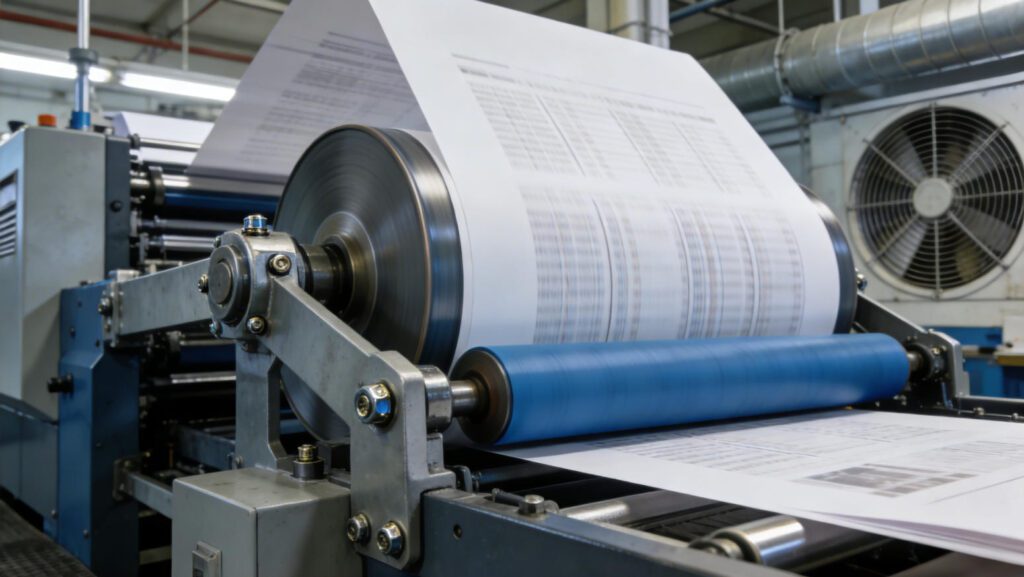
Figure 1: High-speed printing presses require precise frequency stability to maintain registration accuracy
Ⅲ. Standard Power Protection Limitations
Not all UPS systems suit printing press applications. Understanding limitations prevents costly mistakes.
1. Line-Interactive UPS Deficiencies
Line-interactive UPS units switch to battery during outages. They use autotransformers for voltage regulation. However, they pass grid frequency directly to the load. A 49.5Hz grid input becomes 49.5Hz output. Printing motors slow proportionally. These UPS types provide no protection against the frequency variations that cause registration errors.
2. Generator Frequency Instability
Diesel generators provide backup runtime. However, they exhibit frequency drift. Mechanical governors respond slowly to load changes. Frequency varies by ±1-2Hz during transitions. This variation exceeds printing press tolerances. Print quality degrades during generator operation. Some facilities must stop printing during generator tests.
3. Inadequate Frequency Regulation
Some UPS systems specify frequency stability of ±1% or ±0.5Hz. While acceptable for IT loads, this proves insufficient for high-speed printing. A ±0.5Hz tolerance allows ±1% speed variation. Modern presses require ±0.1% registration accuracy. Online industrial UPS systems with ±0.1Hz (±0.2%) frequency precision solve this mismatch.
Ⅳ. Online Industrial UPS Technology for Printing
Purpose-built online industrial UPS systems address printing-specific power quality requirements.
1. Double-Conversion Architecture
True online UPS units completely regenerate output power. Rectifiers convert AC input to DC. Inverters synthesize fresh AC waveforms using crystal oscillator references. Output frequency remains locked to the internal oscillator. It varies by less than ±0.1Hz regardless of input fluctuations.
This architecture provides three key benefits:
- Complete isolation from grid frequency variations
- Zero transfer time during outages
- Sine wave purity exceeding 99%
2. Digital Signal Processing Control
Modern UPS controllers utilize DSP (Digital Signal Processing) technology. These processors sample output voltage 10,000 times per second. They calculate instantaneous frequency deviations. PWM (Pulse Width Modulation) patterns adjust within microseconds. Feedback loops maintain ±0.1Hz precision even with nonlinear printing press loads.
3. Galvanic Isolation
Output transformers provide electrical separation between grid and load. Common-mode noise attenuates by 60-80 dB. Voltage transients clamp before reaching sensitive servo drives. This isolation protects motor controllers from grid-borne disturbances.

Figure 2: Online double-conversion UPS architecture ensures ±0.1Hz frequency precision regardless of grid conditions
Ⅴ. BKPOWER ±0.1Hz Precision Solution
BKPOWER specializes in printing machine ups solution systems engineered for graphic arts applications.
1. Crystal-Controlled Frequency Generation
BKPOWER UPS units utilize temperature-compensated crystal oscillators (TCXO). These devices maintain frequency stability within ±0.1Hz across operating temperatures from -10°C to +50°C. Aging rates remain below 1 ppm per year. Decade-long deployments maintain original precision specifications.
2. Dynamic Load Response
Printing presses present highly dynamic loads. Inrush currents reach 300% of running current when starting. BKPOWER DSP algorithms compensate within 2 milliseconds. Output frequency transient recovery occurs within 20 milliseconds. Printing registration remains unaffected by load steps.
3. Harmonic Distortion Control
VFDs and servo drives generate harmonic currents. These distort voltage waveforms. BKPOWER inverters filter these components. Output THD remains below 3% even with 100% nonlinear loading. Clean power extends servo motor and controller lifespan.
4. Parallel Redundancy Options
Critical installations utilize N+1 redundant configurations. Two or three UPS modules share the load. If one unit requires maintenance, others continue providing protected power. Frequency synchronization between modules maintains ±0.1Hz precision across the parallel bus.
Ⅵ. Implementation Best Practices
Deploying UPS power supply systems for printing requires systematic engineering.
1. Load Assessment and Sizing
Printing presses require careful power analysis. Servo motor ratings indicate running current. Inrush currents demand 3-5x capacity. Drying heaters add resistive loads. UPS sizing considers:
- Total apparent power (kVA)
- Peak inrush demands
- Power factor (typically 0.8-0.9 for motor loads)
- Future expansion (20% headroom)
Online calculators or BKPOWER engineering services optimize specifications.
2. Critical vs. Non-Critical Separation
Not all press components require UPS protection. Critical loads include:
- Main drive servo systems
- Registration control computers
- Ink pump motors
- Web tension controllers
- Prepress RIP computers
Non-critical loads such as general lighting and HVAC use generator backup. This separation reduces UPS capacity requirements by 40-60%.
3. Integration with Existing Infrastructure
UPS installations must coordinate with:
- Existing voltage regulators
- Power factor correction capacitors
- Emergency stop systems
- Building management systems
Proper integration prevents circulating currents. It ensures emergency stops function correctly during UPS operation.
Ⅶ. Economic Impact and ROI Analysis
Investment in precision battery backup systems requires business justification.
1. Waste Reduction Quantification
High-speed printing generates significant waste during startup. Registration adjustments consume paper. Frequency-induced registration errors extend setup times. BKPOWER UPS implementations reduce:
- Setup waste by 30-50%
- In-run registration errors by 90%
- Jam-related downtime by 80%
A press producing 50 tons of paper monthly saves 2-5 tons in reduced waste. At €800 per ton, monthly savings reach €1,600-€4,000. Annual savings justify UPS investment within 12-18 months.
2. Productivity Enhancement
Reduced jams increase effective production hours. A press operating 16 hours daily gains 1-2 hours additional output. Capacity increases by 10-15% without capital expansion. Customer delivery performance improves. Penalty clauses for missed deadlines decrease.
3. Equipment Protection
Servo drives and motors last 30% longer with clean, stable power. Frequency-induced thermal cycling causes insulation degradation. Precise UPS power reduces maintenance costs. Capital equipment life extends.
Conclusion
Paper jams and print waste in high-speed operations often originate from power frequency instability, not mechanical issues. Online industrial UPS systems with ±0.1Hz frequency precision eliminate this root cause. BKPOWER printing machine ups solution technology ensures that servo motors maintain exact synchronization regardless of grid conditions.
The return on investment extends beyond downtime prevention. Quality improvements reduce waste. Productivity enhancements increase capacity. Equipment protection lowers lifecycle costs. For commercial printers competing on quality and reliability, precision uninterruptible power supply infrastructure represents not expense, but competitive advantage.
Implement UPS systems engineered for the exacting requirements of high-speed printing. Your registration accuracy, waste reduction metrics, and customer satisfaction will demonstrate the value immediately.
References
- International Electrotechnical Commission (IEC)Official website: www.iec.ch
- Underwriters Laboratories (UL)Official website: www.ul.com
- European Committee for Standardization (CEN)Official website: www.cen.eu
- Standardization Administration of China (SAC)Official website: www.sac.gov.cn
- Zhongguancun Energy Storage Industry Technology Alliance (CNESA)Official website: www.cnESA.org
- International Organization for Standardization (ISO)Official website: www.iso.org