Welcome to BKPOWER!












Uninterruptible Power Supply: Line-Frequency Architecture
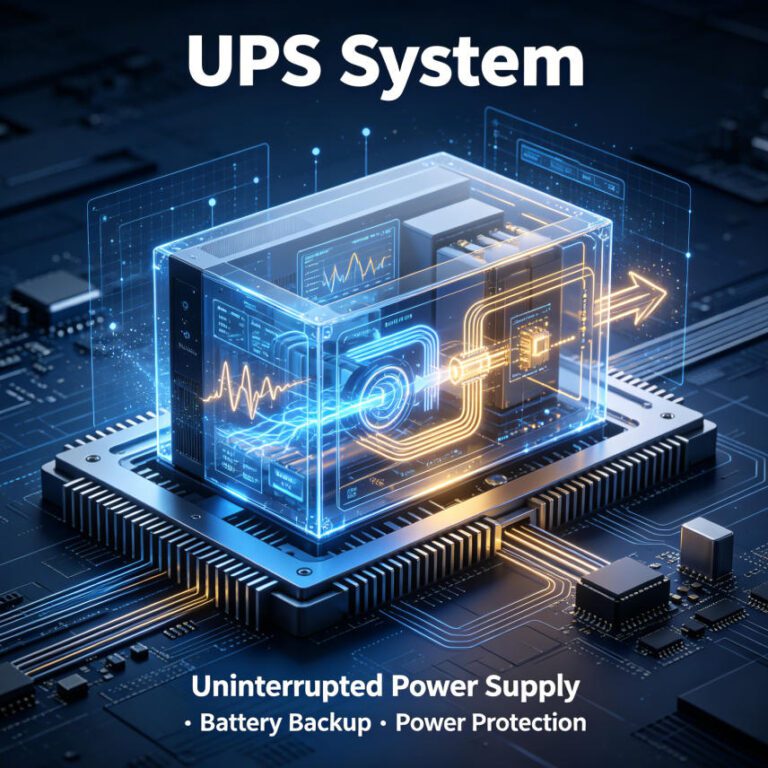
TIPS: Uninterruptible Power Supply is the cornerstone of industrial power protection. Explore BKPOWER line-frequency UPS double-conversion architecture and operating modes.

Ⅰ. The Essence of Uninterruptible Power Supply: More Than a Backup Battery
Many people’s understanding of Uninterruptible Power Supply stops at “automatically switches to battery during power outages.” This perception only describes offline UPS functionality, while industrial-grade online UPS core value extends far beyond.
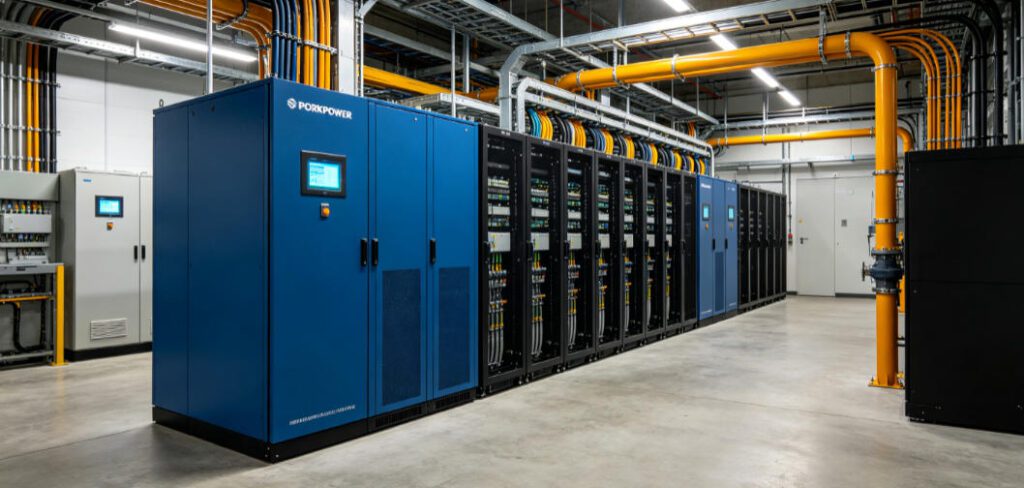
A true Uninterruptible Power Supply is a precision power electronics system integrating power quality management, electrical isolation protection, and zero-transfer backup power. Taking the BKPOWER BK-GH33 Line-Frequency UPS as an example, its internal architecture contains seven core modules: rectifier, DC bus, inverter, static bypass switch, maintenance bypass switch, battery bank, and intelligent control unit. These modules work in concert to ensure loads always operate in a clean, stable, isolated power environment—regardless of utility status.
Ⅱ. Double-Conversion Online UPS Power Path Explained
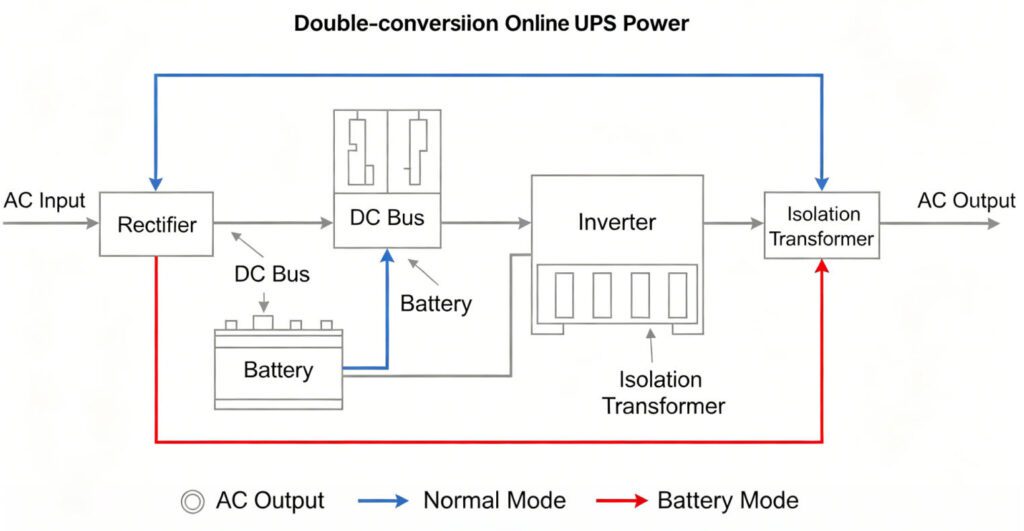
BKPOWER line-frequency UPS employs double-conversion (AC-DC-AC) online topology, defined by IEC 62040-3 as VFI (Voltage and Frequency Independent) mode—the highest protection class among UPS topologies.
1. Normal Utility Mode: Rectifier-Inverter Double Conversion
When utility voltage and frequency are within acceptable ranges, power flows through the following path:
- Input Circuit Breaker: Receives three-phase 380V utility power, providing overcurrent protection
- Rectifier: Converts AC to DC. BKPOWER line-frequency UPS uses SCR phase-controlled rectification or IGBT high-frequency rectification, outputting stable DC bus voltage (typically 384Vdc or higher)
- DC Bus Capacitors: Smooth rectified DC voltage, absorb instantaneous pulse interference, and provide float charge voltage for batteries
- Battery Bank: Connected in parallel with the DC bus, always at full charge and standby-ready
- Inverter: Uses IGBT power modules and SPWM (Sinusoidal Pulse Width Modulation) technology to invert DC bus voltage into pure sinusoidal AC power
- Output Isolation Transformer: The defining feature of BKPOWER line-frequency UPS. The transformer achieves complete electrical isolation between input and output, while performing voltage level conversion (e.g., DC 384V → AC 380V)
- Static Switch: Connects inverter output to load, transfer time <4ms
Key Insight: In this mode, the load is completely isolated from utility power. Harmonics, surges, and voltage sags from the grid are filtered by both the rectifier and inverter stages, producing output with <3% distortion pure sine wave.
2. Battery Mode: Zero-Transfer Seamless Takeover
When utility power fails or exceeds tolerance (e.g., voltage sag >20%, frequency deviation >±2Hz):
- The rectifier automatically shuts down, stopping power draw from utility
- The battery bank directly supplies the inverter through the DC bus, with 0ms transfer time
- The inverter continues outputting stable AC power; the load remains completely unaware
- When utility returns, the rectifier restarts and simultaneously recharges the battery
Zero-Transfer Implementation Principle: Since the inverter is always operating (unlike offline UPS), battery power does not require “starting” the inverter—only changing the energy source (from rectifier to battery). Therefore, no switching delay exists.
3. Bypass Mode: Safety Net for Overload and Fault Conditions
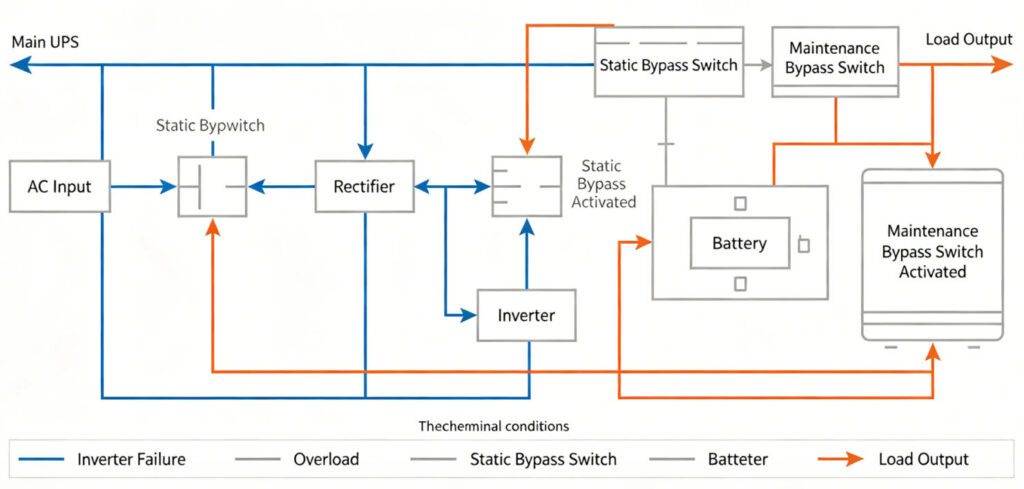
Bypass mode is the UPS “safety valve,” automatically triggered in the following situations:
- Inverter Overload: Load exceeds inverter rated capacity (e.g., motor startup inrush)
- Inverter Fault: IGBT module overheating or drive anomaly
- Internal Maintenance: Manual switching required when servicing UPS main unit
Bypass has two levels:
- Static Bypass: Solid-state switch composed of SCRs, automatic transfer time <4ms (1/4 of a power frequency cycle). During transfer, inverter output and utility must be synchronized (same frequency and phase), otherwise circulating current will occur
- Maintenance Bypass: Mechanical circuit breaker or rotary switch used to completely isolate the UPS for maintenance. Before switching, ensure static bypass is already closed to prevent load interruption
Important Warning: In bypass mode, the load is directly powered by utility, losing UPS protection. If utility fails simultaneously, the load will lose power. Therefore, bypass mode serves only as temporary transition and should not operate long-term.
Ⅲ. Architecture Differences: Line-Frequency vs High-Frequency UPS
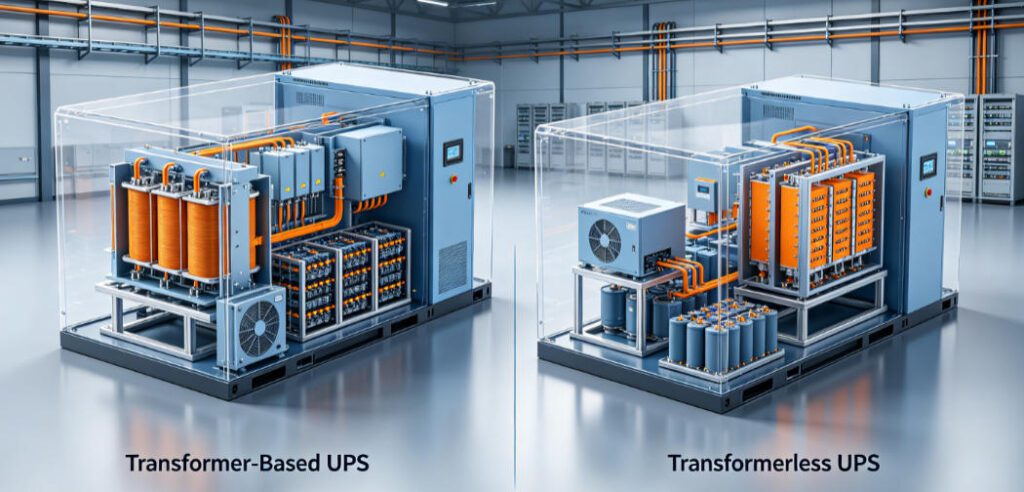
BKPOWER line-frequency UPS (BK-GH33 series) and common high-frequency UPS have fundamental architectural differences:
| Architecture Dimension | BKPOWER Line-Frequency UPS (BK-GH33) | High-Frequency UPS |
|---|---|---|
| Rectification | SCR phase-controlled or IGBT rectification | IGBT high-frequency PWM rectification |
| DC Bus Voltage | Matches battery voltage (192V/384V) | Boosted to ~800Vdc |
| Inverter Output | Via line-frequency transformer isolation/step-up | Direct inversion output (no transformer) |
| Galvanic Isolation | Complete isolation (transformer physical barrier) | No isolation (relies on electronic switches) |
| Surge Withstand | Transformer naturally absorbs current surges | IGBT hard-absorbs, prone to protective shutdown |
| Efficiency | 88%-94% | 94%-98% |
| Applications | Industrial, medical, rail transit | Data centers, commercial IT |
Core Conclusion: The line-frequency UPS transformer is not merely a voltage conversion element—it is an electrical isolation barrier and surge absorption buffer. In industrial environments, motor startup producing 5-7x rated current surges can damage high-frequency UPS IGBT modules, while line-frequency transformers absorb these surges with ease.
Ⅳ. Uninterruptible Power Supply Power Quality Management Functions
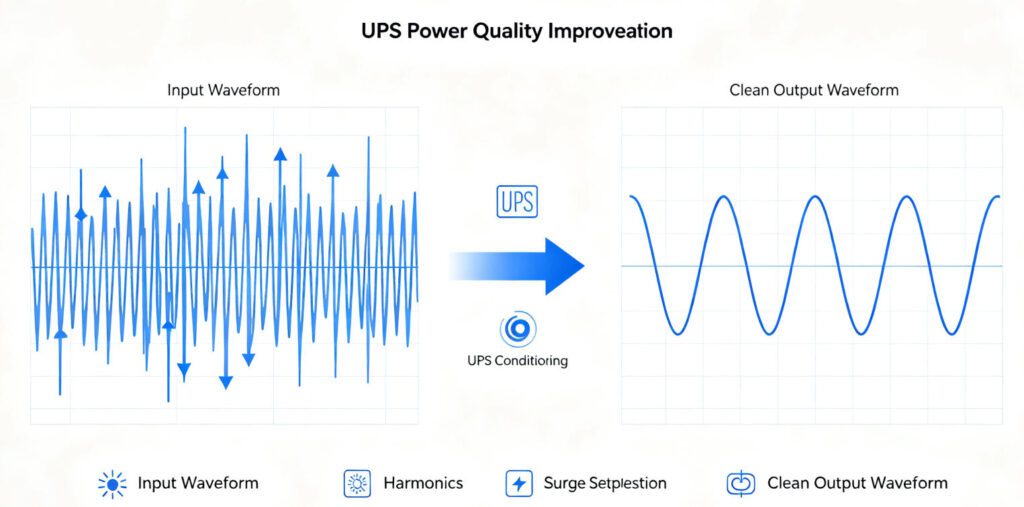
Modern UPS is not just backup power—it is a comprehensive power quality management device. BKPOWER line-frequency UPS purifies grid power through the following mechanisms:
1. Harmonic Suppression
Traditional 6-pulse rectifiers produce input current harmonics (THDi) of approximately 30%, polluting the grid. BKPOWER high-end models use 12-pulse rectifiers with phase-shift transformers, reducing THDi below 10%; or employ IGBT active rectification with PFC technology, achieving THDi <5% and power factor of 0.99.
2. Voltage Regulation
The inverter uses PWM closed-loop control to stabilize output voltage within ±1%, unaffected by utility fluctuations. Even when utility voltage fluctuates ±20%, load-side voltage remains constant.
3. Frequency Stability
Inverter output frequency is precisely controlled by internal crystal oscillators (50Hz ±0.1%), completely decoupled from utility frequency. For precision instruments and communication equipment, this characteristic is critical.
4. Common-Mode Noise Filtering
Line-frequency UPS isolation transformers naturally suppress common-mode noise (neutral-ground voltage, high-frequency interference). The BKPOWER BK-GH33 Series isolation transformer attenuates common-mode noise by over 60dB, protecting sensitive equipment like PLCs and medical instruments.
Ⅴ. BKPOWER Line-Frequency UPS Product Series and Application Matching
| Application Scenario | Key Requirements | Recommended Model | Core Architecture Advantage |
|---|---|---|---|
| Industrial Automation Lines | Anti-motor surge, EMC compliance | BK-GH33 60kVA | Transformer isolation, 150% overload 1 min |
| Hospital OR/ICU | Zero transfer, low leakage current | BK-GH33 30-100kVA | Isolation transformer, leakage <0.5mA |
| Data Center Core Room | High power density, parallel redundancy | BK-G33 100-400kVA | N+1 redundancy, efficiency up to 94% |
| Oil Drilling Platform | Wide temp, explosion-proof, anti-vibration | BK-GH33 Custom | -25°C to +55°C, IP42 protection |
| Rail Transit Signaling | High reliability, long lifespan | BK-GH33 100kVA | MTBF >100,000 hours |
Reference Sources
| Source Organization | Resource Type | URL |
|---|---|---|
| International Electrotechnical Commission (IEC) | UPS Standard IEC 62040-3 (VFI/VFD/VI Classification) | https://www.iec.ch |
| IEEE | Power Quality Standard IEEE 519 | https://www.ieee.org |
| Standardization Administration of China (SAC) | GB/T 7260 UPS National Standard | https://www.sac.gov.cn |
| BKPOWER Product Center | BK-GH33 Line-Frequency UPS Technical Specifications | https://bkpowers.com/products/ups-system/ifups/line-frequency-ups-bk-gh33-60kva/ |
| BKPOWER Technical Blog | UPS Type Comparison & Selection Guide | https://bkpowers.com/service/uncover-what-is-ups/ |
Recommended Internal Links
After reading this article, you may also want to explore:
- How to Calculate Watts: Industrial UPS Power Sizing Guide — Accurately calculate load power to match UPS capacity
- Industrial UPS Benefits & Line-Frequency Guide — Deep dive into seven core advantages of line-frequency UPS
- UPS Battery kWh to Ah Conversion & Sizing Guide — Battery bank capacity calculation and configuration methods
- UPS Preventative Maintenance Checklist — Line-frequency UPS maintenance cycles and inspection items
- Contactless Voltage Regulator Products — Front-end voltage protection solutions
FAQ
1. What is the difference between Uninterruptible Power Supply and a voltage stabilizer?
A voltage stabilizer only regulates voltage when utility power exists; it cannot supply power during outages. Uninterruptible Power Supply integrates voltage regulation, filtering, and backup power functions, with online UPS voltage regulation precision (±1%) far exceeding ordinary stabilizers (±3%-±5%). Industrial scenarios recommend “stabilizer + UPS” combination: the stabilizer protects the UPS, and the UPS protects the load.
2. Why is line-frequency UPS better than high-frequency UPS for industrial motor loads?
Industrial motor startup produces 5-7x rated current surges. Line-frequency UPS built-in transformers naturally absorb current surges, withstanding 150% overload for 1 minute. High-frequency UPS relies on IGBT electronic components to hard-absorb surges, easily triggering protective shutdowns under strong inductive load impact. Additionally, line-frequency UPS electrical isolation blocks high-frequency harmonic feedback from motors to the grid.
3. Does UPS bypass mode protect the load?
No. In bypass mode, the load is directly powered by utility, losing UPS voltage regulation, harmonic filtering, and backup power protection. If utility fails or surges occur, the load is directly exposed to grid risks. Bypass mode serves only as temporary transition during UPS fault or overload conditions and should not operate long-term. BKPOWER line-frequency UPS static bypass transfer time is <4ms; maintenance bypass requires manual operation with synchronization ensured.
4. Where does double-conversion UPS efficiency loss come from?
Double-conversion UPS undergoes AC→DC→AC two-stage conversion, with losses at each stage: rectifier efficiency ~97%-99%, inverter efficiency ~95%-97%, isolation transformer efficiency ~96%-98%. Combined efficiency is typically 88%-94%. BKPOWER uses IGBT+SPWM technology to optimize inverter efficiency; new line-frequency UPS efficiency approaches high-frequency levels while retaining transformer isolation and surge withstand advantages.
5. How do I determine if my scenario needs offline, line-interactive, or online UPS?
Offline UPS suits personal computers, routers, and non-critical devices (transfer time 2-10ms, low cost). Line-interactive UPS suits small offices and network equipment (transfer time <4ms, with AVR regulation). Online UPS suits all industrial, medical, and data center scenarios (zero transfer, complete isolation). BKPOWER specializes in industrial-grade online UPS; the BK-GH33 series covers 10-400kVA, meeting needs from machine tools to data centers.