Welcome to BKPOWER!












Cost-Benefit Analysis of UPS vs Voltage Stabilizers (2026 Technical Guide)
TIPS:The “Cost-Benefit Analysis of UPS vs Voltage Stabilizers (2025 Technical Guide)” delves into core cost and benefit differentiations. For cost, UPS has an initial cost of $20k-$100k (10-100kVA), high battery replacement and maintenance costs, with energy efficiency of 92-96% (Online)/98% (Eco Mode), and an ROI period of 3-5 years. Voltage stabilizers cost $5k-$30k initially (5-50kVA), with no battery replacement costs, lower maintenance, 95-99% efficiency, and an ROI of 2-4 years. In terms of benefits, UPS prevents losses of over $500k/hour in data centers and medical equipment. For instance, a bank cut annual downtime losses by $1.2M using dual-conversion UPS. However, voltage stabilizers only handle voltage fluctuations and lack blackout protection. This analysis serves as a comprehensive reference for industry decision-making, helping enterprises choose wisely in different electrical scenarios.

I. Core Cost Comparison
| Metric | UPS (Uninterruptible Power Supply) | Voltage Stabilizer |
|---|---|---|
| Initial Cost | 20k–100k (10–100kVA) | 5k–30k (5–50kVA) |
| Battery Replacement | 2k–10k/5 years (Lead-acid) / 4k–15k (Lithium) | None |
| Maintenance Cost | 1k–3k/year (battery testing, cooling) | 500–1.5k/year (servo-based calibration) |
| Energy Efficiency | 92–96% (Online) / 98% (Eco Mode) | 95–99% (no battery loss) |
| ROI Period | 3–5 years (high-availability scenarios) | 2–4 years (voltage fluctuation zones) |
II. Benefit Differentiation
1. Power Outage Protection
- UPS:
- Critical Value: Prevents $500k+/hour losses in data centers, medical devices.
- Case: A bank reduced annual downtime losses by $1.2M after deploying dual-conversion UPS.
- Voltage Stabilizer:
- Limitation: Only mitigates voltage fluctuations (e.g., ±30% input range), no blackout protection.
2. Operational Cost Optimization
- UPS:
- Lithium Battery Upgrade: 30% TCO reduction over 10 years (Amazon case: Lithium UPS saved $4.2M capex vs lead-acid).
- Smart Management: Cloud monitoring reduced manual inspections by 15 hours/year.
- Voltage Stabilizer:
- Energy Efficiency: Non-contact stabilizers save 500–1.2k/year via zero fan losses.
3. Technical Compatibility
| Scenario | UPS Preference | Stabilizer Preference |
|---|---|---|
| Data Centers/Labs | ★★★★★ | ★★☆ |
| Industrial Motors | ★★★☆ | ★★★★★ |
| Smart Manufacturing | ★★★☆ | ★★★★☆ |
III. Lifecycle Cost Model
UPS TCO Formula:TCO=InitialCost+Σ(AnnualMaintenance+EnergyCosts)+BatteryReplacement−ResidualValue
Example (100kVA Online UPS):
- Initial Cost: $60k
- Annual Maintenance: $2.4k (battery testing)
- Energy Cost (92% efficiency): 12k×(1/0.92)=13.04k
- Battery Replacement (5 years): $8k
- 5-Year TCO: 60k+(2.4k+13.04k)×5+8k = $156.2k
Voltage Stabilizer TCO:TCO=InitialCost+Σ(AnnualMaintenance)−ResidualValue
Example (50kVA Servo Stabilizer):
- Initial Cost: $18k
- Annual Maintenance: $1.2k
- 5-Year TCO: 18k+(1.2k×5) = $24k
IV. Decision Tree & Sizing Guidelines
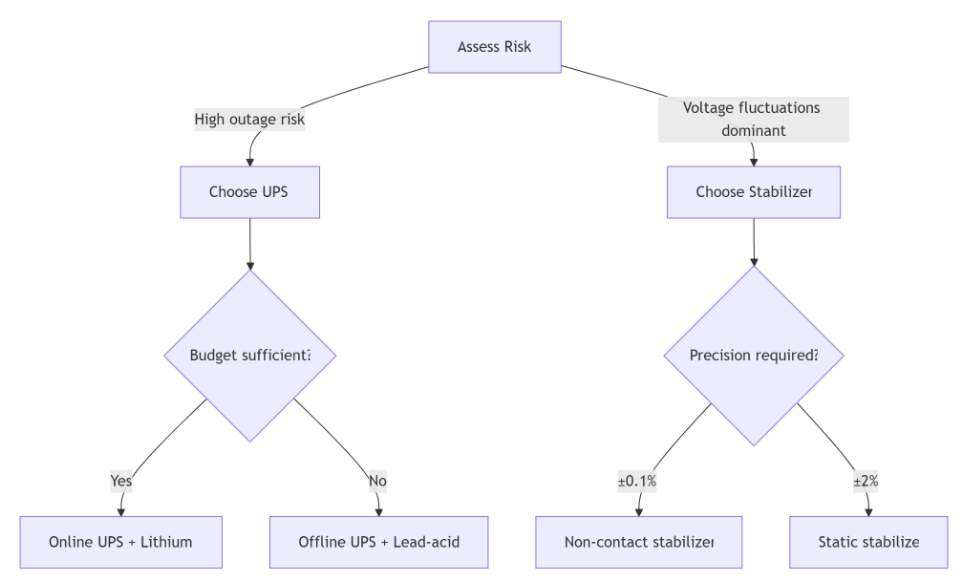
V. Industry Case Studies
- Semiconductor Plant (Stabilizer Preferred)
- Need: Wafer fabrication equipment requires ±0.1% voltage stability.
- Solution: Non-contact stabilizer (MTBF 100k hours), annual failure rate <0.05%.
- Cloud Data Center (UPS Preferred)
- Need: 99.999% uptime.
- Solution: Modular UPS (N+1 redundancy) + Lithium batteries, PUE reduced to 1.15.
VI. Emerging Technologies
- AI Predictive Maintenance: UPS failure prediction accuracy up to 92%, reducing unplanned downtime.
- Hybrid Systems: UPS+DVR combo reduces voltage sag losses by 78% (semiconductor data).
Conclusion
UPS delivers superior ROI in outage-prone, high-availability environments, while stabilizers excel in cost-sensitive, fluctuation-heavy scenarios. Enterprises should quantify risks via IEEE 1159 standards and adopt hybrid solutions for balanced resilience.
References
- International Electrotechnical Commission (IEC)Official website: www.iec.ch
- Underwriters Laboratories (UL)Official website: www.ul.com
- European Committee for Standardization (CEN)Official website: www.cen.eu
- Standardization Administration of China (SAC)Official website: www.sac.gov.cn
- Zhongguancun Energy Storage Industry Technology Alliance (CNESA)Official website: www.cnESA.org
- International Organization for Standardization (ISO)Official website: www.iso.org