Welcome to BKPOWER!












Single-Phase vs Three-Phase UPS: Complete 2026 Buying Guide
TIPS :Choosing between single-phase and three-phase UPS systems is a critical decision for any business. This single phase vs three phase UPS comparison guide breaks down the key differences in capacity, efficiency, wiring, and cost. Whether you need backup power for a home office or a data center, this UPS buying guide helps you make the right choice. BKPOWER engineers explain everything from sine wave physics to real-world deployment cases.
I. What Is the Difference Between Single-Phase and Three-Phase UPS?
1. The Core Electrical Principle
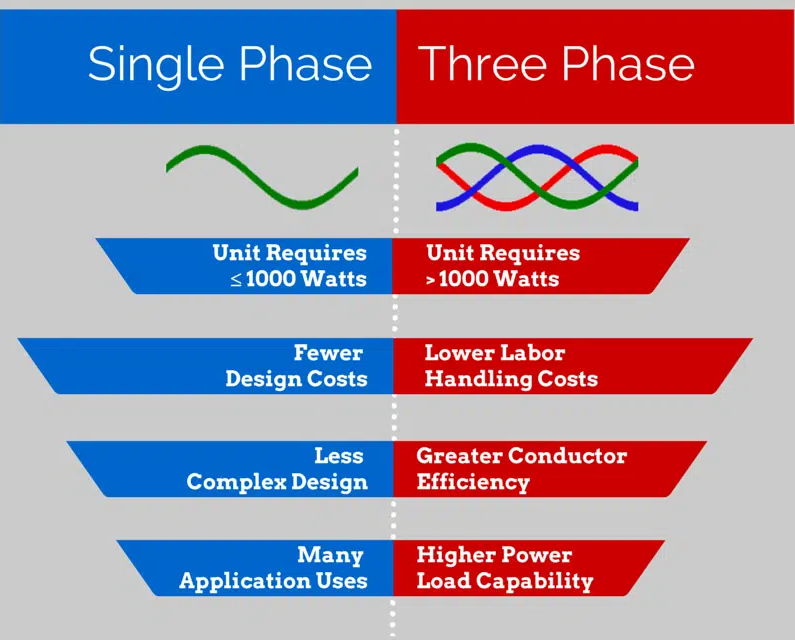
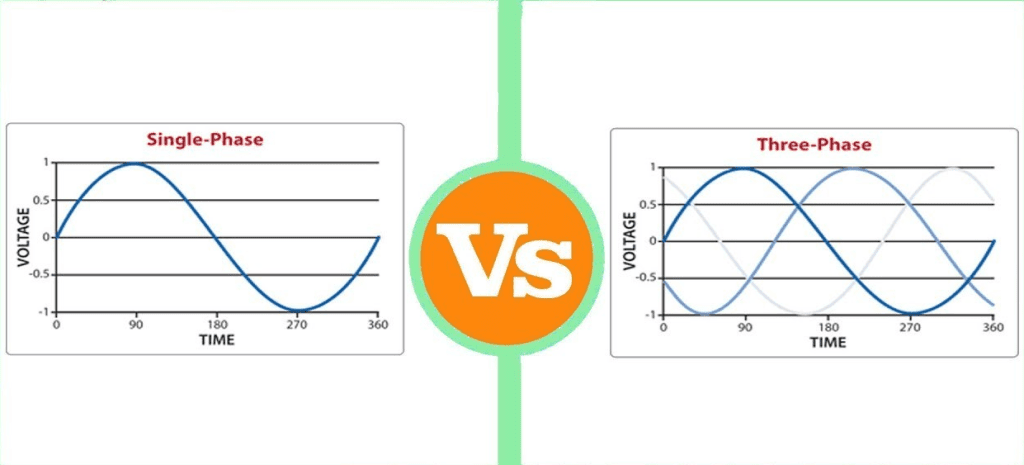
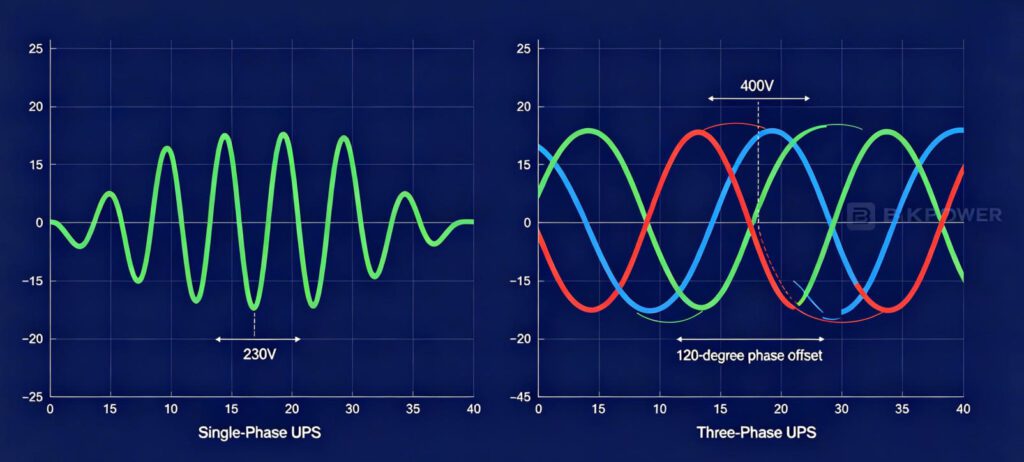
A single-phase UPS delivers power through one alternating current (AC) waveform. It uses two conductors: one live wire and one neutral wire. The voltage rises and falls in a single sine wave. Power drops to zero twice per cycle.
A three-phase UPS delivers power through three AC waveforms. Each waveform is offset by 120 degrees. This creates near-constant power delivery. It uses three live conductors plus one neutral wire (in wye configuration). The result is smoother, more stable power for heavy loads.
2. Why This Matters for Your Business
Power interruptions cost global businesses $150 billion annually. The right UPS system prevents data loss, equipment damage, and downtime. But choosing the wrong type wastes money or leaves you unprotected.
Single-phase UPS systems suit small offices, homes, and light IT loads. Three-phase UPS systems serve data centers, hospitals, and industrial plants. The gap between them is not just size. It is about power quality, efficiency, and scalability.
II. Technical Specifications Compared
1. Voltage and Wiring
| Feature | Single-Phase UPS | Three-Phase UPS |
|---|---|---|
| Conductors | 2 (live + neutral) + PE | 3 live + neutral + PE |
| IEC Voltage | 230 V (L-N) | 400 V (L-L) / 230 V (L-N) |
| North America Voltage | 120 V / 240 V split-phase | 208 V / 480 V |
| Wiring Complexity | Simple, plug-and-play | Requires professional electrician |
| Cable Size | Larger gauge for same power | Smaller gauge per conductor |
Three-phase systems carry the same power with less copper. At equal power, voltage, and power factor, each conductor carries about 57.7% of the current a single-phase system would need. This means smaller cables and lower transmission losses.
2. Capacity Range
| UPS Type | Typical Range | Maximum Capacity |
|---|---|---|
| Single-Phase | 1 kVA – 20 kVA | ~30 kVA |
| Three-Phase | 10 kVA – 600 kVA | 1,000+ kVA (modular) |
Single-phase UPS tops out around 20-30 kVA. Beyond that, current becomes too high for standard wiring. Three-phase UPS scales from 10 kVA to over 1,000 kVA in modular configurations.
3. Efficiency at Different Loads
| Load Level | Single-Phase UPS Efficiency | Three-Phase UPS Efficiency |
|---|---|---|
| 25% load | 85-90% | 88-92% |
| 50% load | 90-93% | 93-96% |
| 75% load | 92-94% | 95-97% |
| 100% load | 93-95% | 96-98% |
At low loads (under 10 kVA), single-phase UPS often wins on efficiency. At medium to high loads, three-phase UPS pulls ahead. Modern three-phase units with ECO mode can reach 99% efficiency.
4. Power Factor and Load Balancing
Three-phase UPS offers natural load balancing. Each phase carries one-third of the total load in a balanced system. This reduces neutral current and heat buildup. Single-phase UPS has no load balancing feature. All load sits on one phase.
Power factor correction (PFC) is standard in both types. But three-phase systems handle reactive loads (motors, compressors) far better. The rotating magnetic field in three-phase motors is self-starting. Single-phase motors need capacitors to start.
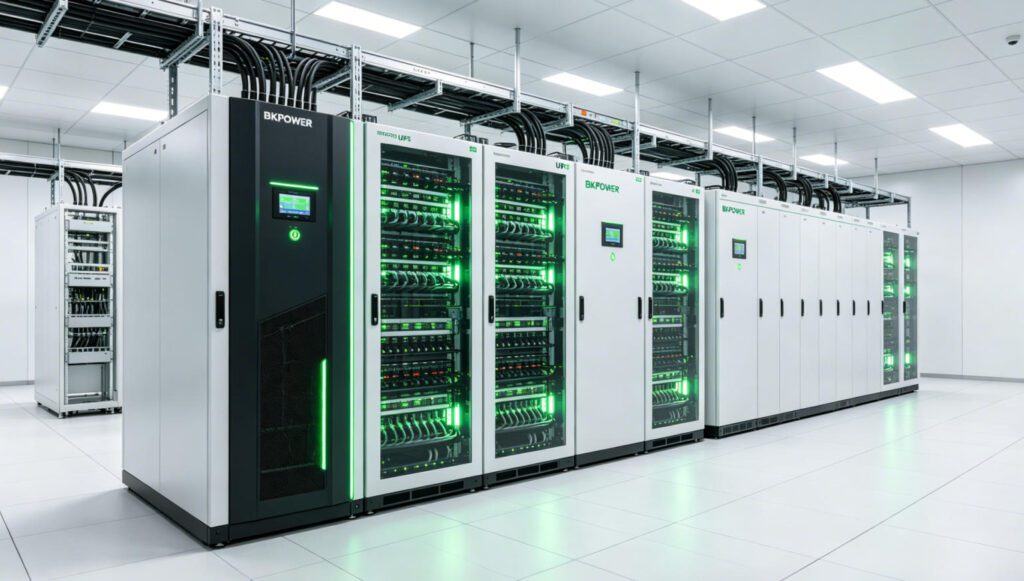
III. Advantages and Disadvantages
1. Single-Phase UPS: Pros and Cons
Advantages:
- Lower upfront cost. Units start under $200 for 1 kVA models.
- Simple installation. Most units plug into standard wall sockets.
- Compact size. Fits under desks or in small server racks.
- Wide availability. Standard in homes and small offices worldwide.
- Easy maintenance. Hot-swappable batteries in most models.
Disadvantages:
- Limited capacity. Cannot scale beyond ~20 kVA without multiple units.
- Higher per-watt transmission cost. Needs thicker cables for high current.
- Poor motor starting. Single-phase motors struggle with high-inertia loads.
- No redundancy. One unit failure means total protection loss.
- Voltage fluctuation sensitivity. Single-phase systems feel grid dips more.
2. Three-Phase UPS: Pros and Cons
Advantages:
- High capacity. Handles 20 kVA to 600 kVA and beyond.
- Superior efficiency at scale. Lower operating costs over time.
- Natural load balancing. Distributes power evenly across three phases.
- Motor-friendly. Self-starting torque for pumps, fans, compressors.
- Scalable architecture. Modular N+1, N+2 redundancy options.
- Smaller conductors. Less copper needed per watt delivered.
- Future-proof. Easy to expand without replacing infrastructure.
Disadvantages:
- Higher upfront cost. Entry-level three-phase units start around $5,000.
- Complex installation. Needs licensed electricians and proper grounding.
- Larger footprint. Requires dedicated electrical room or floor space.
- Professional maintenance. Not a DIY service item.
- Site requirements. Needs three-phase utility service or transformer.
IV. Real-World Applications
1. Single-Phase UPS Use Cases
Home Offices and Small Businesses:
- Desktop computers and workstations
- Home network routers and modems
- Small NAS storage devices
- Point-of-sale (POS) terminals
- Security camera systems (under 10 cameras)
- Medical devices in clinics (dental chairs, X-ray viewers)
IT and Telecom:
- Rack-mounted servers (1-5 units)
- Network switches and firewalls
- VoIP phone systems
- Small UPS for telecom base stations (remote sites)
Typical Load Range: 500 VA to 10 kVA
2. Three-Phase UPS Use Cases
Data Centers:
- Server farms and cloud infrastructure
- Colocation facilities
- Edge computing nodes
- Network operation centers (NOC)
Industrial and Manufacturing:
- CNC machines and robotic arms
- Assembly line automation
- Pump stations and HVAC systems
- Motor control centers (MCC)
Healthcare:
- MRI and CT scanners
- Operating room power
- Hospital-wide emergency power
- Blood bank refrigeration
Commercial Buildings:
- High-rise elevator systems
- Large UPS for shopping malls
- Cinema and theater complexes
- Airport baggage handling
Typical Load Range: 20 kVA to 600 kVA
V. How to Choose: The Decision Framework
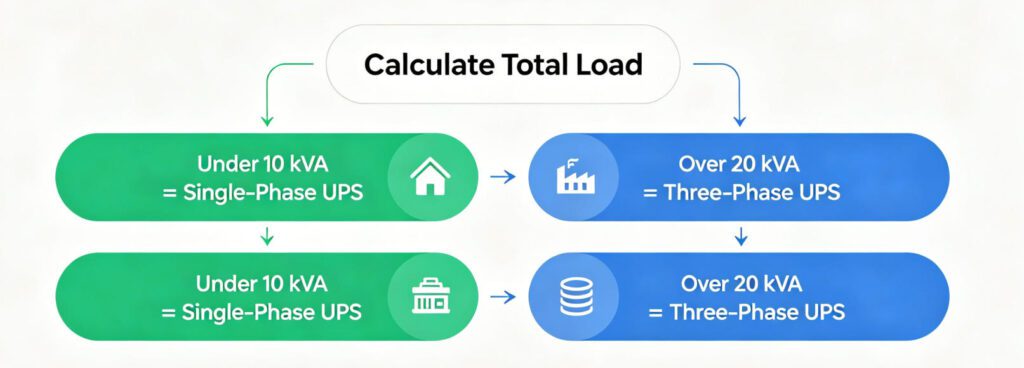
1. Step One: Calculate Your Total Load
Add up the wattage of all equipment you need to protect. Use this formula:
Total Load (W) = Sum of all device wattages × 1.25 (safety margin)
Convert to kVA: kVA = Watts / Power Factor
Use power factor = 0.8 for general IT loads. Use 0.9 for modern servers with active PFC.
Decision Rule:
- Under 10 kVA → Single-phase UPS
- 10-20 kVA → Single-phase or small three-phase (3/1 configuration)
- Over 20 kVA → Three-phase UPS (3/3 configuration)
2. Step Two: Assess Your Power Infrastructure
Check what your building supplies:
- Single-phase only (most homes, small offices)
- Three-phase available (commercial and industrial buildings)
- Need to upgrade utility service (budget $5,000-$20,000)
If your site has single-phase only, a three-phase UPS needs a phase converter or transformer. This adds cost and complexity.
3. Step Three: Evaluate Future Growth
Plan for 3-5 years ahead. Ask these questions:
- Will you add more servers or equipment?
- Are you moving to a larger facility?
- Will you install motor-driven equipment?
- Do you need N+1 redundancy for uptime?
Three-phase UPS with modular design lets you add power modules without replacing the entire system. Single-phase UPS often requires buying a new, larger unit.
4. Step Four: Balance Cost vs. Reliability
| Factor | Single-Phase | Three-Phase |
|---|---|---|
| Initial Cost | $200 – $5,000 | $5,000 – $100,000+ |
| Installation | DIY or basic electrician | Licensed electrician required |
| Operating Cost | Higher per kVA | Lower per kVA at scale |
| Maintenance | Simple, user-replaceable batteries | Professional service contract |
| Uptime Risk | Single point of failure | Redundancy options available |
5. Step Five: Consider Special Requirements
Motor Loads: If you run pumps, compressors, or elevators, three-phase is essential. Single-phase motors above 2.2 kW are inefficient and unreliable.
Power Quality: For sensitive lab equipment or semiconductor manufacturing, three-phase online double-conversion UPS provides the cleanest power.
Space Constraints: Single-phase units fit in tight spaces. Three-phase systems need dedicated rooms with proper ventilation.
VI. Common Mistakes to Avoid
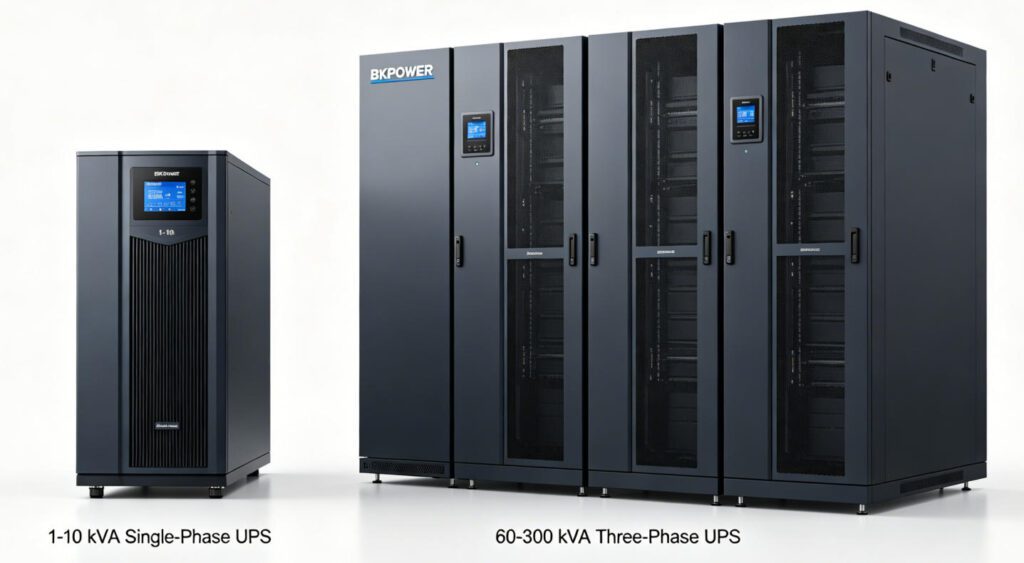
1. Undersizing Your UPS
Many buyers choose UPS based on current load only. They forget future growth. A UPS running at 90% capacity has no headroom. It also runs less efficiently. Size for 125% of current load minimum.
2. Ignoring Power Factor
Old UPS ratings used VA (volt-ampere) without power factor. Modern IT equipment has power factor near 0.9. But motors may have power factor as low as 0.6. Always calculate real power (watts) and apparent power (VA) separately.
3. Mixing Single-Phase and Three-Phase Loads
A three-phase UPS can output single-phase power (3/1 configuration). But this wastes capacity. If most of your load is single-phase, consider separate single-phase units. Or use a three-phase UPS with balanced single-phase distribution.
4. Neglecting Battery Runtime
UPS runtime depends on battery size and load. A 10 kVA UPS with standard batteries may only provide 5-10 minutes at full load. Calculate runtime needs carefully. Add external battery cabinets if needed.
5. Skipping Professional Installation
Three-phase UPS installation is not DIY. Improper grounding causes safety hazards. Wrong cable sizing creates fire risks. Always use certified electricians for three-phase installations.
VII. Summary and Final Recommendations
1. Choose Single-Phase UPS When:
- Total load is under 10 kVA
- You need simple, affordable protection
- Your site has single-phase utility only
- Equipment includes computers, networks, small servers
- Space is limited (under-desk or small rack)
- Budget is under $5,000
2. Choose Three-Phase UPS When:
- Total load exceeds 20 kVA
- You run motors, pumps, or compressors
- Your facility has three-phase utility service
- You need N+1 redundancy for critical uptime
- You plan to expand power needs within 3-5 years
- Budget allows for professional installation and maintenance
3. The BKPOWER Advantage
Whether you need single-phase UPS for a small office or three-phase UPS for a data center, BKPOWER delivers:
- Engineering expertise: 20+ years in power protection design
- Global certifications: CE, UL, ISO 9001, IEC 62040
- Custom solutions: Tailored to your voltage, frequency, and environmental needs
- Full lifecycle support: From design to decommissioning
Contact BKPOWER today for a free power assessment. Our engineers will analyze your load profile, site conditions, and growth plans. We will recommend the optimal single-phase or three-phase UPS solution for your needs.
References Source
| Source | URL | Description |
|---|---|---|
| IEC 62040 Standard | https://webstore.iec.ch/publication/66912 | International UPS safety and performance standards |
| IEEE 446 (Orange Book) | https://standards.ieee.org/standard/446-1995.html | Recommended practice for emergency and standby power systems |
| U.S. Department of Energy | https://www.energy.gov/eere/femp/uninterruptible-power-supplies | Federal energy management program UPS guidelines |
| European UPS Manufacturers Association | https://www.eupse.com/ | European power supply industry standards and best practices |
| Schneider Electric UPS Fundamentals | https://www.se.com/us/en/faqs/FAQ000243825/ | Technical FAQ on single-phase vs three-phase UPS systems |
FAQ
Can I use a three-phase UPS with single-phase equipment?
A: Yes. A three-phase UPS with 3/1 configuration takes three-phase input and outputs single-phase power. However, this is less efficient than using a dedicated single-phase UPS for small loads. For loads under 10 kVA, single-phase UPS is usually the better choice.
What is the typical lifespan of a UPS battery?
A: VRLA (lead-acid) batteries last 3-5 years under normal conditions. Lithium-ion batteries last 8-15 years. Battery life depends on temperature, discharge cycles, and charging profile. BKPOWER smart charging extends battery life by up to 30%.
How do I calculate the right UPS capacity for my needs?
A: Follow these steps: (1) List all equipment wattages. (2) Add them up. (3) Multiply by 1.25 for safety margin. (4) Divide by power factor (0.8 for general loads, 0.9 for modern IT). (5) The result is your minimum UPS kVA rating. For example: 6,000 W × 1.25 ÷ 0.8 = 9.375 kVA. Choose a 10 kVA UPS.
Is three-phase UPS always more efficient than single-phase?
A: Not always. At low loads (under 10 kVA), single-phase UPS can be more efficient. Three-phase UPS shows its advantage at medium to high loads (20+ kVA). Modern three-phase units with ECO mode achieve up to 99% efficiency at partial loads.
What maintenance does a UPS system require?
A: Single-phase UPS needs annual visual inspection and battery testing every 6 months. Battery replacement every 3-5 years. Three-phase UPS needs quarterly preventive maintenance by certified technicians. This includes thermal scanning, connection torque checks, fan inspection, and battery impedance testing. BKPOWER offers annual maintenance contracts for both types.
BKPOWER offers end-to-end UPS supplies, UPS systems, and UPS support. From home to industrial sectors, our products meet diverse power continuity demands. Contact us to tailor your UPS solution today.