Welcome to BKPOWER!












Industrial UPS Benefits & Line-Frequency Guide
TIPS:Industrial UPS benefits go far beyond backup power. Explore 7 core advantages of line-frequency UPS and isolation transformers. Choose BKPOWER for zero-downtime protection.

Ⅰ. The Hidden Cost of Industrial Power Outages: Why You Need a Professional UPS
In manufacturing, petrochemical, and metallurgical industries, a brief power interruption can be catastrophic. Industry statistics show that production line downtime can cost tens of thousands of dollars per minute. More insidious risks come from power quality issues—voltage sags, harmonic interference, and surge impacts—that gradually erode equipment lifespan and inflate maintenance costs.
Commercial UPS units are designed for office servers and IT equipment. They cannot handle motor startup surges, dust, high temperatures, or grid distortion in industrial settings. The industrial UPS benefits from BKPOWER lie precisely in its adaptability to extreme conditions. This article analyzes seven dimensions of how industrial UPS systems serve as “power insurance” for production lines.
Ⅱ. Seven Core Industrial UPS Benefits

1. Zero Transfer Time: Double-Conversion Ensures Absolute Continuity
BKPOWER online UPS employs double-conversion (AC-DC-AC) architecture. The load is always powered by the inverter. This means during a mains failure, the battery bank takes over seamlessly with zero milliseconds of transfer time. For semiconductor wafer processing, precision CNC machines, or hospital operating rooms, even a millisecond of power loss can cause scrap or safety incidents.
By contrast, offline UPS has a 2-10ms switching delay. Line-interactive UPS offers AVR but still relies on a transfer switch. The zero-transfer benefit of industrial UPS is the first line of defense for critical load continuity.
2. Galvanic Isolation: UPS Isolation Transformer Eliminates Neutral-Ground Voltage and Harmonics
In industrial grids, VFDs, welders, and large motors generate high-frequency harmonics and common-mode noise that pollute the entire distribution system. BKPOWER line-frequency UPS features a built-in UPS isolation transformer, achieving complete electrical isolation between input and output. The benefits include:
- Eliminates neutral-to-ground voltage differential: Protects measurement accuracy of precision instruments and medical devices
- Suppresses common-mode noise: Reduces electromagnetic interference with PLC control system signals
- Blocks DC components: Prevents DC leakage from grid faults damaging downstream loads
- Enhances short-circuit protection: The transformer provides high fault current, ensuring rapid selective tripping of downstream breakers
For medical, laboratory, and automation environments, the UPS isolation transformer is not merely a performance option—it is a mandatory safety compliance requirement.
3. 150% Overload Capacity: Handling Motor Inrush with Confidence
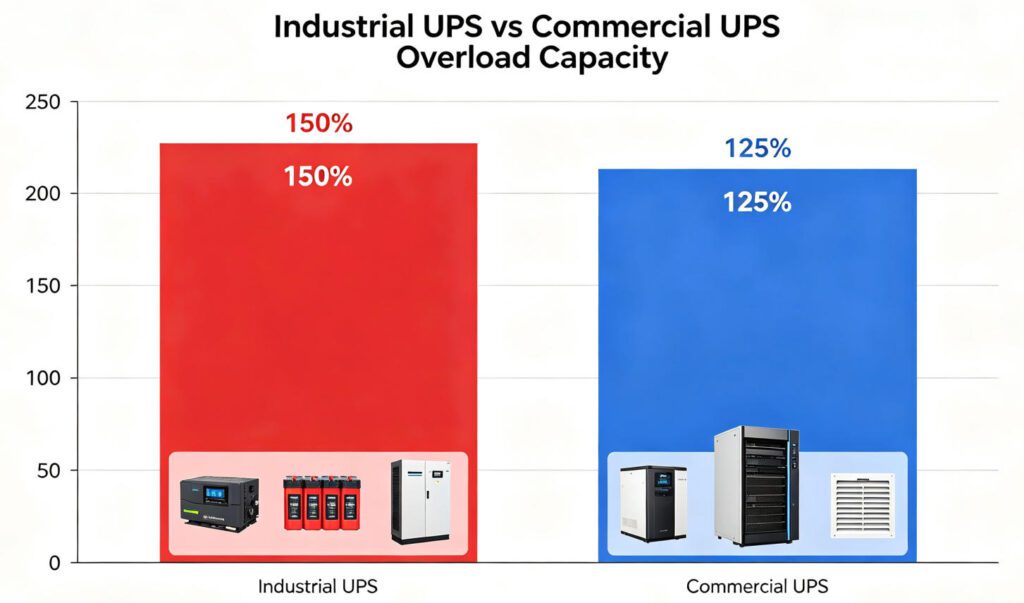
Industrial loads are predominantly inductive. Motors, compressors, and punch presses produce 5-7 times rated current during startup. Commercial UPS can only sustain 125% load for a few minutes before switching to bypass or protective shutdown. BKPOWER industrial UPS is engineered to withstand 150% overload for 1 minute and 125% overload for 10 minutes, ensuring large motors start smoothly without triggering system trips.
This overload advantage stems from the physical characteristics of line-frequency UPS. The built-in transformer naturally resists current surges. High-frequency UPS relies on electronic components to hard-absorb surges, making it significantly less reliable in industrial scenarios.
4. Harsh Environment Adaptability: All-Weather Operation from -25°C to +55°C
Industrial sites often involve high temperatures, dust, humidity, and vibration. BKPOWER industrial UPS uses industrial-grade components with “three-proof” treatment (dust-proof, moisture-proof, corrosion-proof). Protection ratings reach IP31-IP42. The operating temperature range covers -25°C to +55°C with relative humidity tolerance of 0%-95%. Commercial UPS typically operates stably only in air-conditioned environments from 0-40°C.
Industrial UPS Benefits & Line-Frequency GuideIn mines, ports, and outdoor substations, the rugged design of industrial UPS is essential for long-term reliability. Paired with the BKPOWER Three-Phase Contactless Voltage Regulator, it provides dual protection during severe grid voltage fluctuations.
5. Power Quality Optimization: Harmonic Filtering and Pure Sine Wave Output
Modern industrial UPS is more than a backup power source—it is a power quality management device. BKPOWER online UPS uses IGBT rectification with active power factor correction (PFC), controlling input harmonic current distortion (THDi) below 5% and achieving a power factor up to 0.99. The output delivers pure sine wave with less than 3% distortion, far superior to direct grid supply quality.
For factories deploying numerous VFDs, the harmonic filtering capability of UPS reduces additional heating in transformers and cables, cutting investment in reactive compensation devices. This is a hidden benefit of industrial UPS in energy saving and consumption reduction.
6. Total Cost of Ownership (TCO) Advantage: MTBF Exceeding 100,000 Hours
Industrial UPS typically costs 20%-40% more upfront than commercial UPS. However, its total cost of ownership (TCO) is significantly lower. BKPOWER line-frequency UPS achieves an MTBF (mean time between failures) exceeding 100,000 hours with a design life of 15+ years. The core transformer has no electrolytic capacitors or other wear-prone components. Its mechanical structure is stable and maintenance requirements are minimal.
High-frequency UPS, while compact and efficient, has electrolytic capacitors with a typical lifespan of only 5-8 years. They age faster in industrial high-temperature environments. A substation case study showed that a line-frequency UPS operated at full load for 5 years with only fan replacements, while a co-installed high-frequency UPS required two capacitor replacements. For industrial users seeking long-term stability, the TCO advantage of line-frequency UPS is irreplaceable.
7. Synergy with Stabilizers/Transformers: Building a Complete Power Protection Chain
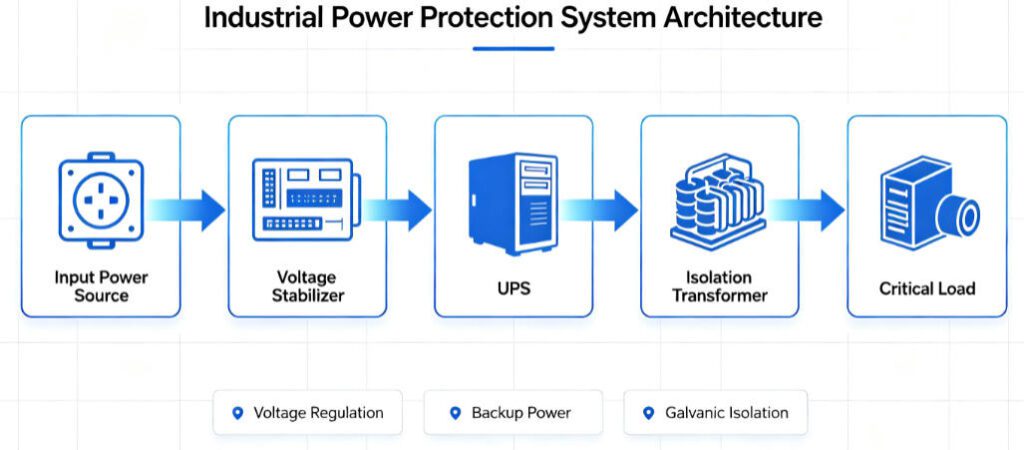
The maximum industrial UPS benefits are realized when combined with upstream stabilizers and downstream distribution transformers. BKPOWER recommends a three-tier architecture: “Stabilizer + UPS + Isolation Transformer”:
- Tier 1: Contactless Voltage Regulator stabilizes wide-fluctuation mains to within ±1%
- Tier 2: Online UPS provides zero-transfer backup power and harmonic filtering
- Tier 3: Dry-Type Isolation Transformer achieves electrical isolation and voltage level conversion
This architecture protects not only the load but also the UPS itself. In regions with poor grid quality, the stabilizer absorbs voltage surges first, significantly reducing UPS battery discharge frequency and extending battery life by over 30%.
Ⅲ. Line-Frequency UPS vs High-Frequency UPS: Why Industry Must Choose Line-Frequency
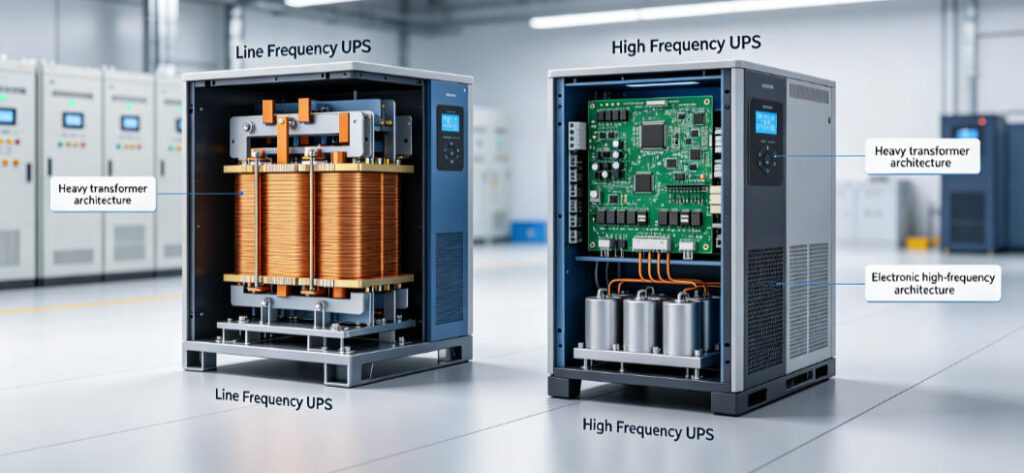
Many users hesitate between line-frequency and high-frequency UPS. The table below provides an objective comparison from an industrial application perspective:
| Dimension | Line-Frequency UPS (BKPOWER BK-G33) | High-Frequency UPS |
|---|---|---|
| Overload Capacity | 150% for 1 min, strong surge resistance | 125% for minutes, prone to shutdown |
| Galvanic Isolation | Built-in isolation transformer, full isolation | No transformer, relies on electronic isolation |
| Environmental Range | -25°C to +55°C, IP31-IP42 | 0°C to +40°C, typically IP20 |
| Load Compatibility | Perfect for motors, compressors, inductive loads | Suitable for servers, resistive/capacitive loads |
| Efficiency | 88%-94% (modern IGBT rectifier) | 95%-98% |
| Size & Weight | Large, requires dedicated room | Compact, rack-mountable |
| Design Life | 15-20 years | 8-10 years |
| Typical Applications | Factories, hospitals, oil fields, rail transit | Data centers, offices, commercial IT |
Selection Conclusion: When loads include strong inductive equipment, require strict electrical isolation, or operate in harsh grid environments, line-frequency UPS is the only reliable choice for industrial scenarios. The BKPOWER BK-G33 60kVA Line-Frequency UPS and BK-G33 100kVA Line-Frequency UPS are specifically designed for heavy industry. Their reliability has been validated in metallurgy, petrochemicals, and port machinery applications.
Ⅳ. BKPOWER Industrial UPS Application Quick Selection Guide
| Application Scenario | Key Pain Point | Recommended BKPOWER Solution | Core Benefit |
|---|---|---|---|
| CNC Machine Line | Motor startup surge, voltage sags | BK-G33 Line-Frequency UPS + Contactless Stabilizer | 150% overload, zero transfer |
| Hospital OR/ICU | Life-support equipment cannot lose power | BK-G33 Line-Frequency UPS + CVT | Galvanic isolation, pure sine wave |
| Data Center Servers | Harmonic pollution, thermal loss | High-Frequency or Line-Frequency UPS + Dry Transformer | THDi<5%, high efficiency |
| Outdoor Substation/Mine | Extreme temperature, dust, humidity | IP42 Line-Frequency UPS + Bypass Isolation Cabinet | Wide-temp operation, three-proof treatment |
| Semiconductor/Precision Instruments | Neutral-ground voltage, microsecond transients | Line-Frequency UPS + Isolation Transformer | Full galvanic isolation, leakage <0.5mA |
Reference Sources
| Source Organization | Resource Type | URL |
|---|---|---|
| International Electrotechnical Commission (IEC) | UPS International Standard IEC 62040 | https://www.iec.ch |
| Institute of Electrical and Electronics Engineers (IEEE) | Power Quality Standard IEEE 519 | https://www.ieee.org |
| Standardization Administration of China (SAC) | GB/T 7260 UPS National Standard | https://www.sac.gov.cn |
| BKPOWER Product Center | Industrial UPS & Stabilizer Technical Specs | https://bkpowers.com/products/ups-system/ |
| BKPOWER Technical Blog | UPS Type Comparison & Selection Guide | BKPOWER Industrial Knowledge Hub: UPS Technology, Power Stability & Industry Applications |
Recommended Links
After reading this article, you may also want to explore:
- How to Calculate Watts: Industrial UPS Power Sizing Guide — Accurately calculate load power to match UPS capacity
- BKPOWER Line-Frequency UPS Product Series — View full BK-G33 series technical specifications
- Contactless Voltage Regulator Products — Front-end voltage protection solutions for use with UPS
FAQ
1. What is the core difference between industrial UPS and commercial UPS?
Industrial UPS is designed for harsh environments with stronger overload capacity (150%), wider temperature range (-25°C to +55°C), and built-in isolation transformers. Commercial UPS targets office IT equipment. It is compact and efficient but cannot handle motor surges or grid distortion. Industrial scenarios should prioritize line-frequency UPS.
2. Why is line-frequency UPS better than high-frequency UPS for industrial motor loads?
Line-frequency UPS contains a transformer with natural surge resistance and galvanic isolation, easily handling 5-7x motor startup current. High-frequency UPS relies on electronic components to absorb surges, making it prone to protective shutdowns under inductive load impact. Additionally, line-frequency UPS offers longer MTBF and lower maintenance costs.
3. Can a UPS isolation transformer replace a dedicated voltage stabilizer?
No. A UPS isolation transformer primarily provides electrical isolation and noise suppression without active voltage regulation. In regions where grid voltage fluctuates beyond ±15%, we recommend adding a BKPOWER Contactless Voltage Regulator upstream of the UPS. This creates a complete “stabilization + isolation + backup” protection chain.
4. How often do industrial UPS batteries typically need replacement?
Traditional lead-acid batteries last about 3-5 years. BKPOWER industrial UPS offers optional LiFePO4 lithium batteries with a lifespan of 10-12 years and better temperature tolerance. At 25°C ambient, lithium batteries achieve over 4,000 charge-discharge cycles, significantly reducing lifecycle maintenance costs.
5. How do I evaluate the return on investment (ROI) for an industrial UPS?
Industrial UPS ROI should be calculated from three perspectives: avoided downtime losses, extended equipment lifespan, and reduced maintenance costs. For example, a production line with annual output value of USD 5 million avoids an 8-hour outage (approx. USD 16,000 loss) thanks to the UPS, which alone covers the procurement cost of a 60kVA line-frequency UPS. Combined with 15-year design life and low maintenance, industrial UPS typically achieves ROI within 2-3 years.