Welcome to BKPOWER!












Industrial UPS Tech Summary: 10-100KVA Selection Guide
TIPS:In the wave of industrial digitalization, industrial UPS systems have become the core infrastructure ensuring critical equipment stability. This Month 1 recap delves into the latest evolution of UPS technology—from sizing logic for 10-100KVA ranges to Li-ion battery innovations and dry-type transformer integration strategies. The value of industrial UPS systems extends beyond outage protection to comprehensive power quality enhancement. Mastering cutting-edge UPS technology is essential for building highly reliable power protection architectures. Through this article, gain BKPOWER’s professional insights into industrial power safeguarding and access practical selection resources.
Ⅰ. Introduction: The Strategic Value of Industrial UPS Systems
Industrial uninterruptible power supply (UPS) systems have evolved far beyond simple backup devices. They now constitute critical infrastructure for modern industrial power architectures. According to recent market data, the global industrial UPS market will expand from USD 6.6 billion in 2024 to USD 12.2 billion by 2034, representing a CAGR of 6.3%.
Within this growth trajectory, UPS systems in the 10-100KVA range have emerged as the dominant choice for manufacturing facilities, data centers, and critical infrastructure. BKPOWER, leveraging expertise in dry-type transformer manufacturing, recognizes the critical importance of coordinated design between uninterruptible power supply units and power conditioning equipment.
This article systematically summarizes key industrial UPS technologies. It covers topology selection, battery innovations, and integration strategies with dry-type transformers. The content targets engineers and procurement decision-makers seeking practical guidance.
Ⅱ. Market Landscape and Technology Trends
1. Market Drivers
Multiple factors drive industrial UPS market expansion:
- Industrial automation upgrades: PLCs, industrial servers, and automated lines demand strict power quality
- Digital transformation: Data centers and edge computing nodes require 24/7 availability
- Grid instability: Extreme weather and aging infrastructure drive protective investments
Regarding power distribution, the 10-100KVA range holds significant market importance. While >500KVA systems currently generate the highest revenue (44.9%), the medium-capacity segment (10-100KVA) shows the fastest growth due to flexibility and broad applicability.
2. Topology Comparison
Industrial UPS systems employ three primary architectures:
| Topology | Market Share | Key Advantage | Best For |
|---|---|---|---|
| Online Double Conversion | 58.1% | Zero transfer time, ±2-3% voltage regulation | Precision manufacturing, medical equipment |
| Line-Interactive | Medium | Good efficiency, moderate cost | General industrial environments |
| Standby/Offline | Lower | Cost-effective, simple design | Non-critical loads |
Online double conversion technology ensures output voltage stability within 2-3% of nominal through AC-DC-AC conversion. This precision far exceeds line-interactive systems’ ±8-15% tolerance.
Ⅲ. Battery Technology Revolution
1. Lithium-Ion Advantages
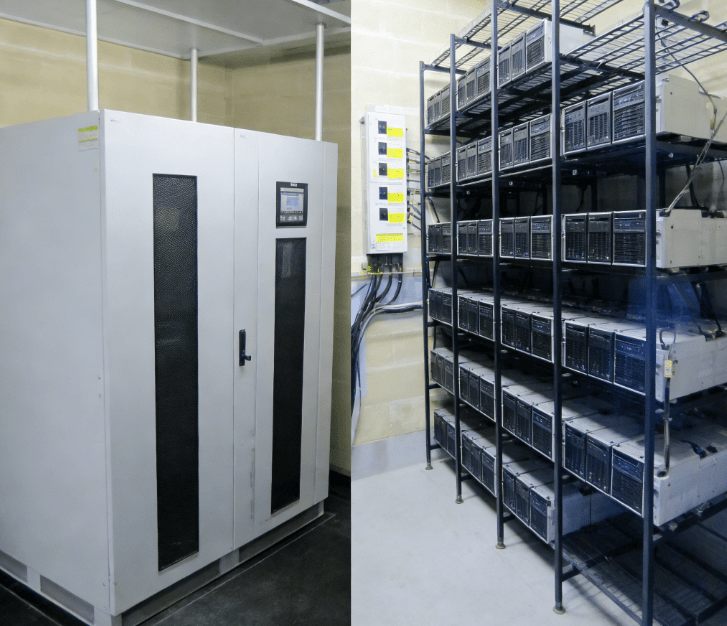
Battery systems form the UPS core. By 2025, lithium-ion technology achieves major breakthroughs in industrial UPS power supply applications:
- Space efficiency: Li-ion battery backup systems save up to 40% floor space versus lead-acid
- Extended lifespan: 2-3 times longer cycle life reduces replacement frequency
- Fast charging: Rapid recharge capabilities minimize recovery time after outages
- Reduced maintenance: Eliminates watering and equalization charging needs
2. Flywheel Storage
For short-duration outage protection, flywheel energy storage provides an eco-friendly alternative. Kinetic energy storage delivers instantaneous response with virtually maintenance-free operation. This technology particularly addresses momentary voltage sags and brief interruptions.
Ⅳ. Modular Design and Scalability
1. Plug-and-Play Architecture
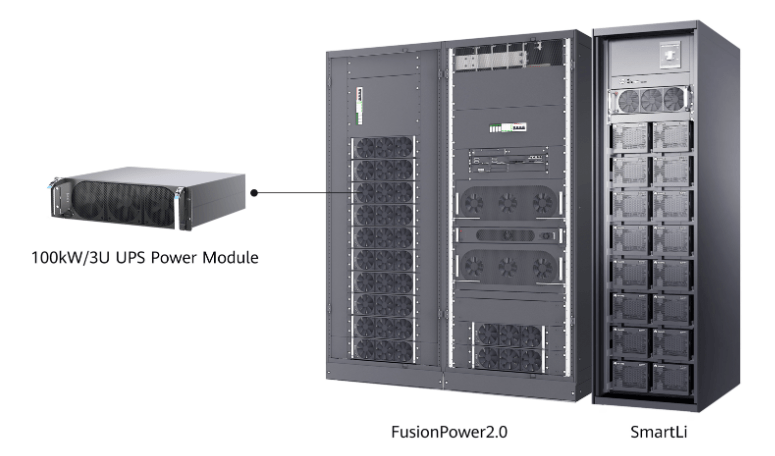
Modular UPS designs overcome traditional monolithic limitations:
- Flexible scaling: Add/remove power modules based on load changes, avoiding over-provisioning
- Fault isolation: Single module failure doesn’t compromise system operation, enabling N+1 redundancy
- Hot-swappable maintenance: Supports online replacement with zero downtime
2. 10-100KVA Modular Practice
For BKPOWER’s focus range (10-100KVA), modularity proves especially valuable. Users can start at 20KVA and scale to 60KVA or 100KVA as operations grow. This “pay-as-you-grow” approach significantly reduces total cost of ownership (TCO).
Ⅴ. UPS and Dry-Type Transformer Integration
1. Why UPS Needs Transformer Pairing
Industrial UPS systems require dry-type transformer integration for critical reasons:
- Voltage matching: Converts utility voltage to UPS input levels (e.g., 415V to 380V)
- Galvanic isolation: Provides primary-secondary electrical isolation, blocking harmonic transmission and ground loops
- K-factor rating: Nonlinear loads generate harmonics requiring K-4 or higher rated transformers
- Bypass protection: UPS bypass lines need separate isolation transformers for maintenance safety
2. Dry-Type Transformer Selection Criteria
When specifying dry-type transformers for 10-100KVA uninterruptible power supply systems, engineers should evaluate:
- Capacity sizing: Transformer ratings should equal 1.25x UPS rated power to handle inverter harmonics
- Insulation class: Copper windings recommend 180°C systems with 115K maximum temperature rise
- Impedance design: Typical 4.5% impedance voltage balances short-circuit current and voltage regulation
- Connection groups: Dyn11 configuration isolates 3rd harmonics and provides stable neutral points
BKPOWER’s dry-type autotransformer and isolation transformer product lines optimize specifically for UPS systems, covering 10-100KVA capacities and complying with IEC 60076 and IEEE C57 series standards.
Ⅵ. Intelligence and Digital Monitoring
1. AI-Driven Predictive Maintenance
Artificial Intelligence (AI) and Internet of Things (IoT) reshape UPS supplies management:
- Real-time monitoring: Continuous tracking of battery internal resistance, temperature, and charge states via sensors
- Fault prediction: AI algorithms analyze historical data to warn of potential failures
- Energy optimization: Dynamic mode adjustment based on utility rates reduces electricity costs
Eaton’s Energy Saver System leverages AI to achieve up to 99% operating efficiency.
2. Digital Twins and Remote Management
Modern industrial UPS systems support cloud connectivity. This allows remote monitoring of multiple units via web interfaces or mobile apps. For geographically distributed enterprises, this centralized capability dramatically improves maintenance efficiency.
Ⅶ. 10-100KVA UPS Selection Decision Framework
1. Load Analysis Procedure
Proper sizing begins with accurate load assessment:
- Inventory compilation: List all equipment requiring protection with rated power
- Power factor correction: Account for load power factor (typically 0.8), calculating apparent power (KVA)
- Inrush current evaluation: Motor loads require considering 5-7x starting current surges
- Future expansion: Reserve 20-30% capacity headroom for business growth
2. Application Matching
| Application | Recommended Capacity | Critical Requirements | Transformer Pairing |
|---|---|---|---|
| Small Data Center | 10-20KVA | Double-conversion online, 15-30min backup | 20KVA isolation transformer, K-4 rated |
| Manufacturing Line | 30-60KVA | Grid disturbance immunity, modular design | 50KVA dry-type transformer, Dyn11 connection |
| Medical Equipment | 80-100KVA | Ultra-low output harmonics, isolation protection | 100KVA medical isolation transformer, copper wound |
| Edge Computing | 10-40KVA | Compact design, intelligent management | Autotransformer for space savings |
3. Efficiency and Sustainability Considerations
- Efficiency ratings: Select ENERGY STAR certified uninterruptable power supply units achieving >95% efficiency
- Eco-design: Verify WEEE compliance and component recyclability
- Thermal management: High-efficiency UPS generates less heat, reducing facility cooling loads
Ⅷ. Conclusion and Outlook
Industrial UPS technology advances toward higher efficiency, intelligence, and sustainability. For users focusing on the 10-100KVA range, the key lies in selecting solutions that meet current needs while enabling future expansion.
Integrating UPS with high-quality dry-type transformers enhances overall system reliability. It optimizes power quality and extends downstream equipment lifespan. BKPOWER leverages deep expertise in dry-type transformers to provide power protection solutions perfectly matched with UPS systems.
Download Professional Selection Guide
If you are planning UPS system upgrades or new projects, download the “BKPOWER Industrial UPS & Transformer Selection Guide“. This comprehensive guide covers 10-100KVA capacity calculations, topology selection, battery configurations, and transformer pairing schemes. It helps you build highly reliable industrial power protection architectures.
References
- International Electrotechnical Commission (IEC)Official website: www.iec.ch
- Underwriters Laboratories (UL)Official website: www.ul.com
- European Committee for Standardization (CEN)Official website: www.cen.eu
- Standardization Administration of China (SAC)Official website: www.sac.gov.cn
- Zhongguancun Energy Storage Industry Technology Alliance (CNESA)Official website: www.cnESA.org
- International Organization for Standardization (ISO)Official website: www.iso.org