Welcome to BKPOWER!












UPS Preventative Maintenance: Line-Frequency Checklist
TIPS:UPS preventative maintenance ensures industrial power continuity. Explore BKPOWER’s semi-annual and annual checklists for line-frequency UPS systems.
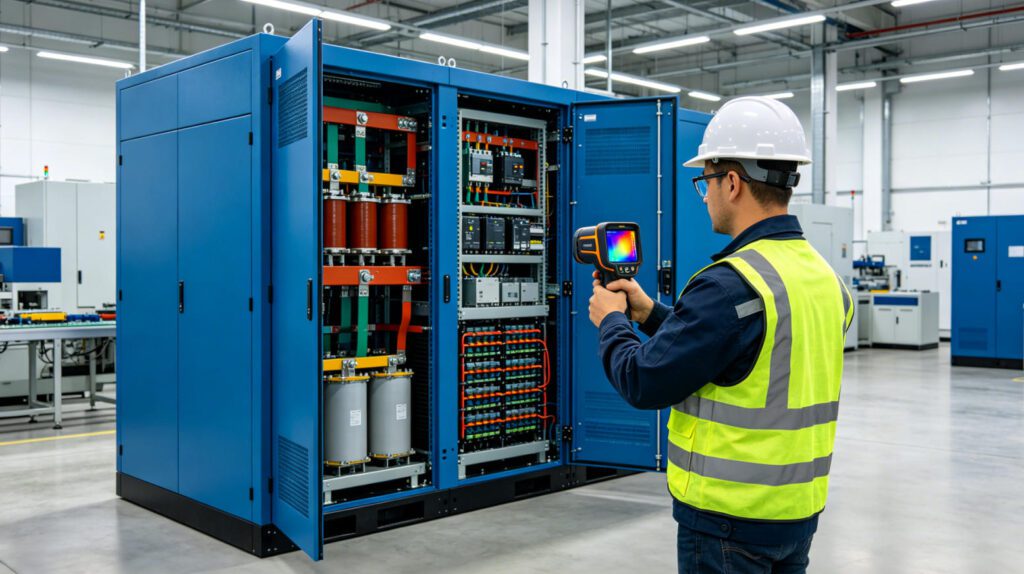
Ⅰ. Why Industrial UPS Preventative Maintenance Is Non-Negotiable
Power interruption is the number one root cause of industrial downtime, and UPS system failures are the leading source of power-related incidents. The Uptime Institute specifically states: “Regular preventative maintenance will significantly reduce the number of failures.” In industrial scenarios, this conclusion carries even more weight—a single unexpected outage can scrap an entire production line, with losses far exceeding maintenance costs.
The core value of UPS preventative maintenance lies in “curing the disease before it occurs.” Through systematic cleaning, inspection, and monitoring, BKPOWER engineers eliminate risks like capacitor bulging, fan seizure, and battery internal resistance spikes before they escalate into catastrophic failures. Compared to reactive repairs, proactive maintenance reduces total cost of ownership (TCO) by over 40% while improving equipment availability to 99.995%.
Ⅱ. BKPOWER Industrial UPS Preventative Maintenance Schedule
BKPOWER classifies maintenance services into Semi-Annual and Annual tiers based on operational intensity and environmental severity. Critical mission facilities (semiconductor wafer fabs, hospital ORs, petrochemical DCS systems) require semi-annual maintenance. Standard industrial scenarios may opt for annual maintenance combined with quarterly inspections.
The core difference: semi-annual maintenance focuses on condition monitoring and trend analysis, while annual maintenance includes deep disassembly inspection and functional verification. The table below provides a complete comparison of BKPOWER line-frequency UPS maintenance checklists:
Ⅲ. BKPOWER Line-Frequency UPS Maintenance Checklist Details
1. Display Value Baseline Check (Semi-Annual & Annual)
Upon arrival, maintenance engineers first record baseline data from the UPS HMI. These values are re-recorded and compared before and after load isolation to identify potential anomalies:
- Bypass Input Voltage/Current: Verifies mains quality stability
- AC Input Voltage/Current: Checks three-phase balance and harmonic content
- Battery Bank Voltage & Charge/Discharge Current: Assesses battery health
- Inverter Output Voltage/Current/Frequency: Confirms output power quality
- Event Log Review: Analyzes historical alarms and transfer records
- Cumulative Battery Operation Time: Excessive values indicate poor mains quality or frequent switching
Key Insight: Battery Operation Time directly reflects mains reliability. A BKPOWER metallurgical client showed abnormally high values during maintenance. Root cause analysis traced this to front-end stabilizer parameter drift causing frequent switching. After adjusting the Three-Phase Contactless Voltage Regulator threshold, battery life extended by 30%.
2. Load Isolation & Deep Inspection (Annual Only)
The core of annual maintenance involves safely transferring load to bypass or a standby UPS for deep no-load inspection:
- DC Disconnect Inspection: Verifies open/close functionality of external, internal, and control circuits
- UPS Internal Inspection: Physical condition of power modules, control boards, and connection cables
- Capacitor Bank ESR Testing: Uses bridge meters to test electrolytic capacitor equivalent series resistance, identifying aging components
- Fan Operation Testing: Measures RPM, listens for bearing noise, checks dynamic balance
Environmental Case: A mining client’s UPS was located on an open floor in a dusty environment. During annual maintenance, BKPOWER engineers found the air filter completely blocked with internal dust forming conductive paths. Without timely cleaning, this could have caused circuit board arcing. In industrial environments, such issues must be proactively addressed through regular maintenance.
3. Battery System Specialized Maintenance (The Top Priority)
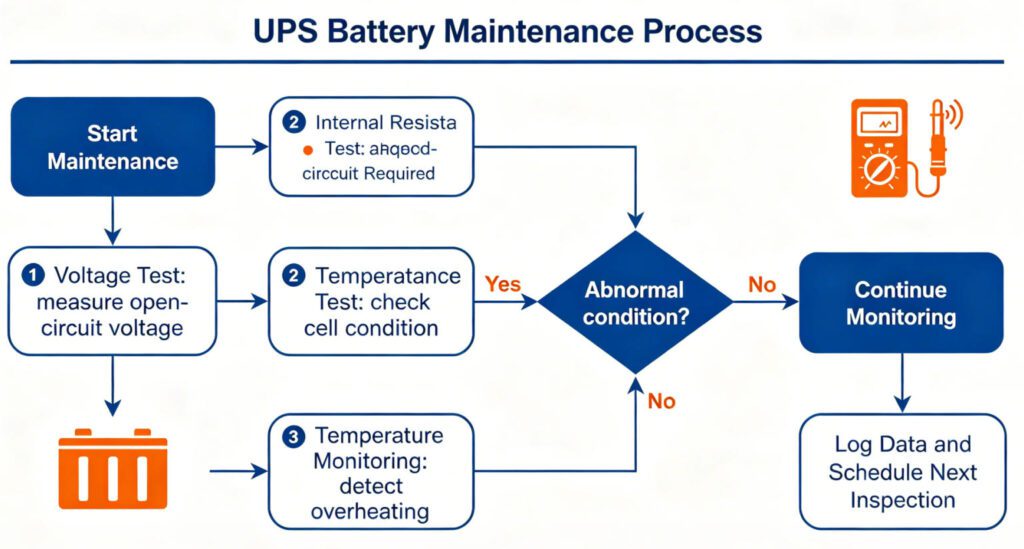
Batteries are the most vulnerable component in UPS systems, accounting for approximately 70% of failures. BKPOWER maintenance checklists enforce strict battery testing:
| Inspection Item | Semi-Annual | Annual | Pass Criteria |
|---|---|---|---|
| Battery Cabinet External Inspection | ✓ | ✓ | No deformation, leakage, or corrosion |
| Individual Cell Voltage | ✓ | ✓ | Deviation ≤ ±0.5V (12V battery) |
| Internal Resistance/Conductance | ✓ | ✓ | Replace if >50% above baseline |
| Ambient Temperature Monitoring | ✓ | ✓ | 20-25°C optimal; >30°C accelerates aging |
| Charge Current Verification | ✓ | ✓ | Per manufacturer float/equalize parameters |
| Ground Fault Detection | — | ✓ | Insulation resistance >1MΩ |
| Data Log Download & Analysis | ✓ | ✓ | Trend analysis for remaining life prediction |
Replacement Cycle Recommendations: Based on BKPOWER field experience and industry standards, VRLA lead-acid batteries in industrial environments should be replaced every 3-4 years. For BKPOWER lithium battery UPS solutions, lifespan extends to 10-12 years. Capacitors should be replaced every 5-7 years, fans every 5 years (shortened to 3 years in high-temperature environments).
4. Power Quality & Functional Testing (Annual Core)
Annual maintenance uses professional power quality analyzers for deep testing:
- Input Power Quality Testing: Identifies harmonics, voltage flicker, and three-phase imbalance—”dirty power” issues
- Current Sensor Gain Calibration: Ensures measurement accuracy and prevents false alarms
- UPS Parameter Recording: Backs up site-specific values before firmware updates to prevent factory reset
- Software Verification & Upgrade: Installs latest firmware, patches known vulnerabilities, enhances grid adaptability
- Control Power Supply Check: Verifies auxiliary power board output stability
Software Upgrade Value: Many users adopt an “if it ain’t broke, don’t fix it” mentality toward firmware updates. In reality, BKPOWER’s latest firmware optimizes switching logic for strained grid scenarios and enhances security authentication—critical for industrial users.
5. Transfer Function & Disaster Scenario Simulation (Annual Mandatory)
This is the ultimate validation of UPS combat capability. BKPOWER engineers simulate multiple extreme conditions:
- Utility Failure Test: Verifies UPS transfer to battery power response time (line-frequency UPS should be 0ms)
- Bypass Transfer Test: Validates static bypass and maintenance bypass reliability
- Emergency Power Off (EPO) Test: Confirms emergency shutdown button functionality
- Remote Operation Test: Verifies SNMP/Modbus remote monitoring and control
- Remote Alarm Test: Confirms SMS/email alarm channels are operational
This series of tests not only validates main board and power supply specifications but simulates catastrophic power quality scenarios, ensuring systems achieve 99.9995% equipment reliability.
Ⅳ. Line-Frequency vs High-Frequency UPS Maintenance Differences
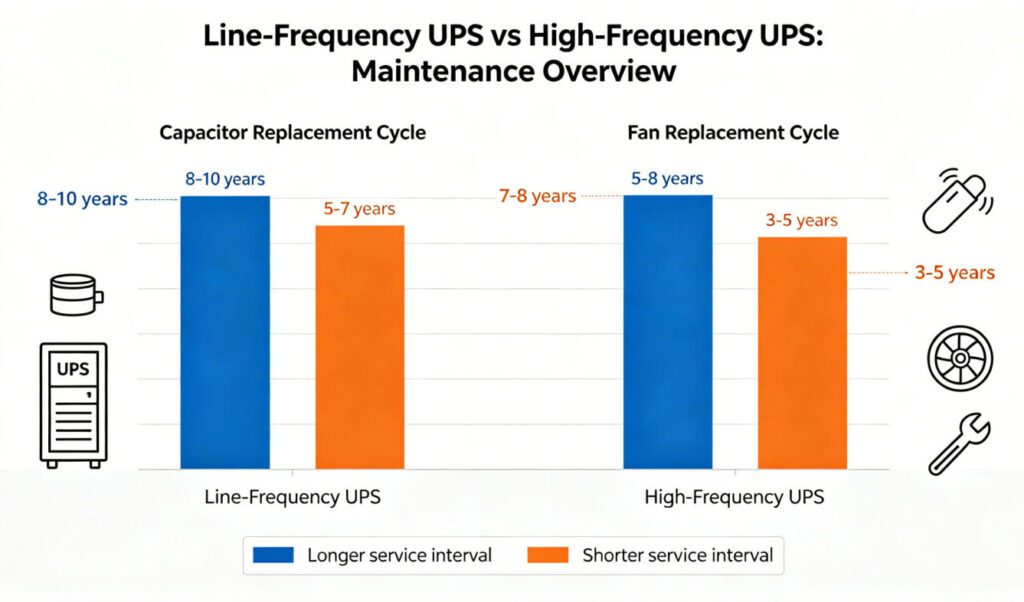
BKPOWER line-frequency UPS (BK-G33 series) and high-frequency UPS differ significantly in maintenance:
| Maintenance Dimension | Line-Frequency UPS (BKPOWER BK-G33) | High-Frequency UPS |
|---|---|---|
| Core Wear Parts | Fans, capacitors, batteries (no transformer losses) | Fans, capacitors, batteries, IGBT modules |
| Capacitor Replacement Cycle | 5-7 years (line-frequency transformer absorbs some ripple) | 4-5 years (higher ripple current) |
| Fan Replacement Cycle | 5 years (independent air channels, lower thermal stress) | 3-5 years (high power density, concentrated heat) |
| Internal Cleaning Difficulty | Easier (spacious layout, transformer shielding) | Harder (dense components, ESD sensitive) |
| Post-Overload Inspection | Focus on transformer winding insulation | Focus on IGBT and driver boards |
| Maintenance Cost Trend | High early, low later (long life, fewer parts) | Relatively stable (modular replacement convenient) |
Conclusion: The core maintenance advantage of line-frequency UPS is fewer parts, longer lifespan, and better serviceability. The BKPOWER BK-G33 60kVA Line-Frequency UPS has a design life exceeding 15 years. With proper maintenance, its TCO is significantly lower than high-frequency alternatives.
Ⅴ. Coordinated Maintenance of Stabilizers and Transformers
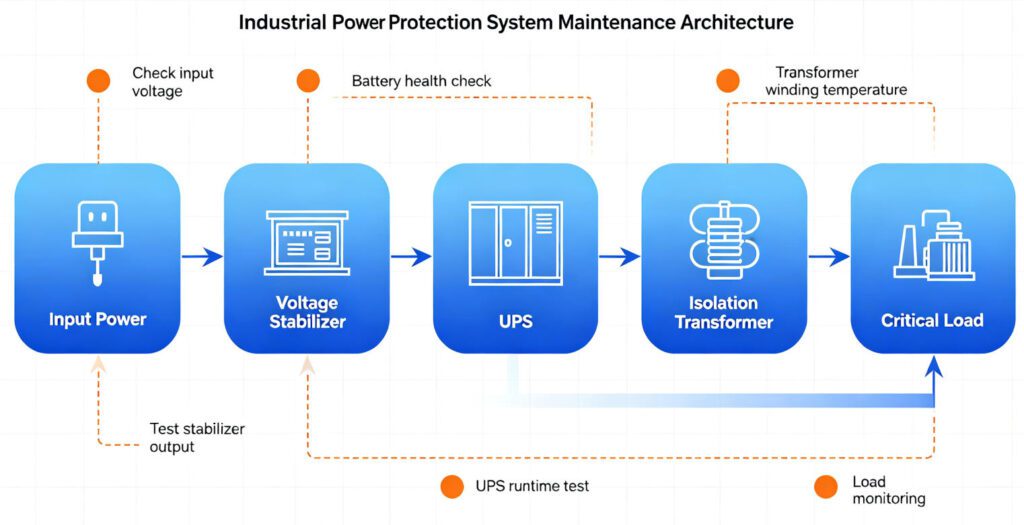
Industrial power protection is a systems engineering discipline. BKPOWER recommends coordinated inspection of front-end stabilizers and downstream isolation transformers during UPS maintenance:
- Contactless Voltage Regulator: Check brush/SCR wear, output voltage accuracy, and response time. BKPOWER contactless stabilizers feature maintenance-free design, but annual connection tightening is still required.
- Dry-Type Isolation Transformer: Check winding temperature rise, insulation resistance, and fan operation. BKPOWER dry-type transformers with Class F insulation allow 155°C temperature rise, but operating below 80% load extends lifespan to 30 years.
- CVT Constant Voltage Transformer: Check resonant capacitor condition and output voltage stability. BKPOWER CVT units in medical applications require special attention to leakage flux detection.
Ⅵ. BKPOWER Maintenance Service Contract Tiers
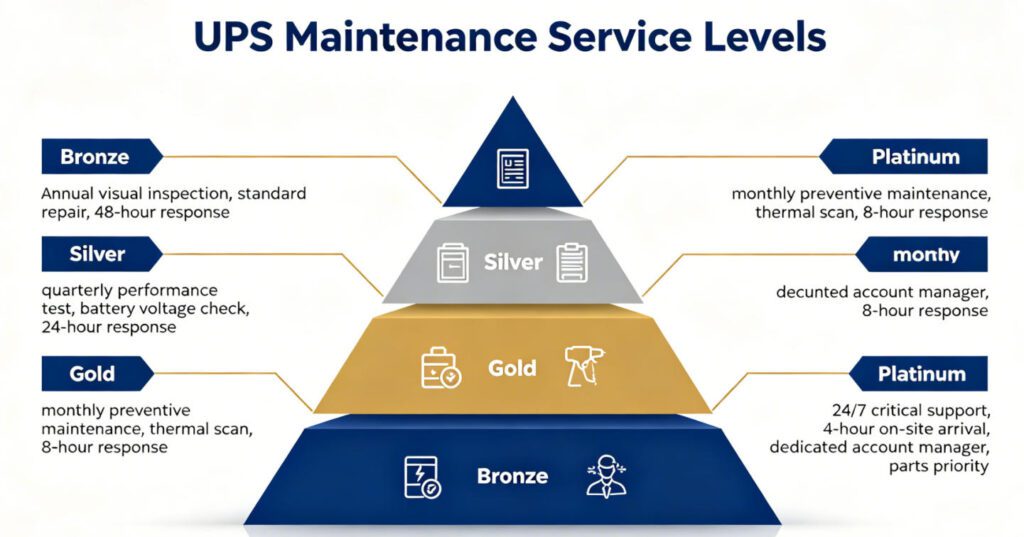
BKPOWER offers four maintenance contract tiers matching different industrial reliability requirements:
| Contract Tier | Preventive Maintenance | Emergency Response | Parts Coverage | Applicable Scenarios |
|---|---|---|---|---|
| Basic | Annual × 1 | Next-day response | 15% battery discount | Non-critical auxiliary equipment |
| Standard | Semi-annual × 1 | 8-hour on-site | 25% discount on batteries/fans/caps | General industrial production lines |
| Advanced | Semi-annual + quarterly inspections | 4-hour on-site | Full parts coverage (excl. batteries) | Data centers, hospitals |
| Platinum | Quarterly deep maintenance | 2-hour on-site | Full parts + standby unit | Petrochemical, semiconductor, finance |
Reference Sources
| Source Organization | Resource Type | URL |
|---|---|---|
| International Electrotechnical Commission (IEC) | UPS Maintenance Standard IEC 62040-3 | https://www.iec.ch |
| IEEE | Battery Maintenance Standards IEEE 1188 / 450 | https://www.ieee.org |
| Standardization Administration of China (SAC) | GB/T 7260 UPS Maintenance Specifications | https://www.sac.gov.cn |
| BKPOWER Product Center | Industrial UPS & Maintenance Parts Technical Specs | https://bkpowers.com/products/ups-system/ |
| BKPOWER Technical Blog | UPS Power Calculation & Sizing Guide | https://bkpowers.com/service/how-to-calculate-watts/ |
Recommended Internal Links
After reading this article, you may also want to explore:
- How to Calculate Watts: Industrial UPS Power Sizing Guide — Accurately calculate load power to match UPS capacity
- Industrial UPS Benefits & Line-Frequency Guide — Learn why line-frequency UPS is better suited for industrial maintenance
- BKPOWER Line-Frequency UPS Product Series — View full BK-G33 series technical specs and maintenance requirements
- Contactless Voltage Regulator Products — Front-end voltage protection equipment maintenance essentials
- Dry-Type Transformer Products — Downstream isolation and distribution equipment maintenance cycles
FAQ
1. How often should UPS preventative maintenance be performed?
Standard industrial scenarios require annual maintenance; critical mission sites (hospitals, data centers, petrochemical) require semi-annual maintenance. In harsh industrial environments (high temperature, dust, humidity), quarterly inspections are recommended. BKPOWER offers flexible service contracts customized to site conditions.
2. How often do line-frequency UPS capacitors and fans need replacement?
Line-frequency UPS capacitors should be replaced every 5-7 years, fans every 5 years. If ambient temperature consistently exceeds 30°C, capacitor life may shorten to 4 years and fans to 3 years. BKPOWER maintenance services include capacitor ESR testing and fan RPM measurement, using trend analysis to precisely predict replacement timing—avoiding premature replacement waste or late replacement failures.
3.What are the risks of operating a UPS without a maintenance contract?
UPS without maintenance contracts face three major risks: battery aging failure preventing backup during outages; capacitor bulging and leakage causing short-circuit fires; fan stoppage leading to overheating and protective shutdown. Uptime Institute data shows approximately 67% of UPS failures stem from lack of preventive maintenance. BKPOWER annual maintenance contracts can reduce failure rates by over 80%.
4. Does maintenance require system shutdown?
Semi-annual maintenance typically requires no shutdown. Engineers complete external inspections, data recording, and battery testing while the UPS remains online. Annual deep inspections (internal disassembly, transfer tests) require brief switching to bypass or a standby UPS, but BKPOWER engineers prepare detailed load transfer plans in advance to ensure zero production interruption.
5. How do I determine if batteries need replacement?
Three key indicators for battery replacement: internal resistance exceeding 50% of factory value, capacity below 80% of rated value, or physical signs of bulging/leakage. BKPOWER maintenance services use professional internal resistance testers and discharge testing equipment to provide quantitative data supporting replacement decisions. For BKPOWER lithium battery UPS equipped with BMS systems, remote SOH (State of Health) monitoring enables predictive maintenance.