Welcome to BKPOWER!












Battery Backup Time Calculation for Industrial UPS
TIPS:Accurate battery backup time calculation is essential for industrial power system design. This comprehensive guide explains the fundamental formula for calculating UPS power supply runtime, provides detailed worked examples for 20kVA to 100kVA industrial systems, and introduces advanced battery backup time calculation methodologies. Understanding these calculations ensures your critical equipment receives adequate protection during power outages. We examine factors affecting actual backup performance, compare battery technologies, and showcase BKPOWER’s intelligent battery management features that optimize runtime predictions. Whether you are sizing a new UPS power supply system or evaluating existing backup capacity, this article provides the technical knowledge needed for confident decision-making in industrial power protection.
Ⅰ. Understanding Battery Backup Time Fundamentals
1. What Is Battery Backup Time?
Battery backup time defines how long a UPS system can sustain connected loads during power failures. This duration determines business continuity capability. It affects generator startup sequencing. It influences safety system operation.
Industrial applications require precise backup time calculations. Manufacturing processes need orderly shutdown periods. Data centers require transfer time to alternate power. Medical facilities demand continuous life support operation.
The calculation seems straightforward. However, multiple factors influence actual performance. Battery capacity provides the foundation. Load power determines consumption rate. System efficiency affects energy conversion losses. Temperature impacts chemical reaction rates. Aging reduces available capacity over time.
2. The Fundamental Formula
The universal battery backup time calculation formula applies across all UPS systems:
Backup Time (hours) = (Battery Capacity (Ah) × Battery Voltage (V) × Efficiency) / Load Power (W)
Where:
- Battery Capacity (Ah): Total ampere-hour rating of the battery bank
- Battery Voltage (V): DC bus voltage of the battery system
- Efficiency: UPS inverter conversion efficiency (typically 0.85-0.93)
- Load Power (W): Actual power consumption of protected equipment
This formula provides theoretical maximum runtime. Real-world conditions reduce this value. Engineers apply safety margins to ensure adequate protection.
3. UPS System Voltage Configurations
Industrial UPS systems use different DC bus voltages based on capacity:
- Small systems (1-10 kVA): 192V DC (16 × 12V batteries)
- Medium systems (10-40 kVA): 384V DC (32 × 12V batteries)
- Large systems (40-100 kVA): 480V DC (40 × 12V batteries)
- Very large systems (100+ kVA): 720V DC (60 × 12V batteries)
Higher voltage reduces current for equivalent power. This minimizes conductor losses. It improves overall system efficiency. However, it increases battery count and system complexity.
Ⅱ. Detailed Calculation Examples
1. Example 1: 20kVA Industrial UPS
System parameters:
- UPS Rating: 20 kVA / 18 kW (Power Factor = 0.9)
- Actual Load: 12 kW (67% of rated capacity, typical for industrial applications)
- Battery Configuration: 32 × 12V 100Ah batteries (384V DC bus)
- System Efficiency: 90% (0.90)
Calculation: Backup Time = (100 Ah × 384 V × 0.90) / 12,000 W Backup Time = 34,560 Wh / 12,000 W Backup Time = 2.88 hours (2 hours 53 minutes)
This runtime provides excellent protection for small industrial facilities. It accommodates generator startup sequences (typically 10-15 minutes). It allows orderly process shutdown if generators fail to start.
The 67% load factor represents typical industrial utilization. Full 18 kW load would reduce backup time to 1.92 hours. Partial loading extends runtime proportionally.
2. Example 2: 60kVA Industrial UPS
System parameters:
- UPS Rating: 60 kVA / 54 kW (Power Factor = 0.9)
- Actual Load: 40 kW (74% of rated capacity)
- Battery Configuration: 40 × 12V 150Ah batteries (480V DC bus)
- System Efficiency: 92% (0.92)
Calculation: Backup Time = (150 Ah × 480 V × 0.92) / 40,000 W Backup Time = 66,240 Wh / 40,000 W Backup Time = 1.66 hours (1 hour 40 minutes)
Medium industrial UPS systems support manufacturing lines, process control, and facility infrastructure. Ninety minutes of backup covers most power interruptions. It provides time for generator synchronization.
For extended backup requirements, external battery cabinets double or triple capacity. Modular battery designs allow hot-swappable expansion.
3. Example 3: 100kVA Industrial UPS
System parameters:
- UPS Rating: 100 kVA / 90 kW (Power Factor = 0.9)
- Actual Load: 70 kW (78% of rated capacity)
- Battery Configuration: 40 × 12V 200Ah batteries (480V DC bus)
- System Efficiency: 93% (0.93)
Calculation: Backup Time = (200 Ah × 480 V × 0.93) / 70,000 W Backup Time = 89,280 Wh / 70,000 W Backup Time = 1.28 hours (1 hour 17 minutes)
Large industrial UPS systems protect critical manufacturing, data centers, and healthcare facilities. Runtime typically focuses on bridge-to-generator capability rather than extended operation.
Adding a second 200Ah battery bank extends backup to 2.56 hours. Some facilities implement four-hour battery configurations for critical processes.

Figure 2: Industrial UPS battery backup system showing cabinet configuration for 100kVA+ applications with extended battery modules supporting runtime requirements from 30 minutes to 4+ hours.
Ⅲ. Factors Affecting Actual Backup Performance
1. Battery Aging Impact
Battery capacity degrades over time. Lead-acid batteries lose 20-30% capacity over 3-5 years. Lithium-ion maintains 80% capacity after 8-10 years.
Aging effects reduce backup time by approximately 15% over the battery lifecycle. Regular capacity testing identifies degradation. Preventive replacement maintains design runtime.
Temperature accelerates aging. Every 10°C above 25°C doubles the aging rate. Climate-controlled battery rooms extend service life.
2. Discharge Rate Considerations
Battery capacity varies with discharge rate. Rapid discharge (high current) extracts less total energy than slow discharge. The Peukert effect describes this relationship.
UPS systems typically discharge at 0.1C to 0.3C rates (10-30% of capacity per hour). This moderate rate minimizes capacity loss. Very high loads may reduce usable capacity by 20%.
High-rate applications require oversized battery banks. Design calculations must account for discharge rate effects.
3. Temperature Effects
Battery chemistry is temperature-sensitive. Lead-acid batteries perform optimally at 20-25°C. Below 15°C, capacity drops 10-20%. Above 30°C, internal losses increase.
Temperature compensation chargers adjust charging voltage. This prevents overcharging at high temperatures and undercharging at low temperatures.
Extreme environments require thermal management. Heating pads maintain minimum temperatures. Ventilation dissipates heat during charging.
4. Load Fluctuation Impact
Industrial loads vary dynamically. Motor starting creates surge demands. Process cycles change power consumption. These fluctuations affect backup time.
Average load determines overall runtime. However, peak loads stress the battery. High-current discharges reduce efficiency. The battery management system must handle surge capability.
Conservative sizing uses peak load for calculations. This ensures adequate backup during worst-case conditions.
Ⅳ. Battery Technology Comparison
1. Valve-Regulated Lead-Acid (VRLA)
VRLA batteries dominate industrial UPS applications. They offer proven reliability. They require minimal maintenance. Initial costs are moderate.
Typical specifications:
- Energy density: 30-50 Wh/kg
- Cycle life: 500-800 cycles (at 50% depth of discharge)
- Service life: 3-5 years (float operation)
- Operating temperature: -20°C to +50°C
- Efficiency: 85-90%
VRLA provides cost-effective backup for standard applications. It suits facilities with regular maintenance programs. Replacement scheduling prevents unexpected failures.
2. Lithium-Ion (LiFePO4)
Lithium-ion technology offers superior performance. It provides higher energy density. It delivers longer service life. It requires less space.
Typical specifications:
- Energy density: 100-150 Wh/kg
- Cycle life: 3000-5000 cycles (at 80% depth of discharge)
- Service life: 10-15 years
- Operating temperature: -10°C to +60°C
- Efficiency: 95-98%
Higher initial costs (2-3× lead-acid) are offset by longevity. Reduced replacement labor and downtime improve total cost of ownership. Lithium-ion suits critical applications and remote facilities.

Figure 3: Visual comparison of Lead-Acid versus Lithium-Ion battery technology showing size, weight and form factor differences for equivalent capacity ratings.
3. Nickel-Cadmium (NiCd)
Nickel-cadmium batteries offer extreme temperature tolerance. They withstand deep discharge. They provide long cycle life.
Typical specifications:
- Energy density: 40-60 Wh/kg
- Cycle life: 1500-2000 cycles
- Service life: 10-20 years
- Operating temperature: -40°C to +60°C
- Efficiency: 80-85%
NiCd suits harsh environments. It tolerates extreme temperatures without performance loss. Environmental regulations limit cadmium use due to toxicity. Disposal requires special handling.
Ⅴ. BKPOWER Intelligent Battery Management
1. Smart Battery Monitoring
BKPOWER integrates advanced battery backup time calculation with real-time monitoring. The system continuously measures:
- Individual cell voltages
- Battery temperature at multiple points
- Discharge current and accumulated ampere-hours
- Internal resistance (health indicator)
This data feeds predictive algorithms. The system calculates actual remaining runtime. It accounts for battery aging and temperature effects. Operators receive accurate backup time estimates, not theoretical calculations.
Remote monitoring via SNMP and Modbus integrates with facility management systems. Alerts notify operators of degraded conditions before failures occur.
2. Adaptive Charging Technology
BKPOWER charging systems optimize battery life. Temperature-compensated charging adjusts voltage based on ambient conditions. This prevents overcharging in summer and undercharging in winter.
Pulse charging desulfates lead-acid batteries. This extends service life by 20-30%. Equalization charges balance cell voltages. This prevents premature failure of weak cells.
Lithium-ion systems use balanced charging. Individual cell monitoring ensures uniform state of charge. This maximizes pack capacity and longevity.
3. Runtime Prediction Algorithms
Traditional UPS battery runtime calculator functions use static formulas. BKPOWER implements dynamic prediction. The system learns from actual discharge patterns. It refines capacity estimates based on historical performance.
Machine learning algorithms identify battery degradation trends. They predict end-of-life dates. Maintenance scheduling optimizes replacement timing. This prevents both unexpected failures and premature replacement.
During discharge, the system continuously updates remaining time. Load changes trigger recalculation. This provides operators with actionable intelligence for power management decisions.
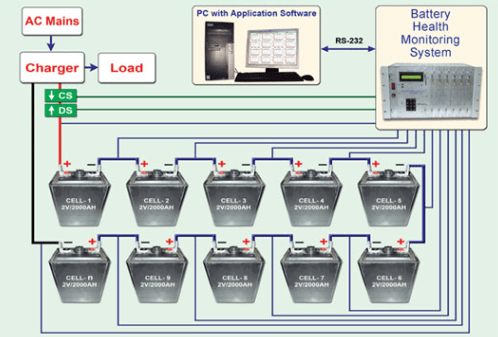
Figure 4: Battery health monitoring system architecture showing individual cell monitoring, data acquisition, and central analysis for predictive maintenance and accurate runtime calculation.
Ⅵ. Practical Application Guidelines
1. Sizing for Different Applications
Manufacturing facilities: Size for 15-30 minutes backup. This covers generator startup. Orderly shutdown requires 30-60 minutes. Critical processes may need 2-4 hours.
Data centers: Minimum 5-10 minutes for IT equipment transfer. Cooling systems need 15-30 minutes. Extended backup protects against generator failure.
Healthcare facilities: Life safety systems need 90+ minutes. Critical care requires indefinite backup via generators. UPS provides bridge power only.
Infrastructure (water, traffic): 30-60 minutes accommodates emergency procedures. Extended backup prevents public safety hazards.
2. Safety Margin Recommendations
Engineers typically apply 20-25% safety margins. This accounts for:
- Battery aging over service life
- Temperature variations
- Load growth projections
- Measurement uncertainties
A 60-minute design target with 25% margin provides 75 minutes initially. After 3 years of aging, capacity drops to 80%. Remaining time is 60 minutes, meeting the original requirement.
Oversizing by 50-100% extends replacement intervals. However, increased costs and space requirements must be justified.
3. Testing and Validation
Initial commissioning validates calculated runtime. Load bank testing simulates actual discharge. Measured backup time confirms design assumptions.
Annual testing tracks battery degradation. Capacity tests compare actual versus rated performance. Trend analysis predicts remaining service life.
Documentation of test results supports maintenance decisions. It demonstrates regulatory compliance. It provides data for future sizing calculations.
Ⅶ. Advanced Calculation Considerations
1. Multi-Stage Discharge Profiles
Some applications use graduated discharge. Critical loads receive full backup. Non-critical loads shed after initial delay. This extends runtime for essential equipment.
Calculation requires stage-specific analysis:
- Stage 1: All loads (5 minutes)
- Stage 2: Critical loads only (remaining backup)
Effective backup time increases significantly. A 60-minute battery may provide 3+ hours for critical loads after shedding non-essentials.
2. Variable Load Scenarios
Industrial loads fluctuate. Process cycles change power demands. Motor starting creates surge loads.
Monte Carlo simulation models variable loads. It generates statistical backup time distributions. Engineers size for 95th percentile confidence, not average conditions.
BKPOWER systems log actual load profiles. Software tools model various scenarios. This provides data-driven sizing recommendations.
3. Generator Integration
UPS backup time must accommodate generator startup. Typical sequence:
- 0 seconds: Power failure, UPS assumes load
- 10 seconds: Generator starting sequence initiated
- 30-60 seconds: Generator reaches rated speed
- 60-90 seconds: Transfer switch moves load to generator
UPS must sustain load until generator takes over. Minimum 2-3 minute battery backup is essential. Longer backup protects against generator starting failure.
Conclusion: Accurate Calculation Ensures Reliability
Battery backup time calculation forms the foundation of reliable UPS system design. The fundamental formula provides theoretical runtime. Real-world factors require engineering judgment. Safety margins ensure adequate protection.
This article provided calculation examples for 20kVA, 60kVA, and 100kVA industrial systems. These cover typical manufacturing, commercial, and infrastructure applications. Actual projects require site-specific analysis.
Battery technology selection affects long-term performance. Lead-acid offers cost-effectiveness. Lithium-ion provides longevity. Temperature and maintenance requirements influence optimal choice.
BKPOWER intelligent battery management transforms theoretical calculations into reliable protection. Real-time monitoring, adaptive charging, and predictive algorithms optimize runtime performance. These features ensure that calculated backup times translate to actual operational capability.
For your next UPS power supply project, apply these calculation methods. Consider all influencing factors. Implement appropriate safety margins. Contact BKPOWER engineering for application-specific guidance. Accurate battery backup time calculation protects your critical operations when power fails.
References
- International Electrotechnical Commission (IEC)Official website: www.iec.ch
- Underwriters Laboratories (UL)Official website: www.ul.com
- European Committee for Standardization (CEN)Official website: www.cen.eu
- Standardization Administration of China (SAC)Official website: www.sac.gov.cn
- Zhongguancun Energy Storage Industry Technology Alliance (CNESA)Official website: www.cnESA.org
- International Organization for Standardization (ISO)Official website: www.iso.org