Welcome to BKPOWER!












Single-Phase vs Three-Phase Industrial UPS: Which to Choose?
TIPS:Selecting between three phase industrial UPS and single-phase systems requires understanding fundamental power requirements. This comprehensive guide compares three phase industrial UPS configurations with single-phase alternatives across power capacity, load types, and total cost of ownership. For industrial applications ranging from small workshops to large manufacturing facilities, choosing the correct industrial power UPS topology directly impacts operational reliability. We analyze power demands from 1 kVA to 1000 kVA, examine motor load compatibility, and evaluate cost implications from initial investment through 10-year operational lifecycle. The data reveals that while single-phase UPS offers simplicity for loads under 30 kVA, three phase industrial UPS provides superior efficiency, scalability, and motor starting capability for demanding industrial environments.
Ⅰ. Fundamental Differences in Power Delivery
1. Single-Phase Architecture
Single-phase UPS delivers power through one active conductor and one neutral wire. The sine wave oscillates between positive and negative peaks. Voltage drops to zero twice per cycle. This creates inherent power delivery limitations.
The system works well for linear loads. Small computers, lighting, and office equipment operate effectively. Power capacity typically ranges from 500 VA to 30 kVA. Beyond this, single-phase systems become impractical.
Voltage options include 120V (North America) and 230V (international). These voltages limit current capacity. High-power loads require excessive conductor sizes. Installation costs escalate for large single-phase systems.
2. Three-Phase Architecture
Three-phase UPS uses three active conductors. Each carries sinusoidal voltage offset by 120 degrees. At any instant, at least one phase delivers maximum voltage. This ensures continuous power flow without zero-crossing gaps.
The configuration supports higher power densities. Industrial facilities require 10 kVA to 1000+ kVA capacities. Three-phase distribution achieves this efficiently. Standard voltages include 208V, 380V, 400V, and 480V phase-to-phase.
Load balancing occurs naturally. Three-phase motors draw equal current from each phase. This symmetry reduces neutral conductor requirements. Power quality improves across the distribution system.
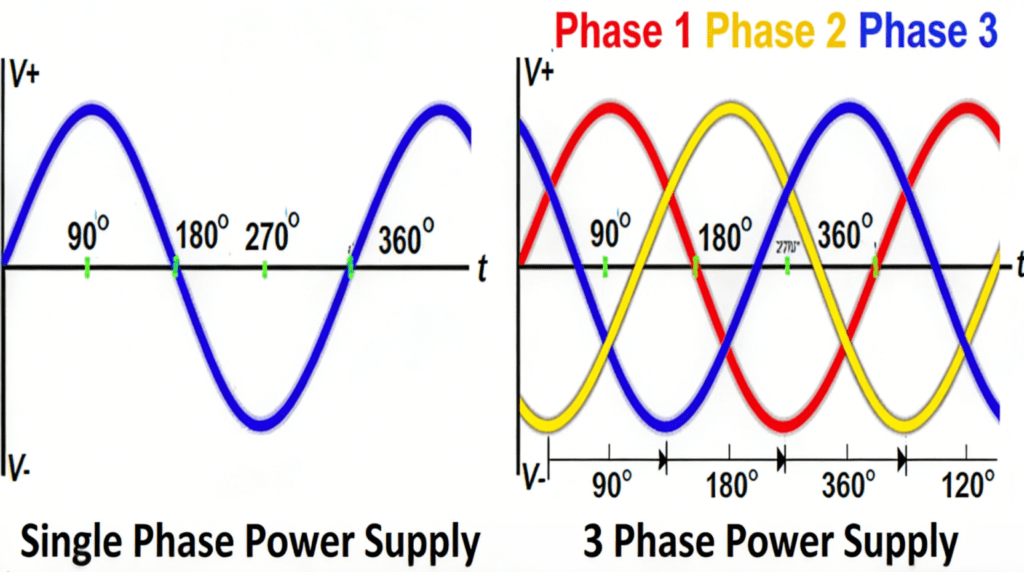
Figure 2: Single-phase power supply showing single sinusoidal waveform dropping to zero twice per cycle versus three-phase supply with three waveforms offset 120° apart providing continuous power delivery without zero-crossing interruption.
Ⅱ. Power Capacity and Application Mapping
1. Small-Scale Applications (<10 kVA)
Home offices and small retail spaces suit single-phase UPS. Loads consist primarily of computers, networking equipment, and lighting. Power demands remain predictable. Single-phase installation offers plug-and-play simplicity.
Advantages include lower initial cost, simpler maintenance, and standard electrical outlets. No specialized electrician requirements exist for units under 10 kVA. Expansion is limited but often unnecessary for these applications.
However, motor loads create challenges. Even small compressors or pumps demand high starting currents. Single-phase UPS may struggle with surge demands. Static bypass activation becomes frequent. Equipment reliability suffers.
2. Medium Commercial (10-30 kVA)
Small businesses enter a decision zone. Single-phase UPS remains technically viable. However, three-phase options offer compelling advantages. Load balancing improves efficiency. Future expansion becomes possible.
Three-phase UPS at 10-20 kVA costs similar to high-capacity single-phase units. The infrastructure investment makes sense for facilities with growth plans. Mixed loads—motors, computers, HVAC—benefit from three-phase distribution.
Retail stores with refrigeration, small manufacturing with machine tools, and medical offices with imaging equipment represent transition applications. Three-phase infrastructure supports current and future needs.
3. Industrial Applications (>30 kVA)
Manufacturing facilities require three-phase UPS. Motor loads dominate industrial power profiles. Compressors, pumps, conveyors, and machine tools operate on three-phase power. Single-phase UPS cannot serve these loads effectively.
Power quality demands increase with industrial automation. Programmable logic controllers (PLCs) require stable voltage. Variable frequency drives (VFDs) need clean power. Robotic systems cannot tolerate interruptions. Three-phase UPS provides this protection.
Scalability becomes critical. Industrial facilities expand production capacity. Three-phase UPS supports parallel configurations. Additional modules increase capacity without system replacement. This modular approach protects capital investment.
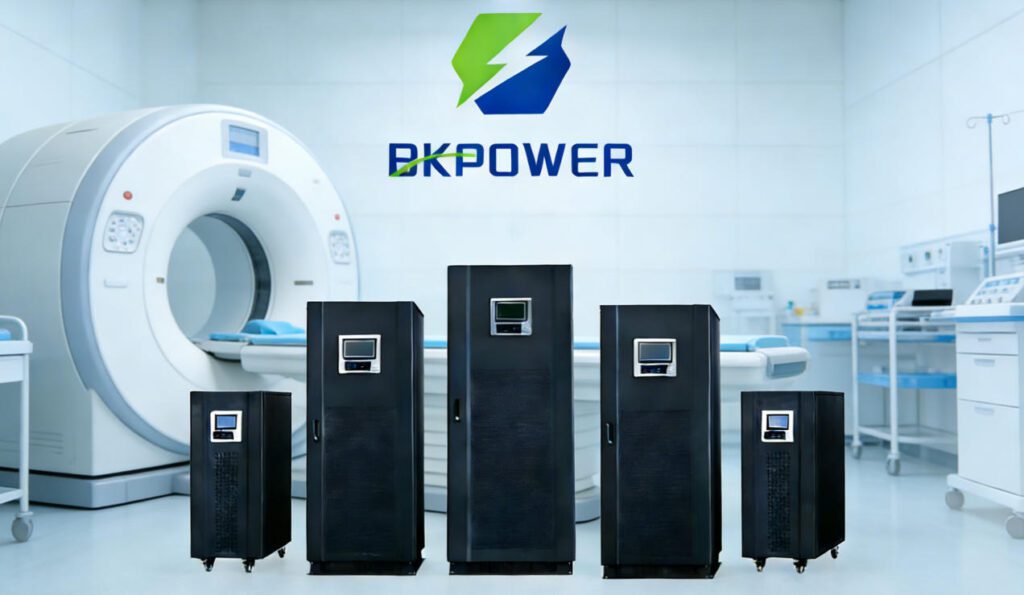
Figure 3: Industrial three-phase UPS system rated 10-800 kVA showing robust cabinet construction designed for manufacturing environments with high motor loads and continuous operation requirements.
Ⅲ. Load Type Considerations
1. Linear vs Non-Linear Loads
Linear loads draw current proportional to voltage. Incandescent lighting, resistive heaters, and traditional motors exhibit this behavior. Both single-phase and three-phase UPS handle linear loads effectively.
Non-linear loads complicate power delivery. Switch-mode power supplies, VFDs, and electronic ballasts draw current in pulses. These pulses create harmonic distortion. Three-phase UPS manages harmonics better through phase cancellation. Single-phase systems face higher harmonic accumulation.
Total Harmonic Distortion (THD) impacts equipment life. High THD causes overheating in transformers and motors. Three-phase distribution spreads harmonic content across phases. Individual phase distortion remains manageable.
2. Motor Starting Requirements
Motor starting represents the most demanding UPS load. Direct-on-line (DOL) starting draws 6-7 times rated current for 5-10 seconds. This surge tests UPS overload capability extensively.
Single-phase UPS handles motors up to 3-5 HP (2.2-3.7 kW). Beyond this, starting currents exceed UPS capacity. Voltage sags affect the entire protected load. Three-phase UPS accommodates motors to 100+ HP (75+ kW). Transformer-based designs provide magnetic buffering. Starting surges are managed effectively.
For industrial applications with multiple motors, three-phase UPS is essential. Staggered starting sequences help. However, the fundamental capacity requirement mandates three-phase infrastructure.
3. Mixed Load Environments
Modern facilities combine diverse loads. IT equipment, HVAC systems, lighting, and production machinery operate simultaneously. Single-phase UPS struggles with this diversity. It cannot serve three-phase equipment without phase converters.
Three-phase UPS with appropriate distribution serves all loads. Phase-to-neutral connections provide single-phase power. Phase-to-phase connections serve three-phase equipment. One UPS protects the entire facility. Management simplifies. Maintenance consolidates.
Ⅳ. Cost Analysis: Initial Investment vs Lifecycle
1. Acquisition Costs
Single-phase UPS offers lower entry costs. A 10 kVA single-phase unit costs $3,000-$5,000. Equivalent three-phase systems range $4,000-$6,000. The 20-30% premium reflects additional power electronics and transformer complexity.
At 30 kVA, cost curves converge. High-capacity single-phase units require specialized construction. Three-phase systems leverage standardized industrial components. Pricing becomes competitive.
Beyond 30 kVA, single-phase UPS becomes prohibitively expensive. Custom engineering is required. Three-phase systems maintain economic scalability to 1000+ kVA.
2. Installation Expenses
Single-phase installation utilizes standard electrical infrastructure. Residential and light commercial wiring suffices. Installation costs remain minimal for smaller units.
Three-phase installation requires professional electricians. Conduit sizing increases. Switchgear must accommodate three-pole breakers. Initial infrastructure investment is higher.
However, three-phase copper requirements decrease per kVA. Three conductors share the load versus one oversized conductor. Long-term wiring costs favor three-phase for larger installations.
3. Operational Efficiency
Three-phase UPS demonstrates superior efficiency at medium and high loads. Single-phase efficiency ranges 85-90% at full load. Three-phase systems achieve 90-96% efficiency.
The efficiency differential affects operating costs. Assuming 100 kW load, 92% versus 88% efficiency creates 4 kW difference. At $0.10/kWh, annual savings reach $3,500. Over 10 years, efficiency savings offset higher acquisition costs.
4. Total Cost of Ownership (TCO)
Table 1 summarizes 10-year TCO for various capacities:
| Capacity | Single-Phase TCO | Three-Phase TCO | Optimal Choice |
|---|---|---|---|
| 10 kVA | $12,000 | $14,500 | Single-Phase |
| 20 kVA | $22,000 | $24,000 | Comparable |
| 30 kVA | $35,000 | $32,000 | Three-Phase |
| 60 kVA | N/A | $55,000 | Three-Phase only |
| 100 kVA | N/A | $85,000 | Three-Phase only |
Break-even occurs at approximately 25-30 kVA. Below this, single-phase TCO advantages exist. Above this threshold, three-phase economics dominate.
Ⅴ. Technical Specifications Comparison
1. Voltage and Frequency
Single-phase UPS outputs 120V or 230V at 50/60 Hz. These voltages match residential and light commercial standards. Equipment compatibility is universal.
Three-phase UPS offers 208V, 380V, 400V, or 480V phase-to-phase. Phase-to-neutral provides 120V or 230V for single-phase loads. This flexibility supports mixed-voltage environments.
Frequency stability is equivalent. Both topologies maintain ±0.1% frequency regulation. Sensitive equipment operates reliably on either system.
2. Load Balancing
Single-phase systems have no load balancing concept. One conductor carries all current. Neutral conductors must be full-sized.
Three-phase UPS actively balances loads across phases. Intelligent distribution systems monitor phase currents. Alerts notify of imbalances exceeding 15%. This protection prevents transformer overheating and neutral overloading.
For industrial facilities with uneven single-phase loads, three-phase UPS with distribution panels manages balance. Individual phase adjustments optimize power quality.
3. Scalability and Redundancy
Single-phase UPS scales through unit replacement. Limited parallel capabilities exist. Redundancy requires 2N configurations with 100% spare capacity.
Three-phase UPS supports true parallel operation. Multiple modules share load equally. N+1 redundancy achieves 99.999% availability with minimal spare capacity. This architecture suits mission-critical industrial processes.
Expansion is modular. Additional 10-20 kVA units increase capacity without system shutdown. Growth is accommodated seamlessly.
4. Maintenance and Serviceability
Single-phase UPS offers simpler maintenance. Fewer components require attention. Standard technicians perform service. Spare parts availability is excellent through multiple vendors.
Three-phase UPS requires specialized expertise. Factory-trained technicians handle complex issues. However, modular designs isolate failures. Service affects only defective modules. System availability remains high.
Mean Time Between Failures (MTBF) favors three-phase at higher power levels. Robust industrial-grade components outlast consumer-oriented single-phase designs.
Ⅵ. Decision Framework for Industrial Applications
1. Single-Phase UPS Selection Criteria
Choose single-phase UPS when:
- Total load is less than 20 kVA
- No three-phase equipment exists
- Installation simplicity is prioritized
- Budget constraints are severe
- Facility has single-phase utility service only
- Load consists primarily of IT equipment
Applications include small offices, retail stores, remote monitoring stations, and residential backup systems.
2. Three-Phase UPS Selection Criteria
Choose three-phase UPS when:
- Total load exceeds 30 kVA
- Three-phase motors are present
- Future expansion is anticipated
- Industrial environment exists
- High availability is required (>99.9%)
- N+1 redundancy is desired
Applications include manufacturing plants, data centers, hospitals, water treatment facilities, and large commercial buildings.
3. The Transition Zone (20-30 kVA)
This range requires careful analysis. Both topologies are technically feasible. Consider these factors:
Current facility infrastructure: If three-phase power is already available, three-phase UPS offers better value. Retrofitting single-phase service for three-phase UPS is expensive.
Load composition: Any three-phase motor loads mandate three-phase UPS. Phase converters introduce inefficiency and reliability concerns.
Growth trajectory: If load growth is likely, three-phase infrastructure provides headroom. Replacing single-phase UPS within 3-5 years is poor economics.
Operational criticality: For revenue-dependent operations, three-phase redundancy capabilities justify premium costs. Single points of failure in single-phase systems present unacceptable risks.
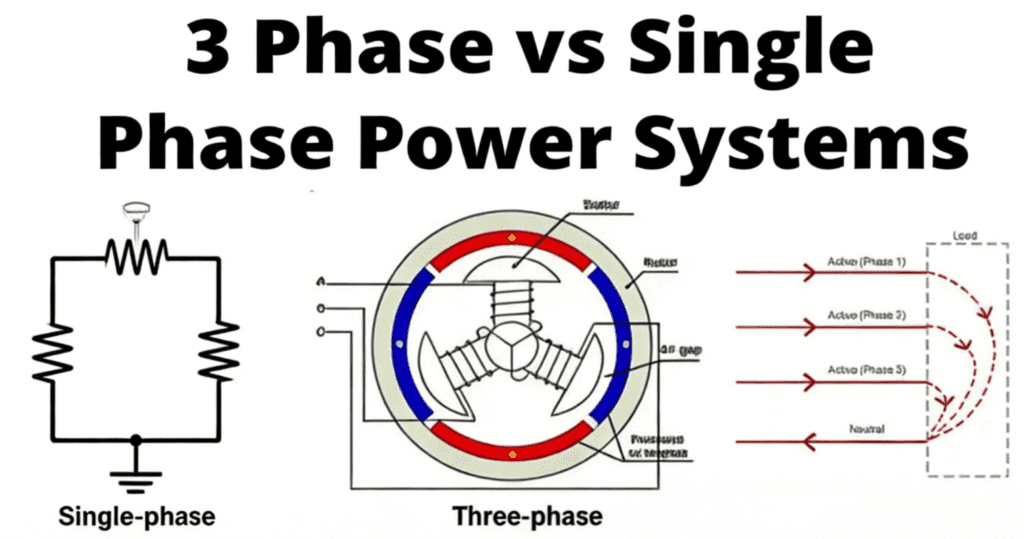
Figure 4: Comparison of single-phase versus three-phase motor systems showing three-phase advantages in power delivery, torque characteristics, and industrial automation compatibility.
Ⅶ. BKPOWER Application Guidance
1. Product Portfolio Alignment
BKPOWER offers both single-phase and three-phase UPS solutions. Our SP Series covers 1-20 kVA single-phase applications. TF Series addresses 10-400 kVA three-phase requirements.
SP Series features plug-and-play installation. Tower and rackmount configurations suit office environments. LCD displays provide intuitive monitoring. USB and SNMP connectivity enable remote management.
TF Series provides industrial-grade protection. Transformer-based designs handle motor surges. Parallel operation supports N+1 redundancy. Advanced battery management extends service life. Touchscreen interfaces simplify operation.
2. Engineering Assessment Services
BKPPOWER engineers conduct site assessments. We measure load profiles. We evaluate power quality. We recommend optimal configurations.
Our load analysis identifies:
- Peak demand and diversity factors
- Harmonic content and power factor
- Motor starting requirements
- Growth projections
- Criticality classifications
This data drives UPS sizing and topology selection. We ensure appropriate protection without over-engineering.
3. Total Value Proposition
BKPOWER evaluates UPS solutions on 10-year TCO basis. Initial cost is merely one factor. Energy efficiency, maintenance costs, and availability impact dominate lifecycle economics.
For applications under 20 kVA, our SP Series provides cost-effective protection. For industrial applications, TF Series three-phase UPS delivers superior value despite higher acquisition cost.
We provide detailed TCO analysis. Clients understand break-even points. Investment decisions align with operational realities. This transparent approach builds long-term partnerships.
Conclusion: Making the Right Choice
The single-phase versus three-phase UPS decision depends on power requirements, load characteristics, and operational objectives. For loads under 20 kVA with primarily IT equipment, single-phase UPS offers economic simplicity. For industrial applications exceeding 30 kVA with motors and three-phase equipment, three-phase UPS is essential.
The transition zone between 20-30 kVA requires careful analysis. Infrastructure availability, growth plans, and criticality determine optimal selection. TCO analysis typically favors three-phase when future expansion is anticipated.
Three-phase UPS provides measurable advantages: higher efficiency (90-96% vs 85-90%), superior motor starting capability, natural load balancing, and modular scalability. These benefits justify premium costs for demanding industrial applications.
BKPOWER assists clients in navigating these decisions. Our engineering expertise ensures appropriate UPS selection. We balance initial investment against lifecycle value. Your critical power infrastructure deserves this systematic approach.
Contact BKPOWER for application-specific recommendations. We analyze your requirements. We specify optimal solutions. Your operational continuity is our priority.
References
- International Electrotechnical Commission (IEC)Official website: www.iec.ch
- Underwriters Laboratories (UL)Official website: www.ul.com
- European Committee for Standardization (CEN)Official website: www.cen.eu
- Standardization Administration of China (SAC)Official website: www.sac.gov.cn
- Zhongguancun Energy Storage Industry Technology Alliance (CNESA)Official website: www.cnESA.org
- International Organization for Standardization (ISO)Official website: www.iso.org